Posts filed under 'TopTen2025'

Our Top Ten Articles of 2025, as Chosen by You: #1 Translation, AI, and the Political Weight of Words by Daniel Saldaña París

París mediates on translation through AI, where questions of ethics and effectivity take center-stage—can AI do as we do, but better?

It follows that our most anticipated and widely read work of 2025, tackles the most batted topic of the year: AI. Daniel Saldaña París’s “Translation, AI, and the Political Weight of Words” (tr. Christina MacSweeney) tackles it head-on in an interesting project for Cita Press, and shares his reflections in a thought-provoking essay published in the Summer issue.

For context, Cita Press is an open access publishing project that “pairs contemporary authors and designers with public domain or open-licensed texts to create a free online library of carefully designed books by women, in Spanish and in English.” The project at hand, the “Literary Translation & Technology Project,” involves using  AI (Large Language Models, Neural Language Models, and Machine Translators), traditional translation tools, and of course, a literary translator to evaluate AI’s potential for creating open access editions of works in translation. París took on a Spanish translation of Ten Days in a Mad-House by Nellie Bly. In this piece, they mediate on translation through AI, where questions of ethics and effectivity take center-stage—can AI do as we do, but better?

Exactly how revolutionary is this new technology in terms of our profession? Based on my one-off experience of translating Diez días en un manicomio, I can say that the benefits are limited to speeding up the translation process while not necessarily improving it.

. . .

When choosing the most appropriate translation of a particular phrase or sentence, I keep in mind the readership of the text, in addition to its social function: I don’t make the same decisions when translating for a Spanish publishing house as I would for an independent Latin American publisher, or for an open access project that will be consulted by Spanish-speakers of different origins who are unfamiliar with my version of the language. At the other extreme, when translating, I am also conscious of the historical immutability of the original: I am working with a text written in 1887 and I must retain certain usages of that context, even when this may shock our contemporary political sensibilities. 

First, París stresses the unacknowledged and unpaid labor concerning the body of work that trains AI. Given that this work is largely skewed to texts by male authors, there is an inherent gender bias in AI results. This would likely apply to translating the subtleties of minority-specific content that the software isn’t adequately trained to handle. Not to mention, were you aware that “each ChatGPT consultation uses two glasses of water?”
READ MORE…

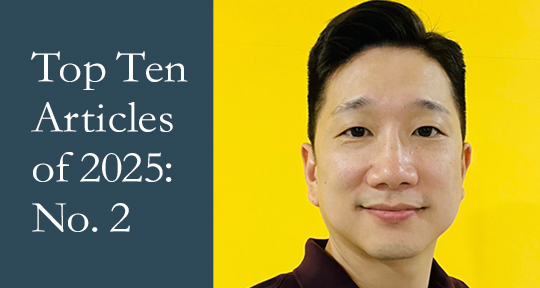
Our Top Ten Articles of 2025, as Chosen by You: #2 An Interview with Anton Hur

Hur holds language in the highest esteem. Rightly so, for when we all turn to dust, poetry is our final imprint on the universe.

Our runner-up for the title of most widely read article of 2025—also courtesy of Assistant Interview Editor Sarah Gear—is our interview with Anton Hur from the Spring issue. A Korean-English translator who debuted in our pages nine years ago, Hur’s work includes Cursed Bunny by Bora Chung, I Want to Die but I Want to Eat Tteokbokki by Baek Sehee, I Decided to Live as Me by Kim Suhyun, and Beyond the Story: 10-Year History of BTS (number one in the NYT’s 2023 bestseller list). Hur is a literary force with much to learn from, this enlightening interview takes us through his writing, thoughts on language, AI, activism, and his role as a judge for the International Booker prize.

Gear points to Hur’s blog as a boon full of advice for emerging translators, such as how to draft successful pitches to publishers, amongst other notes. In this interview, for one, Hur acknowledges the frustrations of the current publishing industry that is, to no one’s surprise, “racist and sexist and homophobic and xenophobic.” This is a gap that can be addressed by hiring more translators of color and those working from their heritage languages—Hur’s success is a testament against native-speaker elitism in the translation space.

In 2025, Hur has translated the likes of Bora Chung, Le Young-do, Sung-il Kim, Kim Choyeop and Park Seolyeon. With ‘at least five’ titles slated for 2026, Hur’s writing is the gift that keeps on giving. That includes, of course, his own exceptional novel, Toward Eternity.

The discussion of this novel offers profound takeaways. The plot explores the larger role of language and poetry through an AI machine named Panit, who learns how to understand poetry. Toward Eternity, as described by Gear, “explores the nature of what it is to be human and, I would argue, the intrinsic importance of literature—a reflection of Hur’s academic background in Victorian poetry, his experience of translation, and his belief in the power of language.”

READ MORE…

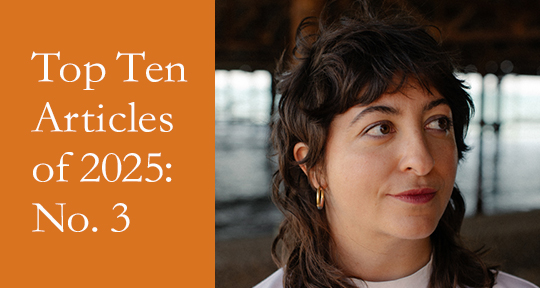
Our Top Ten Articles of 2025, as Chosen by You: #3 An Interview with Jen Calleja

Calleja is a worthy mentor for aspiring translators. Here, she offers a deeply informative dive into the niche.

Our third most widely read piece of 2025 hails from our Fall issue: a fascinating interview with literary translator Jen Calleja conducted by Assistant Interview Editor Sarah Gear. Much of this discussion is anchored by Calleja’s experimental memoir, Fair: The Life-Art of  Translation (Prototype, 2025), the summative advice of an industry veteran with a body of over twenty translated novels from German (including International Booker Prize nominee The Pine Islands  by Marion Poschmann).

Needless to say, Calleja is a worthy mentor for aspiring translators. Here, she offers a deeply informative dive into the niche. The distilled life lessons in Fair are many, and as Gear says, it reads as both an “inspiration and manifesto.” This interview also spans the lives of translators in general, challenges of the field, and the implications of AI.

A key theme to anchor the discussion: What does it mean to be a translator? Calleja boldly takes this on, describing the core of it as “holding hope for dialogue and understanding that is face to face.”

READ MORE…

Our Top Ten Articles of 2025, as Chosen by You: #4 Anthropocene by Carolina Brown

A cocktail with notes of dark humor, existential dread, and a macabre aftertaste to complete a hard-hitting flavor.

Our fourth most popular article of 2025 is a stand-out from the Summer 2025 issue: “Anthropocene” by Carolina Brown (tr. Jessica Powell). In this literally biting cli-fi, we follow two postdocs investigating the excrement of an endangered penguin species in Antarctica. To give you a taste of the narrator’s acerbic voice, here’s how the story begins:

I’ve caught myself, several times a day, thinking about Octavio’s pelican dewlap. The thing about doing research full time is that it leads you to fantasize; you spend a lot of time alone and sampling is a repetitive task. Also, who hasn’t dreamed of killing a coworker? Everyone has, obviously. Of course they have. People have this image of scientists as evolved, circumspect types. What’s that word people use to describe Brits? Phlegmatic. 

Alex feels uncomfortably real—the details of their study are intriguing, and their isolation is felt as raw misery. The tension that builds between Alex and Octavio is intense and engrossing; we’re kept on our toes by razor-sharp exchanges and an unapologetic stream of consciousness. A well of pity for Alex quickly morphs into a raging sense of alarm for our futures. The touch of climate horror presents a perfectly believable future to our present, belying an entirely appropriate sense of anxiety. READ MORE…

Our Top Ten Articles of 2025, as Chosen by You: #5 Pickled by Johanna Sebauer

Society must confront the question: do we really still need the pickle?

Coming in at number five is a matter of contentious debate, a real pickle. No, really. Winter 2025 gave us “Pickled” by Johanna Sebauer (tr. Lillian M. Banks and Aaron Sayne), a hilarious morsel of Austrian humor.  This is a piece that distills the fanaticism of trends and the infectious capacity of unworthy opinions.

What comes first, milk or cereal? Toothpaste or water? Yes, there is a correct answer. Yes, it’s still wrong to someone, vehemently so. With a finger on the heated pulse of such disagreements, Sebauer adds to the genre with the identity crisis of a pickle—the question being, should it exist?

In a newsroom office setting, instigating character Pertak is burned by pickle brine while opening a jar. In total shock at the unchecked damage of this vicious snack, he takes it upon himself to raise the alarm. What should be a lone man’s subway take evolves into a national tirade against the pickle. Our unfortunate narrator becomes witness to a gag gone rabid.

 Isn’t it time we took a closer look, he wrote, at pickles packed in vinegar? The liquid can rob a person of his sight, yet it is being sold on local supermarket shelves as-is, no warning labels, within easy reach of children! Who knows what damage accidents involving pickle juice have already caused? And what about our much-vaunted socialized health care system, already on shaky ground: shouldn’t we help save it by calling these liquids what they are? A menace!

READ MORE…

Our Top Ten Articles of 2025, as Chosen by You: #6 from Elegies of the Earth by Ahmad Shamlou

With protest as poetry, resistance as love—Shamlou offers inspiring sentiments to guide us in the new year.

Our sixth most-read article of the year is a golden find from our Summer 2025 issue, an excerpt from the late Ahmad Shamlou’s (1925-2000) “Elegies of the Earth(tr. Niloufar Talebi). A nominee for the Nobel Prize in Literature, Shamlou’s time-honored status as a poet, translator, editor, and Irani cultural icon is a known fact. What better time to honor the literary great than the year of his centennial? With a body of work that stretches past seventy, we have Niloufar Talebi to thank for these deftly translated verses that impart Shamlou’s belief that “poetry should incite, uplift, and endure.”

As the people’s poet from a time when poetry was public speech, Shamlou’s contemporary blend of East and West has aged all too well. His legacy lives on through poignant works; feather-light in speech yet dense in meaning.

Sample an excerpt:

from Nocturnal (Among the Eternal Suns)

Among the eternal suns
your beauty
is an anchor—
a sun
that frees me
from the dawn of all stars.

Your gaze
is the fall of tyranny—
a gaze that dressed
my bare soul
in love
so fully that now
the darkest night of never
feels like nothing but a comedy of ironies.

Your eyes told me
tomorrow
is a new day—
eyes that spark love!
And now, your love:
a weapon
to wrestle with my fate.

*

I had thought the sun lay beyond the horizon,
that no escape remained but an early exit,
or so I had believed.

Then came Aida, undoing the eternal exit.


August 1962 
From Aida in the Mirror (Nil Press, 1964)

Shamlou’s romantic view of love as the ultimate weapon against oppression is a tale as old as time, one that continues to endure in its truth. Fearless and bold in its emotion, composed in mesmerizing language, this piece unlocks that which supercedes all: sacred freedom.

It’s also ultimately an eloquent reminder of what matters most from a revolutionary that came before us. With protest as poetry, resistance as love—Shamlou offers inspiring sentiments to guide us in the new year. 

As we reach the second half of this year’s round-up, check-in tomorrow for number five!

READ OUR SIXTH MOST WIDELY READ ARTICLE OF THE YEAR

*****

Discover more on the Asymptote blog:


Our Top Ten Articles of 2025, as Chosen by You: #7 Love and Mistranslation by Youn Kyung Hee

This seamless work of lyrical criticism charts a path that begins with this: poems as gifts.

Poems, they are also gifts—gifts to the deeply attentive. Fate-carrying gifts. 

—Paul Celan, letter to Hans Bender, May 18, 1960


Merry Christmas! #7 is a perfect pick for today. A crowning jewel of our Spring 2025 issue, The Gift, is  “Love and Mistranslation”  by Youn Kyung Hee (tr. Spencer Lee-Lenfield). Youn’s prose is beyond gorgeous—translator Lee-Lenfield described it best, saying she “revels in tight and rhythmic choreography of long sentences, in menageries of carefully chosen vocabulary, in sheer love of the expressive capabilities of Korean.” Complementary to the season, this seamless work of lyrical criticism charts a path that begins with this: poems as gifts.

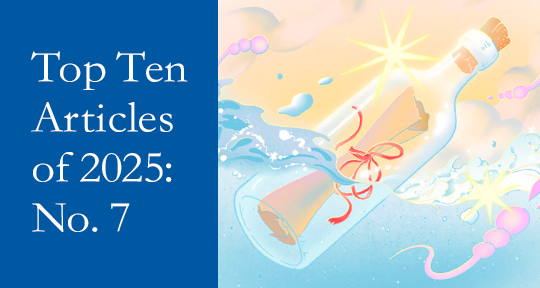
The concepts of ‘poem’ and ‘gift’ are flipped inside out as Youn flows from one point to the next, enlightening us further with each progression. Key observations point to the ‘postal essence’ of gifts, and poems as ‘words in motion.” Youn likens the latter to the message in a bottle—the poem is adrift, a precious gift for the reader who meditates on the meaning, and impassioned by the art, pays it forward through translation.

A poem-gift is only unlocked by the deeply attentive. The reader becomes a poet through translation, and in turn, the sender-poet becomes the recipient. In the process of engagement, ‘mistranslation’ is poetic embellishment, born out of a love for the message.

Youn deeply appreciates the artistry of exchanging one term for another, the symphony of finding words that capture the ‘right’ meaning. After all, “What should we call this person, who says in poems what the poet does not say, if not “a poet”? And so, mistranslations increasingly disappear. Even mistranslations are a different language turning into a poem.”

READ MORE…

Our Top Ten Articles of 2025, as Chosen by You: #8 The House of Termites by Ubah Cristina Ali Farah

Whether displacement is forced or voluntary, there is one prevailing symptom: loss.

Coming in at number eight, “The House of Termites” is a poetic essay from our Winter 2025 issue by Somali-Italian writer Ubah Cristina Ali Farah (tr. Brandon Michael Cleverly Breen) that paradoxically succeeds at being both unique and universal. As she reflects on a life between borders, from Somalia to Italy to Belgium, Ali Farah ponders a question close to all migrants: What does it mean to live in exile?

This work is a treasure trove for the reflective reader. Sure to be bookmarked, there is a goldmine of pensive moments to glean wisdom from. One of many to start us off: “Migrating means disappearing into yourself, dying and being reborn, running the risk of becoming invisible, or rather, of being seen in another way.”

Whether displacement is forced or voluntary, there is one prevailing symptom: loss. There is a constant undercurrent of disconnection from the physical space one inhabits and their distant home. Ali Farah draws on the wisdom of James Baldwin to describe this condition:

My obsession had always been that of reimagining Mogadishu, my “Garden of Eden,” even if it was anything but a terrestrial paradise. “Maybe life only offers the possibility of remembering the garden or forgetting it,” Baldwin writes in Giovanni’s Room. “One thing or the other: you need strength to remember, you need another kind of strength to forget, and you need to be a hero to do both things together.” 

READ MORE…

Our Top Ten Articles of 2025, as Chosen by You: #9 When I looked into the face of my torturer . . . I recognized my old school-friend by Bassam Yousuf

This evocative piece blends warm and melancholic notes that linger long after reading.

One day, as I was undergoing yet another round of torture from the secret police in the infamous Palestine Branch, I cried out: “Abdullah al-Daliyah!” Abdullah al-Daliyah is one of our Alawite ancestors, a saint whose name the men from my village invoke to this day when they’re in dire straits. The man torturing me suddenly stopped and yanked off my blindfold. With a wild-eyed stare, he demanded: “Who are you?”

I kept quiet, since in the opposition we were strictly forbidden ever to disclose our names. He shouted in agitation: “Say something! Are you Bassam?”

I nodded. Turning away, he marched around the interrogation room, then closed the door and continued pacing up and down without looking at me. Finally he wheeled around and asked, his eyes full of tears: “Don’t you know me?”

I shook my head. After ten years, he was unrecognizable. With a sigh, he bowed his head. “I’m Abdullah . . . ”

Occasionally, one comes across circumstances so unbelievable they can only be engineered by fate. Coming in at No. 9 in our countdown of the most-read articles of 2025, this poignant piece of nonfiction follows Syrian political activist Bassam Yousuf (tr. Katherine Van de Vate) as he reflects on his relationship with a childhood friend, Abdullah. In this essay featured in our Summer 2025 issue, Yousuf traces their parallel paths as he sides with the political opposition, and Abdullah with the Assad regime—a choice that culminates in their bitter reunion. The title gives it away: “When I looked into the face of my torturer . . . I recognized my old school-friend.”

READ MORE…

Our Top Ten Articles of 2025, as Chosen by You: #10 Attention as Predation: Fields of Influence and Omnivorous Forces of Alignment by Johanna Drucker

Attention consumes its participants—subjects and objects alike—and in its current ravenous high scale dynamic, becomes predatory.

Before we turn the page on the tumultuous year that was 2025, let’s look back on the pieces that readers couldn’t stop reading, sharing, and talking about—i.e., our most popular articles across four massive quarterly issues. From insightful essays to mind-bending fictions, this curated-by-you selection features work from all around the world that not only captured your attention but also seized your imagination. Wonder if your own favorite made the list? Every day from now till Dec 31st, we’ll be counting down to our most-read article of the year, so come back here each day to find out!

First up at #10 is Johanna Drucker’s “Attention as Predation: Fields of Influence and Omnivorous Forces of Alignment”—a fitting grand opening to our Fall 2025 Special Feature themed on attention, as urgent to the moment as it is riveting a read.

Distinguished Professor Emerita in the Department of Information Studies at UCLA, Drucker poses a radical re-imagining of the nature of attention itself. Rather than a self-willed, intentional act, Drucker describes the exchange of attention between subject and object as a bottomless energy field where we consume as we are consumed: an ouroboric cycle where we feed off a topic as it feeds off our attention. The result is a serious argument for us all living in dystopia.

Drucker’s theory is an enlightening framework for the digital age, importantly, one that credits attention as the primary instrument of authoritarianism—Exhibit A: Donald Trump’s command of the media landscape.

Here’s a brief explanation in Drucker’s own words:

“Most recently, the Trump phenomenon demonstrates the way the accumulation of attention
becomes a social force, a type of predation on the body politic in which influence devours the
source on which it feeds . . . they become consumed in the process of absorption, returning the investment of attention to the system which, in turn increases in energy and demands more attention to sustain itself. Huge as they are, enormous as transactional beings, focal points in a massive network of attention exchange, the central figures are themselves colonized by the process. In a vulnerable individual, this can be fatal, but in a socio-pathological one the focal object inflates, feeding from an increasingly insatiable need.
. . . 
Authoritarianism works through alignment. Alignment is driven by affect and instrumentalized through attention. Attention consumes its participants—subjects and objects alike—and in its current ravenous high scale dynamic, becomes predatory. The monopoly will only be broken by distributing attention across multiple attractors the terms and values of which remain to be determined but must operate through an appeal to affect.”

READ MORE…