Posts filed under 'speculative fiction'

Section Editors’ Highlights: Summer 2020

From Misty poetry to texts both visual and conceptual, our latest issue is bright with offerings.

As testament both to our times and to Asymptote’s ongoing commitment to accentuating the richness and value of global literature, our Summer 2020 issue is replete with texts that vary in their gifts but are unified in their resonance. To help you navigate this selection, our section editors are here with their top picks.

From Lee Yew Leong, Fiction Editor and “Vignettes” Special Feature Editor:

Less diverse than a typical Asymptote lineup, I’m nevertheless proud of the five pieces I curated for the regular Fiction section: Each one wrestles with despair—even if it’s a different timber of dread than the one we’re currently in. In Italian author Christian Raimo’s “No More Cult of the Dead for Twentieth-Century Italy,” two men, haunted by dreams of dead bodies, set out to find and bury one. It’s an exhilarating tale of redemption set against the backdrop of a financial crisis—rendered in Brian Robert Moore’s tonally perfect translation. Don’t miss Czech novelist Daniela Hodrová’s Puppets (Living Pictures); cotranslators Elena Sokol and Véronique Firkusny took home a 2020 PEN Translates Award for their masterful work. In the hypnotic excerpt that we were lucky to present, the reader is whisked across time via a jump-rope. Featuring translations from the Arabic, Chinese, Macedonian, Portuguese, Russian, and Telugu, our more diverse wildcard Special Feature shines a spotlight on the humble vignette. From conventional shorts to metafictional haikus, there’s truly something for everyone. My favorite is perhaps Marianna Geide’s People and Other Beings. Via translator (and past contributor) Fiona Bell, Geide conjures up bizarre creatures—insects shaped like bird droppings, predators shaped like human ears, uselessly decorative bugs, mushroom people—and examines each of her specimens with the precision of a jeweler.

From Garrett Phelps, Poetry Editor:

“Dead Sea” by Yang Lian feels about as close as a piece of writing can get to its subject. Even more impressive is that he does this in two hundred and seventy words, and that the subject is a country gripped by a modern plague. It’s a vision of hell illustrated with “a dense tessellation of images, often hard for the translator to disentangle, which build and build to powerfully symphonic effect,” in the words of translator Brian Holton. Despite the obscurity, however, it’s oddly tangible and even familiar at times, probably because this same hell has become global.

dead fishies drift with the tide     with no high hopes of escaping underwater
there is no underwater in your world

From Sam Carter, Criticism Editor:

In a review of Dmitri Prigov‘s Soviet Texts, Dan Shurley makes the Russian conceptualist writer’s work come alive by grounding an analysis of his work in broader trends both inside and outside the former Soviet Union. Prigov was, as Shurley explains, “a shape-shifter and a master of appropriating the lofty rhetoric of Soviet authority in whatever form it took,” and Shurley carefully guides us through the many offerings and intricacies of the collection that was published by Ugly Duckling Presse and translated by Simon Schuchat with Ainsley Morse.

Another collection, this time of work from multiple writers, is discussed in Ysabelle Cheung‘s review of That We May Live, which contains seven stories of Chinese speculative fiction that delve into alternate realities not entirely separate from our own. Cheung walks us through examinations of particular concerns that, taken together, allow this anthology to “reference global philosophical quandaries and anxieties.” READ MORE…
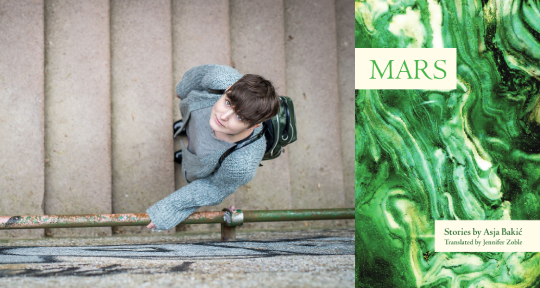
Review of Mars by Asja Bakic

[B]eing forced to live on Mars—named for the god of war and the male counterpart to Venus—makes her sick . . .

Mars by Asja Bakić, translated from the Croatian by Jennifer Zoble, Feminist Press, 2019

From a journalist reporting from inside a cult village to children who are convinced their neighbor is a forest monster, the characters portrayed in Mars, the debut short story collection by Bosnian poet, writer, and translator Asja Bakić, are forced to figure out how to survive in their strange realities. Bakić, playing a role reminiscent of Rod Serling in “The Twilight Zone,” carefully pushes aside the curtain on these parallel universes to underscore the uncanniness of everyday life. Each story in the collection takes place in a world that looks and feels familiar at first, but becomes stranger and more foreign the longer you spend in it.

Bakić was born in Tuzla, Bosnia, where she obtained a degree in Bosnian language and literature, two themes deeply explored in the collection. Mars, originally published under the same title in 2015, was shortlisted for the Edo Budiša Award. The stories shift seamlessly in genre from science fiction to dystopian horror, and Bakić deftly combines aspects of speculative fiction and realism to form a cohesive collection that explores universal issues. Bakić has a unique, perceptive voice and was selected as one of Literary Europe Live’s New Voices in 2017. Her work has been translated into seven languages. She currently lives and works in Zagreb, Croatia. READ MORE…

Portrait of the Translator as Neologist

Translating neologism resembles a tiny model of the whole process of translation

The Horde of Counterwind, written by the French writer Alain Damasio, takes place in a world of violent winds where a band of hardened, élite travelers make their arduous way toward the Upper Reaches, from where the winds are said to originate. Translating the thickly packed, virtuosic prose of this singular Science Fiction/Fantasy epic is a bit like having to join the Horde to battle against the winds. Skeptical readers have declared the Horde untranslatable, filled to the brim as it is with wordplay and even a long jeu-parti, or poetic duel, between the improvising troubadour Caracole and his ultraformalist counterpart, Seleme the Stylite. The poetic duel involves palindromes, among other enormous challenges to the translator. Translation, through the Horde of Counterwind, becomes a test of vigor and endurance for both writer and translator, who must faire bloc—become a single vital force—before the shattering gale of language.

Yet the Horde’s translator ultimately spends a great deal more time working on single words than on entire passages. The most difficult task facing the translator of the Horde, and indeed of many works of so-called speculative fiction, lies in the proper rendering of the novel’s innumerable neologisms. Within the first page, the Horde’s translator is called upon to translate the word furvent, a term denoting one of the most violent forms of the wind. After several hours of live discussion by Skype, and after brainstorming literally dozens of possible alternatives, Damasio and I settled on the term threshgale. Furvent derives in large part from the word furieux (furious), and the French word for wind (vent), whereas the neologism retains neither component, preferring winnowing and thrashing to fury, and the storm or gale in place of the mere wind.

READ MORE…

Translation Tuesday: “The Imaginary Pet,” “On Dragons”

Surreal tales from Mexican author Cecilia Eudave, translated by criticism editor Ellen Jones

The Imaginary Pet

As I was drinking my tea and noting the unique colour of the jacaranda tree, I was struck suddenly by a sad, painful memory: my first pet. She wasn’t cruel or aggressive, quite the opposite, she was a sweet creature, delicate and extremely intelligent (she taught me to read), with a slender body the colour of a jacaranda, so skinny she could have passed for a bookmark. She was my best friend, she went with me everywhere, slept in my bed, came out with me in my bag, played games with me, sang me to sleep. She always kept watch over my dreams, and with her by my side no nightmare ever dared enter my head.

READ MORE…