Posts filed under 'Nazism'

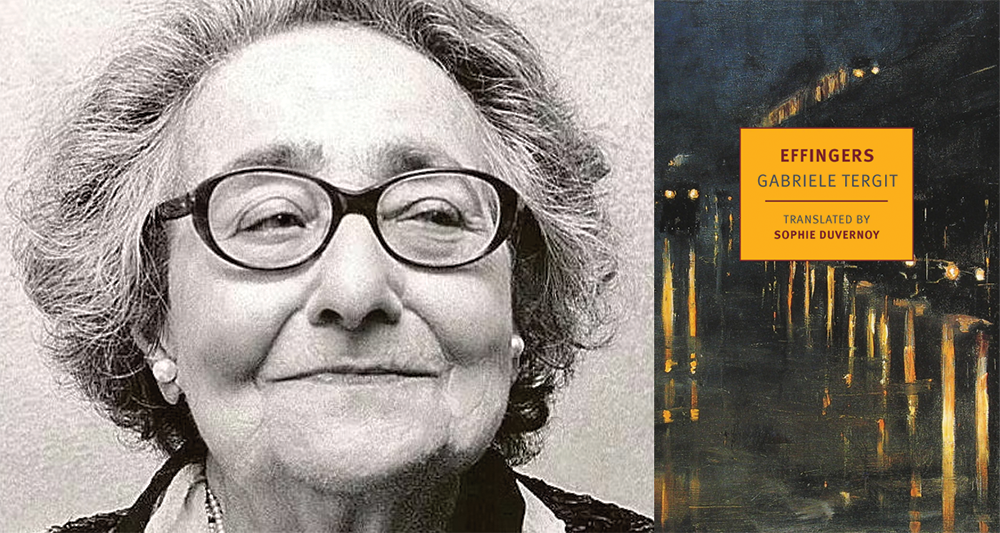
In the Aftermath of the Impossible: A Review of Effingers by Gabriele Tergit

It is easy to look back on history soberly, not so easy when it is happening as you write.

Effingers by Gabriele Tergit, translated from the German by Sophie Duvernoy, New York Review Books, 2025

There are few endings more shocking than that of Thomas Mann’s The Magic Mountain, when, after hundreds of pages of convalescence and long discussions, its hero is called down from the Swiss sanatorium to the battlefield:

Thus he lay; and thus, in high summer, the year was once more rounding out, the seventh year, though he knew it not, of his sojourn up here.

Then, like a thunder-peal—

Mann refuses to complete his sentence, specifying only that the thunder-peal “made the foundations of the earth to shake”; it is too well known what it portends. It is the Great War, and Hans Castorp must rejoin the world before he can leave it. Suddenly, from one paragraph to the next, he is in the trenches, and Mann can’t help but describe the scene. Castorp is in the mud, beneath the rain, a town on fire behind his back, the enemy before his eyes—and “What is it? Where are we? Whither has the dream snatched us? Twilight, rain, filth.” Whether he’s ill or not, the question that Mann has asked over the course of the novel, no longer matters: he’ll live or die on the battlefield.

That’s the trouble with writing a novel before history did us the courtesy of ending. Mann began The Magic Mountain in 1912, when all of Europe knew war was coming, and sat sagely at dinner tables discussing it. Two years later, that war had begun, and the world had ended. The novel Mann had begun could no longer be finished; what ought to have been the main performance could no longer be more than a happy prologue to the swelling act. The Magic Mountain was published in 1924. There was no more kaiser, there was no more tsar, there was no more Europe.

Gabriele Tergit’s Effingers was conceived in the new world, eight years later in 1932. Things were different, the great break was over, the war was long behind her, and so too were the revolutions that followed. READ MORE…
What’s New in Translation: June 2020

New publications from Brazil, Japan, and Poland!

This month, our selections of newly published literature from around the globe seem to cohere under the umbrella of trauma and memory, and the way they inevitably turn into narratives in the process of retrospection. From a Polish work of non-fiction that traces the sufferings of Poles during WWII, to the journals that document a Jewish immigrant in Brazil, to the strange and unspoken secrets of a small village in Japan—these works are of both documentation and imagination.

Logo-World-Editions-2018-black-white

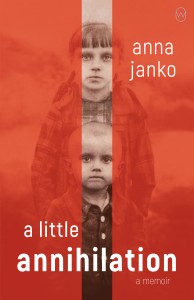
A Little Annihilation by Anna Janko, translated from the Polish by Philip Boehm, World Editions, 2020

Review by Katarzyna Bartoszyńska, Educational Arm Assistant

It is a grim fact, one that acquires increasing urgency in recent years, that those who were alive to experience the horrors of the Second World War are getting older: before long, we will no longer be able to talk to people who have direct experience of those times. Thus, we are increasingly grappling with the problem of second-generation memory: with the matter of how the descendants of survivors preserve and pass on the stories of the past for future generations, and with questions as to whether, or how, those descendants inherit the trauma of their ancestors. Anna Janko’s A Little Annihilation is a powerful meditation on these issues.

In this reckoning with the past, Janko describes the destruction of the Polish village of Sochy by the German military on Tuesday, June 1, 1943: the inhabitants massacred and buildings burned to the ground over the course of a mere few hours. Nine-year-old Teresa Ferenc, Janko’s mother, was among the survivors. In recounts of conversations, her mother describes her memories of that day—most especially, witnessing the death of both of her parents. Janko also chronicles interviews with other survivors from the village, interweaving their stories and noting the discrepancies between them, while describing efforts to tabulate the exact number of lives lost. The impossibility of establishing precise details is a crucial reminder of the intertwined nature of history and memory, a refutation of the common notion of their opposition, as well as a reflection on the challenges of documenting a massacre.

For some English-language readers, Janko’s text may be the first work they have encountered that discusses the sufferings of non-Jewish Poles during the Second World War. For Americans especially, to learn about Nazi atrocities is generally to learn about their efforts to exterminate European Jews, without a detailed understanding of how their eugenicist ideology shaped their policies and strategies in a broader variety of ways. Confusion over the fact that Poland was occupied territory has led to mistaken statements about “Polish death camps” (most notably, perhaps, when President Barack Obama used the term during a ceremony awarding the Presidential Medal of Freedom to Jan Karski in 2012; he later apologized for the error)—as Janko angrily reminds readers. “In my opinion it would be best if Germany gathered up all the camps they left behind in Poland. So that no one would be mistaken any longer.” READ MORE…

Weekly Dispatches from the Front Lines of World Literature

On Terezín, censorship in Iran, thrilling new Uzbek titles, and the long-awaited Nobel Prize for Literature announcement.

This week is an exciting one in the world of literature, and our editors are bringing you dispatches from the ground. Xiao Yue Shan discusses the winners of the 2018 and 2019 Nobel Prize in Literature. Julia Sherwood reports on a march from Prague to Terezín, a concentration camp established by the Nazis during their occupation of the Czech Republic. Poupeh Missaghi gives an account of literary podcasts in Iran, as well as the government’s role in quality control and censorship. Filip Noubel brings us an introduction of several new titles from the established authors of Uzbekistan. 

Xiao Yue Shan, Assistant Blog Editor, reporting on the Nobel Prize for Literature

The long-awaited Nobel Prize in Literature announcement of 2019 was prefaced by the usual barrage of news and predictionssome cynical, some vaguely hopeful, and most of which hedged their bets on women writers and/or authors who did not write predominantly in English. After the controversy of last year’s award (or the lack thereof), it followed a natural trajectory that our current politics lead us to search for brilliant literary representation that breaches the limits of our accepted canon of well-celebrated white men, and the Swedish Academy had seemed eager to prove themselves to be advocates for social progress, as they once again took on the role of alighting the flames of literary luminaries that will forever be enshrined as embodiments of success in the world of letters.

In a case of half-fulfillment, the 2018 Nobel Prize in Literature went to Asymptote contributor Olga Tokarczuk, and the 2019 Prize was awarded to the prolific Austrian writer Peter Handke. The latter aroused quite the maelstrom of negative responses, even with most still acknowledging his significant contributions and his fearlessly bold oeuvre, while the former is being hailed as a well-deserving, original, feminist voice, standing in the exact spot of where the spotlight should be shone.

READ MORE…