

In our final round-up of the year, we present a thrilling novel capturing the margins of Germany as the nation begins to veer into fascism, a collection gathering the voices of powerful Hungarian women poets, a Brazilian novel testifying to the colonial erasure of indigenous language and being, a series of essays considering the act of reading as an oppositional force against capitalism, and more!

Kappa by Ryonosuke Akutagawa, translated from the Japanese by Geoffrey Bownas, Pushkin Press, 2025
Review by Kaelie Giffel
Even if one is unfamiliar with his work, English readers will recognize the name Ryonosuke Akutagawa from the prestigious Japanese literary prize, named after him posthumously by a friend. Kappa is a novella published in the final year of the author’s life. Pushkin Press’s reissue of Geoffrey Bownas’s 1970 translation comes on the heels of a 2023 retranslation by Lisa Hofmann-Kuroda and Allison Markin Powell, published by New Directions in 2023. Multiple, competing translations indicate the continued importance of Akutagawa’s work, which has a renewed urgency in our time.
Kappa is a philosophical meditation on whether difference can be encountered without violence and how we might meet others in the strange in-between spaces. Structured as a frame narrative, its inciting incident is the testimony of a patient in an unnamed mental institution. The patient speaks about meeting strange creatures with tummy pouches called Kappas. The Kappas have their own cultural, historical, and philosophical institutions and orientations to life, and the narrator lives among them for a while, alternately admiring, baffled, or repulsed as he learns more about their existence. They oppose birth control for silly reasons; sacrifice workers who have been laid off by literally eating them; prohibit artistic performance because they believe the general public to be hopelessly stupid; and are generally misogynist—female Kappas are cast as libidinous huntresses that oppress male Kappas. The narrator is bewildered by the similarities and differences between himself (Japanese) and the Kappanese. Hence, the mental institution.
How to interpret this story is an open question, as the tradition of reading it has been stuck between two modes of interpretation, rehearsed in G.H. Healey’s lengthy introduction to the book. One can either read the book autobiographically, as an effect of Akutagawa’s declining mental health, or allegorically as a satire of Taishō Japan. But what if we read Kappa literally, as a story about a man who has been plunked down in the middle of an alien culture? About what it means to feel totally isolated and unmoored amid competing value systems (Kappa versus Japan; or even the West versus Japan), neither of which works toward a livable, enjoyable world? What if it’s just about the experience of encountering another culture, abstracted into the mythical figure of the Kappa? In any case, the book provides plenty to chew on in an age where xenophobia and violence are the norm.

Berlin Shuffle by Ulrich Alexander Boschwitz, translated from the German by Philip Boehm, Pushkin Press, 2025
Review by Dan Shurley
Ulrich Alexander Boschwitz’s Berlin Shuffle is an unusual novel in that it unfolds on a rung of the social ladder so low that most novelists wouldn’t even bother looking there for inspiration. What’s more unusual, the novel’s ensemble of beggars, buskers, thieves, sex workers and their traffickers—all scrambling for purchase in 1920s Berlin—supports an even lower rung of marginal people.
Fundholz, a beggar who sleepwalks through life, provides for Tönnchen, an intellectually disabled man with an endless appetite. Minchen Lindner, a sex worker, supports her unemployed father, who has been reduced to drinking himself into a stupor nightly. Sonnenberg, a blind veteran who plays the accordion for a living, brutalizes his wife Elsi, who endures his abuse because returning to the streets would be worse.
Boschwitz clearly knew his poverty, judging by the plausible details he offers on the myriad hustles of poor people, but his Handsome Wilhelm, a pimp who sidelines as a cabaret singer, feels more like a naïve homage to Brecht’s “Pimp’s Ballad” than the (much nastier) real thing.
The book rapidly shifts between about a dozen characters’ perspectives, which makes the less convincing characterizations less of a problem, while its finely-wrought plot grinds relentlessly onward toward the Jolly Huntsman, a divey club where the down-and-out drink with internal tourists from the better-off parts of the city. It’s at this site of intersection that Boschwitz really shines. The climax does not disappoint.
Boschwitz is a sociologist’s writer, dignifying his characters’ dubious life choices with ample back story and Marxist analysis, in slyly euphemistic prose that is at once transparent and coy. If the book had a thesis, it would be that unemployment is the root of all evil.
Alfred Döblin mined similar material in his Weimar-era novel Berlin Alexanderplatz, but the lives of his Lumpenhund were in the grips of a cosmic fatalism, not economics forces alone. And where Döblin’s prose reveled in expressionistic pastiche, Berlin Shuffle is its workmanlike cousin.
The author never saw where it all led. Having fled Germany following the passage of the Nuremberg laws and dashed off two novels while studying in France, he died at twenty-seven, shot down by a Nazi gunboat on his way from a detention camp in Australia to England in search of yet another temporary refuge.
The book’s marketing copy misleadingly suggests the book brings “to life a society that enabled fascism’s takeover,” but Boschwitz isn’t concerned with the political class that allowed Hitler to gain traction. He’s showing us an urban people coping with a period of intense mechanization, inflation, and cultural upheaval. It’s an oddly hopeful book, given the bleak circumstances.
Boschwitz does give us one proto-Nazi—Friedrich Müller, an unemployed locksmith turned conspiracist—but renders him more absurd than menacing. In an indelible exchange, Müller has chosen the simple-minded Tönnchen’s park bench for his soap box:
“Do you know that the Freemasons are to blame for everything?”
Tönnchen evidently didn’t know that yet. He didn’t smile, but stared at the other man open-mouthed.
Friedrich Müller was glad to find someone so interested.
For all its shortcomings, Berlin Shuffle succeeds in what few novels even attempt: showing the lives of marginalized people playing the hands they’ve been dealt, and not always playing them well. Set a full decade before the Nazi consolidation of power, the novel honors a moment of genuine uncertainty rather than imposing our retrospective knowledge of what came next. You may even want to linger in this Berlin on the cusp of radical transformation—or destruction.
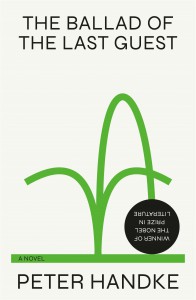
The Ballad of the Last Guest by Peter Handke, translated from the German by Krishna Winston, Farrar, Straus and Giroux, 2025
Review by Hilary Ilkay
The newest novel in translation from Nobel laureate Peter Handke is a brooding, interior drama that grapples with the swiftly changing world of the twenty-first century. The Ballad of the Last Guest is Kafkaesque in spirit, chronicling a man’s disorienting return to a world that should be familiar but that appears alienating; it’s no accident that the character’s name is Gregor—almost certainly a nod to the famous salesman-turned-beetle of The Metamorphosis. Kafka had commented on the individual’s inability to feel at home in a radically transformed world through his overt and absurd metaphor, but Handke takes a quieter and more introspective approach, writing in an intimate third-person perspective that gives the reader access to his protagonist’s direct experiences and reflections.
From the moment Gregor arrives in his hometown, something is off—an unsettling feeling of strangeness: “. . . he longed, even yearned, to be seen, and more than merely seen: to be recognized.” He feels lost and isolated, exacerbated by the fact that he carries a dark secret that he is unable to communicate to his family, creating a sense of distance between them. It’s also telling that an object missing from his childhood house is the mirror, precluding the possibility of self-reflection.
Throughout the novel, Gregor goes on a number of “one-man expeditions,” during which he overlays his impressions of the surroundings with the past, especially inflected in the memories of his brother. The narrator often implicates the reader directly in the story, such as by withholding certain details and instructing us to fill them in ourselves, perhaps mirroring the partial vision that afflicts the one-eyed Gregor.
Another major point of reference is the Odyssey, the great story of a difficult homecoming. Gregor sees himself in the man who comes home from war a stranger, who has to undergo a journey of recognition to transition back into his domestic life. As Gregor’s reality blends more and more with fiction and veers into the surreal, the writing can feel belabored and heavy-handed, and the plotlessness difficult to bear; but perhaps this is the point of Handke’s novel, to make the reader feel the same sense of disorientation and groundlessness as his protagonist does—so that not even something as immovable as a text can be returned to.
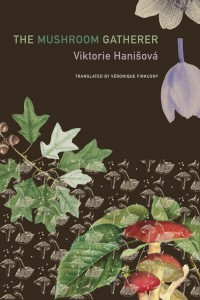
The Mushroom Gatherer by Viktorie Hanišová, translated from the Czech by Véronique Firkusny, Seagull Books, 2025
Review by Hilary Ilkay
Viktorie Hanišová’s The Mushroom Gatherer is a richly layered story about living in the shadow of childhood trauma. In the wake of her mother’s death, Sára must confront their fraught relationship head on, inciting a painful onslaught of the past. Opening with a striking “I hated it,” a reaction to her recollection of going to the symphony as a child, Sára is immediately established as someone who refuses to participate in any performance of domestic harmony. She frames her family as a surreal façade of happiness that obfuscates a much darker reality, a shadow play of suffering and tragedy.
Sára is a recluse, estranged from her two brothers. Through a gradual revelation of her memories, the reason for her exile comes to light; she is the victim of years of sexual abuse. Her attempts at reaching out for help had been in vain, and her misery became the condition by which the family could thrive: “No one suspected what price I’d had to pay for the family’s peace of mind.”
Yet it isn’t just the abuse that harms Sára, but the way it is met with continuous attempts at erasure, building to a climactic psychological breakdown that results in her vilification. Now in her twenties, Sára resists institutionalization and medication and is plagued by insomnia, chronic pain, and malnutrition. She tries to live anonymously on her own terms: “I camouflage myself like the most delicious mushroom. I am not memorable.” But as her history begins to invade, she discovers that—like mushrooms—even seemingly innocuous memories have the potential to harm.
As she begins to write her story, she wonders: “How could I possibly try to translate that horror into words?” Sára’s reclamation of her narrative allows her to go on living, but it does not heal her. As Neige Sinno observes in her own testimony of sexual violence, Sad Tiger: “It is a mistake and a source of suffering to believe in the myth of the survivor . . .” Hanišová’s novel, in Véronique Firkusny’s compelling translation, is an agonizing and devastating exposure of the wounds that remain in even the most steadfast attempts to go on living, equal in its refusal to compromise and its demand for recognition.

Every Day I Read: 53 Ways to Get Closer to Books by Hwang Bo-Reum, translated from the Korean by Shanna Tan, Bloomsbury, 2025
Review by Kaelie Giffel
Hwang-Bo Reum takes a distinctly laidback approach to anti-capitalist critique; let’s call it “cozy anti-capitalism.” For her, the problem is that capitalism deforms our subjectivities and causes us to pursue the wrong things. Hwang’s approach, in this most recent volume (as well as across her fiction), suggests that anti-capitalist thought can inhabit a range of feeling and literary styles, rather than only working with the more obvious feelings of anger or alienation. This specific intervention focuses on how reading can cultivate subjectivity beyond the logic of utility or profit, a hypothesis she explores in both of her books translated into English. Every Day I Read is an important personal and philosophical extension of her fictional work, Welcome to the Hyunam-Dong Bookshop.
The essays in Every Day I Read are deceptively simple, organized around fifty-three tactics for reading more in your everyday life. Essays have headings like “Movies and Novels” or “Independent Bookshops,” but beneath these rather straightforward headings, the essays demonstrate rather than solely describe the act of reading as a means of cultivating subjectivity and a unique point of view, suggesting new directions for valuing and creating the individual in an age of mass culture—something we urgently need. As each chapter unfolds, we discover the true subject of the book is not books but Hwang Bo-Reum herself. Gradually, we get a deeper sense of Hwang, her interests, desires, and commitments in reflections I found incredibly poignant and clear-eyed.
Compared with a more stridently political book of criticism, Hwang’s book might seem naive. However, in her wide-ranging use of books and their content, Hwang demonstrates that reading is a multi-faceted activity that cannot be reduced to one mode. For instance, she often talks about empathy when reading fiction, but this happens alongside methods of reading in which she reflects on her personal life and extensive descriptions of reading as an activity opposed to work, in which activity is coerced and the individual is totally subsumed under labor. Hwang’s strengths lie in her refusal to issue edicts and prohibitions, opting instead to solicit reflections on our own relationship to reading and the constraints in our lives that might prevent it (and, therefore, our becoming). Hwang provides new glimpses of togetherness through the cultivation of a life surrounded by and immersed in books. As a life-long reader and recently minted critic, she gave the magic of reading back to me.
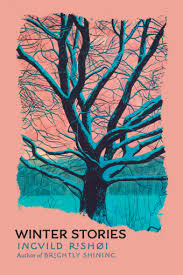
Winter Stories by Ingvild Rishøi, translated from the Norwegian by Diane Oatley, Grove Press, 2025
Review by Kaelie Giffel
Winter Stories is the second of Ingvild Rishøi’s works to be translated to English in the past year. The first, Brightly Shining, takes a class-conscious approach to Christmas in compelling ways, and Winter Stories continues this radicalization of the holidays by representing it as a time of secular grace and generosity. As a journalist writing for publications like Dagbladet, a liberal progressive paper in Norway, Rishøi’s fiction extends her journalistic commitments to explore what it means to live in a liberal society in which help comes to those who need it. Thus, her work is ultimately concerned with class and the way money and social norms shapes our relationships and character.
Winter Stories comprises three novellas about down-and-out individuals who are met with a moment of grace. These gestures seem small but are world-saving—world-making even. In “We Can’t Help Everybody,” a young mother in need of underwear for her daughter is the recipient generosity from a stranger. In “The Right Thomas,” the titular character, believing that he must be the architect of his life in order for it to go right, struggles with anxiety after his release from prison. Unable to buy a pillow for his son because of a snobbish store manager, Thomas fears all is lost until old friend makes sure he gets his pillow and arrives home to see his son—all transpiring without any control on Thomas’s part. In “Siblings,” an eldest daughter (responsible for her younger siblings) runs away with her younger brother and sister after a daycare worker calls child services on their family. The siblings’ slog through the snowy woods is surely ill-fated, but a woman helps them and does not report them to the authorities.
Reading Rishøi is a sobering reminder that we desperately need stories that demonstrate the vital need we all have of that abstract concept “society,” which is made not just of civil institutions, but also ordinary people we meet in passing, those we know only vaguely, and those who feel responsible toward us (or vice versa). The kind stranger who gives money unbidden and with no strings; the long-lost friend who miraculously shows up and helps us in a dire moment; the woman who has no familial relationship helping to keep a family together. My education has steeped me in left critiques of society and its failures, but ultimately, we need to devise new frameworks and tactics for care because to put it simply: we are all we have. Rishøi’s work demonstrates this beautifully, and I recommend her work to anyone whose heart needs a little lightening.

Marayrasu by Edgardo Rivera Martínez, translated from the Spanish by Amy Olen, Curbstone Books, 2025
Review by Xiao Yue Shan
In Landscape and Power, W. J. T. Mitchell set a list of nine “Theses on Landscape,” the second of which reads: “Landscape is a medium of exchange between the human and the natural, the self and the other. As such, it is like money: good for nothing in itself, but expressive of a potentially limitless reserve of value.” Who’s to say if the natural world has benefited from this transaction, but certainly we owe it a tremendous debt. One can hardly think of human creation without it, albeit as fitted into metaphors and sublimated into forms and structures, somehow diminished even in the testimonies of its grandeur. For we cannot conceive landscape as a whole, of course, being in the middle of it and all, occupied foremost with our own sensual perception; the values we express are our own.
It’s easy to call upon the peaks or the waters to give magnitude to our own acts and ideas, but those who do so are dealing in conceptualizations instead of actualities. It is then a happy discovery to travel through the stories of Edgardo Rivera Martínez’s Marayrasu, in which landscape is formative and pivotal, but never falsely appropriated to supplement human interiorities, nor expounded upon for its capacity to incite stylistic resonance. Situated in Central Andean towns and the ancient city of Cusco, the city squares of Lima and the still-wild valleys, landscape is always working its own will in the background of these tales, marinated in weather, ruling its own domains, and where it intersects with the people, Rivera Martínez subtly determines that the roles we assign and the use we make out of the natural world are limited and temporary—that the true forces exerted by landscape are entirely unknowable. In the opening piece, a gemstone hunter wanders the high planes in search of beautiful fragments, thinking of how far he has wandered from home and his loved ones, weighing the cost of his nomadism. Neither the menial profits nor the fascination for his wares are quite enough to sustain him in the life he has chosen, and as his thoughts continually return to his family, his wavering presence in the world, his solitude, he begins to entertain dreams of a more stable social existence, one in which the gleaming stone he’s procured could be a gift to his family, some kind of apology for his prolonged absence, and he could finally sit down to a hot meal, feeling complete in his human position. Yet as he walks and walks, the wind and the man moving in their own rhythms, as if in hallucination, as if in incantation, the driving forces of consciousness and landscape each enact their own processions—but only one endures. The story culminates with him deciding to return his precious finding to the place where it came: “He had no right to pull it from its centuries-old rest. He would leave it, then, and that way, at night, its rays would light up in that solitary depth. How they would shine, then!”
Throughout the eight stories in this collection, Rivera Martínez expertly renders the ontological depths of his characters—most of whom are stranded, physically or spiritually or socially—with the aid of mythology, fantasy, and fable—all of which are melded, in true Andean fashion, with the surrounding overwhelm. Within this context, he speaks powerfully of class alienation, of loneliness, and of heritage. Yet the settings are not construed so much as settings—which do the bidding of the narrative—and thus must be explicated and cohered for our understanding, but simply as place, which tolerates but does not restrain itself to our seeing. As such, these places—so faraway to most of us—are enacted with presence but not familiarity, paying homage to an indigenity that never assumed land as only property, and thus creating a collision between mystery and knowledge that does not preclude the possibility of even the most wondrous and impossible events. In the gorgeous and brief episode “Dancers of the Night and of Death,” the dead members of a troupe gather again on a festival night, treading across the dark to play again for the people of their town. Confounded but grateful to have risen from oblivion to once again conduct the music that he had loved so much in his lifetime, the leader wonders:
Are you really the same as you were before, church, courtyard, arches? Do you flow the same, central source and surrounding springs? Are you the same streets coming from Jauja, Yaricocha, and Julcamarca?
One does not presume to know, but only suspect that it is some temporary collaboration between the physical and the temporal—made by imagination, fortified by the world. In Marayrasu, the great Peruvian writer thus provides a beautiful equation to the idea of a value exchange between us and our landscape; it gives us space, and we give it time. Though, of course, the latter matters only to us.

The Jaguar’s Roar by Micheliny Verunschk, translated from the Portuguese by Juliana Barbassa, Liveright, 2025
Review by Hilary Ilkay
When Micheliny Verunschk visited an exhibition in São Paulo dedicated to Brazil’s history, she saw two famous portraits of an Indigenous boy and girl, taken by German naturalists in the early nineteenth century. Upon further research, a dark story emerged; they had been kidnapped from their home in the Amazon and taken to the Bavarian court in Germany, where they both died in reaction to the unfamiliar conditions. The young girl’s face resonated so strongly with Verunschk that she felt compelled to tell her version of their story, and The Jaguar’s Roar is the resulting text, masterfully blending historical and literary fiction restore the voices of those silenced by colonialism. The author is clear, however, that her aim is not to speak for the girl, or to offer a definitive account of imperial violence in her country: “This is the voice of the dead, the language of the dead, in the writing of the dead. All of it is riven with faults, true, but what can I do except tell this story through the cracks?”
In lyrical, captivating prose, the novel is narrated through a tapestry of voices: the Miranha girl, who receives the name Iñe-e; the German scientists Martius and Spix; the two rivers that Iñe-e encounters in her short life; the jaguar that she imagines when she needs protection and strength; excerpts from archival material and period texts; and the autofictional character of the Brazilian researcher Josefa. Yet the narrative is foregrounded through Iñe-e’s perspective, forcing the reader to share in her childlike confusion and pain.
On their forced journey across the world, the two children, who know only their dialects, cannot speak to anyone else—but this incommunicability goes beyond language; it speaks to the isolation bred by colonialism and the consequential inability to testify to one’s own experiences. Martius praises the lasting power of the written word, which brings with it the ability to control the historical record. After all, stories, if not recorded, die with their tellers. One of the novel’s most searing insights, then, is the methodology by which European colonizers erased Indigenous identity—not just through acts of genocide, but by remaking them in their own image. As Martius says of Iñe-e: “. . . she had no name before she was Isabella Miranha, no history.” To resist this obliteration, Verunschk bestows upon the anonymous girl not just a name in her own language, but a story with the ferocity and volume of a jaguar’s roar.

Under a Pannonian Sky: Ten Women Poets from Hungary, edited by Ottilie Mulzet and translated from the Hungarian by Anna Bentley, Erika Mihálycsa, Ottilie Mulzet, Ivan Sanders, Claire Pollard with Anna T. Szabó, and George Szirtes, Seagull Books, 2025
Review by Hilary Ilkay
This collection of Hungarian women’s poetry from the twentieth and twenty-first centuries is a treasure trove of riches. A celebrated translator of Hungarian poetry and prose—whose works include that of Nobel laureate László Krasznahorkai—Ottilie Mulzet is the perfect curator for Under a Pannonian Sky. The poems themselves delve into Hungarian history, reflect on the country’s diverse landscapes, meditate on inherited stories and objects, and grapple with the complexities of identity, womanhood, and literary creation, all in a variety of forms, tones, and voices.
The experience of women past and present is a thread that connects many of the poems. In “Before the mirror,” Ágnes Nemes Nagy considers the complexity of women’s self-perception: “You take your face and slowly remove the paint / but would remove the face that fate assigned you.” This delicate alienation is continued in a later long poem: “When she looked back her face had disappeared.” Elsewhere, Anna T. Szabó captures the visceral solidarity of giving birth in “Delivery Room”: “Animals give birth in dens, but women / must suffer together. In the delivery room, / in the extended, polyphonic wailing.”
In a haunting poem called “Persephone,” Szabó interweaves the titular myth with the trauma of a sex worker, for whom life is already a hellscape: “Just never here, no more no more, / that’s all I ever want: / to be not here and something else / another world to haunt.” Zsuzsa Beney engages in a similar act of classical rewriting; two of her poems in the anthology are retellings of the Orpheus and Eurydice myth, with the first written from Eurydice’s point of view: “I no longer see myself. // My gaze is only in his gaze now.” Reminiscent of H.D., Beney reinvigorates the past from a contemporary perspective. Her parable-esque poem “The Translator” reads like one of Daisy Johnson’s mixed metaphors for translation: “He steps into the poem. Rock. It closes / behind him, he too becomes rock.”
Beyond ancient narratives, lineages of cross-cultural poetic legacy are also visible throughout the collection; Agnes Gergeley’s existentially fraught, spare poems read as kindred spirits of Emily Dickinson’s: “I looked into the well, and nothing did I see.” Szabó inhabits and speaks alongside the poetic voices of T.S. Eliot in “Tiresias” and Baudelaire in “Au Lecteur.”
There is something to discover and return to on every page, turns of phrases and images that startle and dazzle. With the little availability of Hungarian poetry in English, Under a Pannonian Sky makes an impressive leap.
Kaelie Giffel regularly publishes essays and reviews about feminist literature and politics, focusing on works in translation. Her first book, University For a Good Woman, is out from Lived Places Publishing and uses the memoir form to interrogate class and misogyny in an American university. She holds a PhD from University of Washington where she studied feminist world literature.
Hilary Ilkay works in sales for the Canadian indie press Biblioasis, and she is an Associate Fellow in the Early Modern Studies Program at the University of King’s College in Nova Scotia. She is a Managing Editor for Simone de Beauvoir Studies Journal and an Assistant Managing Editor for Asymptote.
Xiao Yue Shan is a poet, writer, editor, and translator.
Dan Shurley is a writer and journalist in Philadelphia. His fiction, poetry, and criticism have appeared in Granta, BOMB, the TLS, the LA Review of Books, and a few other places. His writing on Indigenous cultural erasure in Philadelphia has been cited by the American Library Association.
*****
Read more on the Asymptote blog: