
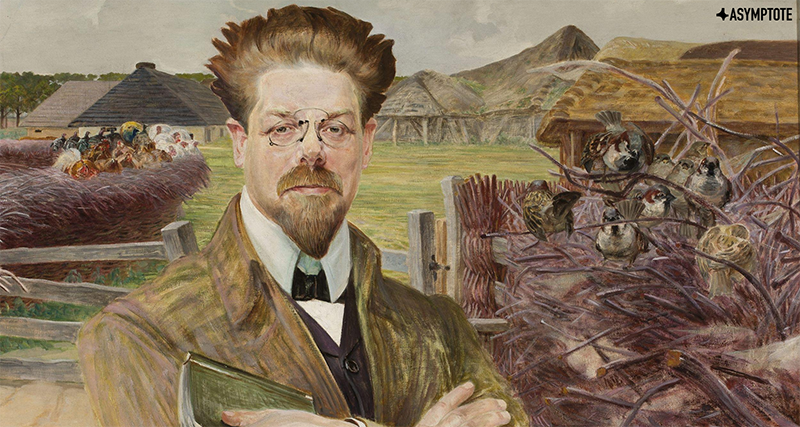
Posts featuring Władysław Reymont

Władysław Reymont: Poland’s Chronicler of the Profane

Reymont’s work had become so particularly Polish . . . that it once again became universal.

These days, the reading world eagerly anticipates the Swedish Academy’s annual awarding of the Nobel Prize for Literature, placing bets and preparing stacks of shiny gold stickers, ready to be stamped on newly reprinted books. Yet the Prize, now over one hundred years old, has had many of its laureates fall into obscurity, either due to a seeming lack of contemporary resonance, or the changing priorities of the Academy itself. In this essay, we look towards the works of one such writer, whose pivotal titles perhaps deserve a revisit for their stylistic commitment, persistent human themes, and documentation of the times.

Władysław Reymont, Poland’s second Nobel Laureate, was born to the family Rejment in 1867; in 1892, when he was first published, he insisted on changing his name’s spelling (if not its pronunciation), in part, as Polish academic Kazimierz Wyka speculated, because of its closeness to the verb rejmentować: “to cuss” in certain Polish dialects. For some authors, this would be a humorous footnote in their biographies, but for Reymont, it proves an apt metaphor for his oeuvre. His major works—including, most famously, Ziema obiecana (The Promised Land) and Chłopi (The Peasants)—are beautiful and distinct depictions of nasty, earthy lives. Like curses disguised with respelling, they reconfigure their surprising, sometimes shocking base material, deriving elegant representations from the inelegant. Despite being drawn, like so many Polish intellectuals of his era, towards a vision of Polish nationhood that literature had to help create, Reymont opted to render Poland as a grimy, smoky, bloody place—but where he becomes intriguing, and what perhaps most compelled the Nobel Committee to award him the 1924 Prize in Literature, is when that focus on the bodily and the brutish becomes celebratory and even liberatory, for both its subjects and their nation.

Reymont was born into a Poland that was, by then, absent for decades. By 1867, the nation had been partitioned between Austria, Prussia, and Russia for nearly seventy years. Seemingly mirroring this fragmentary state, Reymont was a shoemaker, then an actor, then a linesman on the Warsaw-Vienna Railway, then a prospective candidate at a monastery, before he made his way to writing. Nonetheless (or perhaps because of his aimless decades), Reymont had established himself as a major figure in the Młoda Polska (Young Poland) movement by the end of the nineteenth century, primarily through his short fiction and travel narratives. The Young Poles—working across literature, music, and art—were neo-romantics, skeptics of the old world order that seemed to edge closer to collapse with each toppled European monarchy or imperial clash, and Reymont’s best-known works are no different. In Ziema obiecana, modernity is simply decried; in Chłopi, Reymont seeks a solution by turning inwards to Poland’s rural culture, timelessly isolated from modern concerns. In both works, we meet plenty of violence, gory detail, and literary profanity, but Reymont’s choice of subject for the latter novel reframes the grit in terms that the Nobel Committee registered as transcendental and universalist. READ MORE…
Weekly Dispatches From the Front Lines of World Literature

Literary news from Poland, Kenya, and North Macedonia!

In this week of updates on world literature, our Editors-at-Large bring news on an upcoming film adaptation of Władysław Reymont’s The Peasants, a monthly calendar highlighting African writers and literatures, and the most recent winner of the esteemed Golden Wreath in North Macedonia! From Asymptote contributors’ recent accolades to a brief look into Vlada Urošević’s poetry, read on to learn more!

Julia Sherwood, Editor-at-Large, reporting on Poland

A film version of the modern Polish classic, The Peasants by Nobel-prize winning author Władysław Reymont, will hopefully hit the screens later this year, following a lengthy delay caused by COVID and the war in Ukraine. Those familiar with the Gdańsk-based filmmakers Dorota Kobiela and Hugh Welchman will know that this won’t be your run-of-the-mill costume drama; the film uses the same painstaking hand-painted technique that the team pioneered in their earlier acclaimed short film Loving Vincent. Originally scheduled for release in 2022, the production of The Peasants came to a standstill, as twenty-three of the artists working on the film were Ukrainian and based in a studio in Kyiv. Interestingly, it is the film that we have to thank for the new English edition of The Peasants; since the existing translation published in 1924 was rather outdated, Welchman commissioned Anna Zaranko, winner of the 2020 Found in Translation Prize, to translate a couple of chapters for him and subsequently managed to persuade Penguin Classics to publish the complete novel, which is nearly 1000 pages long. 

In 2021, one year after Zaranko won it, the Found In Translation Award went to Ewa Małachowska-Pasek and Megan Thomas for their new English version of Tadeusz Dołęga-Mostowicz’s 1932 satirical novel The Career of Nicodemus Dyzma. They discuss the novel with Daniel Goldfarb in the first episode of his series of Encounters with Polish Literature. Now in its third year, this consistently illuminating series of monthly videos that Goldfarb has been producing for the Polish Institute in New York has clocked up twenty-six episodes so far. In Episode 2, which focuses on Andrzej Sapkowski, Goldfarb is joined by David French, who has translated six out of the fantasy writer’s eight novels in the Witcher series into English, as well as all three parts of his Hussite Trilogy. In the most recent Episode 3, Goldfarb and the scholar and translator Benjamin Paloff introduce Leopold Tyrmand, author of one of the great Warsaw novels and popularizer of jazz in mid-twentieth-century Poland, a transformative figure in Polish culture between the death of Joseph Stalin and the post-Stalin thaw.

There have been nominations and prizes galore for Asymptote contributors: Marta Dziurosz has won the First Translation Prize of the UK Society of Authors 2022 for her ‘truly astounding translation’ from the Polish of Marcin Wicha’s Things I didn’t Throw Out, sharing the prize with editors Željka Marošević and Sophie Missing. Mikołaj Grynberg’s heartbreaking collection of short stories, I’d Like To Say Sorry But There’s No One To Say Sorry To, translated by Sean Gasper Bye, has been named a finalist of the Sami Rohr Prize for Jewish literature (the winner to be announced on September 12). Olga Tokarczuk’s monumental The Books of Jacob in Jennifer Croft’s translation finds itself on the shortlist of the 2023 European Bank for Reconstruction and Development Literary Prize alongside fellow Polish author Maciej Hen and Anna Blasiak, translator of his book According to Her (see interview). 

And finally, if you are a writer or translator with at least one published book, are currently working on a writing project, are interested in learning more about the Polish literary community, and have a connection with any UNESCO City of Literature outside of Poland, don’t miss the opportunity to apply for a two-month literary residency in Kraków (July 1 to August 31, 2023). The deadline for applications is April 23.

READ MORE…

Weekly Dispatches From the Front Lines of World Literature

The latest in literature from Poland, Hong Kong, and Puerto Rico!

This week on Asymptote, we’re your eyes and ears for updates on award seasons, special national literature features, and postcolonial discourse and strategy. Polish literature is soaring at a high after celebrated adaptations and translations are introducing new readers to long-loved works. From Hong Kong, the national security law once again catalyses questions in its suppression of writing, even as local writers are seeing much love abroad. in Puerto Rico, writers are questioning US-backed funding and its entrapments. Read on to find out more.

Julia Sherwood, Editor-at-Large, reporting for Poland

Autumn is Poland’s award season, and this year saw the prizes go to a variety of genres. For the first time since 2009, NIKE, Poland’s most prestigious literary prize, went to a book of poetry: Jerzy Jarniewicz’s “erotically daring” collection Mondo Cane. Edward Pasewicz, whose novel Pulverkopf was also shortlisted, took home the coveted Angelus Prize for literature from Central Europe—only the second Polish book to win the accolade in the award’s twelve-year history. The Readers’ Angelus Prize went to Czech writer Jaroslav Rudiš for his novel Winterbergs letzte Reise, written in German and translated into Polish by Małgorzata Gralińska, and his publisher Książkowe klimaty scored another success with Bartosz Sadulski’s “literary fable and anti-historical reportage” Rzeszot, garnering the Kościelskich Prize.

Polish literature has enjoyed something of a boom in English, placing second in a recent survey conducted by The Bookseller, which is based on Nielsen BookScan data for the fifty-two weeks since April 16, 2022. The results show that in this period, translated fiction accounted for 11.4% of total fiction revenue, proving that we have moved even further from the proverbial 3%. Broken down into languages, 60% of the translations were from Japanese—unsurprising given that 99.7% of the total revenue was generated by manga. The next language, French, trailed at 6.1%, and Polish came in at third with 4.6%, beating translations from Italian, German, Spanish, Swedish, Russian, and Norwegian. Much of this success appears to be linked to Andrzej Sapkowski’s blockbuster fantasy The Witcher, which has filled the Game of Thrones-shaped hole on Netflix; the first two volumes of the eight-part saga were translated by Danusia Stok and the remainder by David French, who went on to translate his Hussite Trilogy. Olga Tokarczuk’s Nobel Prize has also contributed to this success, as has the fact that Polish literature was the market focus at the 2017 London Book Fair.

Here’s hoping that this interest will extend to a slew of recent translations from the Polish. According to Her, “a book-length interview with the Mother of God” by Maciej Hen (recently interviewed on the Asymptote blog by fellow writer Wioletta Greg), was published by Holland House in Anna Blasiak’s translation on November 3. On the same day, Penguin Books released Anna Zaranko’s long-awaited translation of The Peasants, one of Poland’s most famous twentieth-century epics by the 1924 Nobel Prize winner Władysław Reymont. In What We Leave Behind: A Birdwatcher’s Dispatches from the Waste Catastrophe, translated by Zosia Krasodomska-Jones and published by MacLehose Press on October 13, ornithologist and writer Stanisław Łubieński shows how consumer society has spun out of control, leading to the point of environmental catastrophe. Finally, Vine Editions, a new non-profit publisher based in Detroit with a focus on world literature, is about to bring out its first title, Piotr Paziński’s Bird Streets (Ptasie ulice) translated by Ursula Phillips. READ MORE…