
Posts featuring Teju Cole

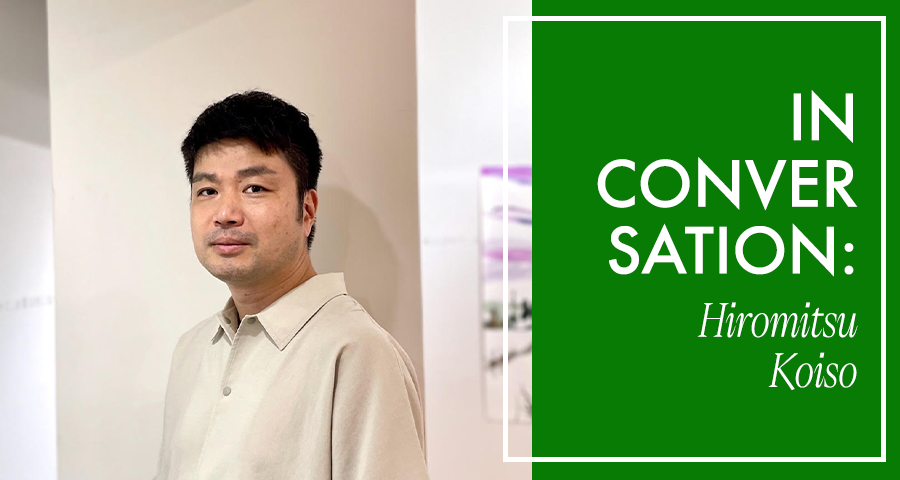
Desire is No Light Thing: An Interview with Hiromitsu Koiso on Translating Anne Carson and Teju Cole into Japanese

Rather than being shaped by any single figure, I’m more interested in how one’s present moment can be placed in relation to a much longer history.

Hiromitsu Koiso’s path to becoming one of Japan’s most ruminative literary translators was anything but linear. It began, as he recounts, in the second-hand bookshops of western Tokyo, poring over paperbacks and comparing translations by seasoned Japanese translators, a sort of discipleship that would later lead him on a peripatetic route to the MA in Literary Translation and MA in Creative Writing (Poetry) programmes of the University of East Anglia in Norwich, United Kingdom. His body of work reveals a translator who is attuned to works of hybridity and gravitas, from the Sebaldian solivagant of Teju Cole’s Open City to the mythopoetic vestiges of Anne Carson’s Autobiography of Red. This extends to the works of Ocean Vuong, Isabella Hammad, Grayson Perry, Noor Hindi, and Ursula K. Le Guin, as well as more recent translation projects like Carson’s Wrong Norma (published on 10 January by honkbooks’ thoasa) and Bryan Washington’s Memorial (forthcoming in Spring 2026). He has also co-translated Japanese poets Kamiyu Ogyu, Naha Kanie, and Ayaka Satō into English.

When asked about influence, Koiso speaks less of particular poetic lineages and more of situating himself within and against literary history, and of navigating the orientalising gaze directed at Asian writers: a “gaze [that] shapes both how we are read and how we respond, creatively and intellectually.”

In this interview, I spoke with Koiso (who is in Tokyo) about his unorthodox career trajectory, the immersive craft behind recasting specific genres and texts, and the poetic reflection underpinning his work as a poet and translator who seeks to meditate on “how one’s present moment can be placed in relation to a much longer history.”

Alton Melvar M Dapanas (AMMD): Koiso-san, I want to begin with how you started as a translator. As a university student, you pored over Paul Auster and J.D. Salinger paperbacks at the second-hand bookstore Nishi Shoten in Kunitachi. By comparing your early attempts with the translations of seasoned practitioners like Motoyuki Shibata and Takashi Nozaki, you developed an appreciation for the craft. Yet you didn’t pursue translation right after university. So, what were the key moments that ultimately led you here?

Hiromitsu Koiso (HK): After graduating from university, I wanted to work in literary translation, but I had no idea how to enter the profession. Throughout my twenties, I worked various jobs while studying and trying to find my way into the field. I took temporary positions, worked in offices, saved money, and eventually decided to pursue postgraduate studies at the University of East Anglia in the UK.

I first learned about UEA’s MA in Literary Translation program and a particular centre for literary translation through the Japanese translations of W. G. Sebald. Discovering that Sebald had taught at UEA and helped establish the translation centre made a deep impression on me. I felt strongly that I wanted to study Literary Translation in the very place where he had lived, taught, and built a community for translators. READ MORE…
Weekly Updates from the Front Lines of World Literature

The latest news from Singapore, Taiwan, and the United Kingdom!

This week, our writers bring you the latest news from Singapore, Taiwan, and the United Kingdom. In Singapore, the Singapore Writers’ Festival hosted international writers, such as Liu Cixin, Teju Cole, and Sharon Olds, whilst the Cordite Poetry Review published a special feature on Singapore poetry; in Taiwan, Kishu An Forest of Literature centre has held a discussion about a new translation of Mary Shelley’s Frankenstein; and in the UK, Carcanet Press has launched Eavan Boland’s final collection, The Historians, whilst new books about renowned poets Seamus Heaney, Sylvia Plath, and Anne Sexton have been released. Read on to find out more! 

Shawn Hoo, Editor-at-Large, reporting from Singapore:

The beginning of November sees a deluge of new writing coming from a host of literary journals. Joshua Ip and Alvin Pang have guest edited a special feature on Singapore poetry in Cordite Poetry Review that gives us the rare pleasure of rethinking Singapore poetry through the art of transcreation. The editors commissioned thirty young poets (who write primarily in English) for the challenge of transcreating verse, not just from the official languages of Malay, Tamil, and Chinese, but also ‘minor’ languages such as Kristang, Bengali, and Tagalog that make up Singapore’s linguistic soundscape. Additionally, Mahogany Journal, a new online periodical on the scene for anglophone South Asian writers in Singapore, has just released their second issue, which is themed ‘Retellings.’ Finally, one of our longest-running online journals, the Quarterly Literary Review of Singapore, has launched its October issue. Lovers of Singapore literature have a huge array of choice.

Meanwhile, this year’s virtual Singapore Writers’ Festival (mentioned in my October dispatch) concluded last weekend. While festivalgoers did not experience the familiar ritual of queuing and squeezing into a room packed with fellow writers and readers, the online format delivered its own peculiarities. Liu Cixin, Teju Cole, and Sharon Olds were some of the international stars joining us from different time zones across our devices. Margaret Atwood, whose message to novelist Balli Kaur Jaswal was a hopeful “we will get through,” had many viewers sending questions through a live chat box asking the author of The Handmaid’s Tale what it means to write in these dystopian times. Instead of browsing the festival bookstore in between panels, I scrolled through the webstore run by Closetful of Books. Nifty videos were added to lure me to new book releases, booksellers curated a list of recommended reads, while readers craving connection left love notes to nobody in particular. The copy of Intimations I ordered arrived with a sweet touch: it came with a bookplate signed by Zadie Smith. With access to video on demand, rather than rushing from room to room, I found myself toggling between panels on Southeast Asian historical fiction and Korean horror without so much as lifting a finger. If I find myself unable to concentrate (as Zadie Smith said of our social media age: “I feel very bullied at the speed I am told to think daily”), I tune in to Poetry Bites to hear Marc Nair engage in ten-minute intimate chats with ten poets. Kudos to festival director Pooja Nansi and her team for this massively successful event. We are all already looking forward to what the next year’s edition of the festival brings. READ MORE…