
Posts featuring Nicholas Glastonbury

Unreliable Narrator, Unreliable Translator: Nicholas Glastonbury on Sener Ozmen’s The Competition of Unfinished Stories

. . . if we can unmake or destabilize the novel, we might similarly destabilize the nation, which warrants or conscripts the novel.

The Competition of Unfinished Stories is one of those texts that would be classified as “untranslatable” by the more cynical amongst us. Aside from addressing the intricate language politics of Turkey—namely the oppression and marginalization of Kurdish—Sener Ozmen’s text is full of jokes, narrative tangles, loose ends, shapeshifting characters, and suspicious translators. As such, the English edition of the novel is a triumph, not only in Nicholas Glastonbury’s fluid and adventurous prose, but also in his own interjections that celebrate the original’s chaos and multiplicity. In this interview, he speaks on the challenges of translating the book, authorial authority, and language’s resistance to containment.

The Asymptote Book Club aspires to bring the best in translated fiction every month to readers around the world. You can sign up to receive next month’s selection on our website for as little as USD20 per book; once you’re a member, join our Facebook group for exclusive book club discussions and receive invitations to our members-only Zoom interviews with the author or the translator of each title.   

Hilary Ilkay (HI): This is a challenging and strange book! How did you find out about it? Did you pitch it to a publisher, or was it pitched to you?

Nicholas Glastonbury (NG): I met Sener maybe six years ago. I was in Diyarbakır doing research for my PhD, and there was an organization trying to build an online platform for Kurdish literature, given all of the obstacles that it has in accessing foreign language audiences, and I did some work for them. I was aware of Sener’s work a little bit, but when I met him, I became really interested in it. He’s also a visual artist, so I became really interested in how he saw the world. He’s also written quite a few books; The Competition of Unfinished Stories is his second novel, and the title is what drew me in. After I read it, I thought, what is going on here? This is a crazy book. Then I began pitching it around, and it landed with Sandorf Passage, which I’m very happy about.

HI: I was delighted to discover Sener’s prolific artistic practice when I was reviewing the book. I wonder if you could say a little bit about how you see his practice as a visual artist influencing his writing. Do you see an interplay between his art and the way that he constructs stories and narratives?

NG: I think he’s really interested in the absurd. For example, there’s one photograph of his that comes to mind; it’s a group of men hoisting a flag up a flagpole, and they’re all wearing neck braces, and they’re unable to look up at the flag. There’s a tension between violence and nation, and the obligation to nation is very much an aspect of this novel.

He has another piece, a sequence of photographs of himself dressed as Superman. He takes off his cape and uses it as a prayer rug, and the title of the work is “Supermuslim.” He’s got a real sense of humor about things that are so heavy and serious.

There was another piece he did called “Road to Tate Modern,” which is him and another artist trying to make their way to London, to the museum. They do a kind of Don Quixote and Sancho Panza act, riding a horse and a donkey, asking shepherds around the Kurdish countryside where the Tate Modern is. And the shepherds say things like, oh, it’s just over the hill. . . So there’s a sense of the distance that Kurdish cultural production has to surmount in order to reach international audiences—of course conditioned by the violences of the nation-state—that comes through in both his writing and his visual work. I think the way that his approach to writing is shaped by his visual work is how he captures images. For example, in The Competition of Unfinished Stories, the image of Neil Armstrong on the prayer mat dying stands out to me, or all the scenes of Sertac masturbating. There’s a real sense of creating these absurd tableaus, and I think that’s probably influenced by how he sees and visualizes the world through his art.

HI: You have such an impressive and interesting portfolio of translations under your belt and I’m curious, given the scope of your work, what made Ozmen’s writing unique, or what stood out about the way that he wrote? And related to that, what was the biggest challenge in trying to render this unwieldy text into English? READ MORE…
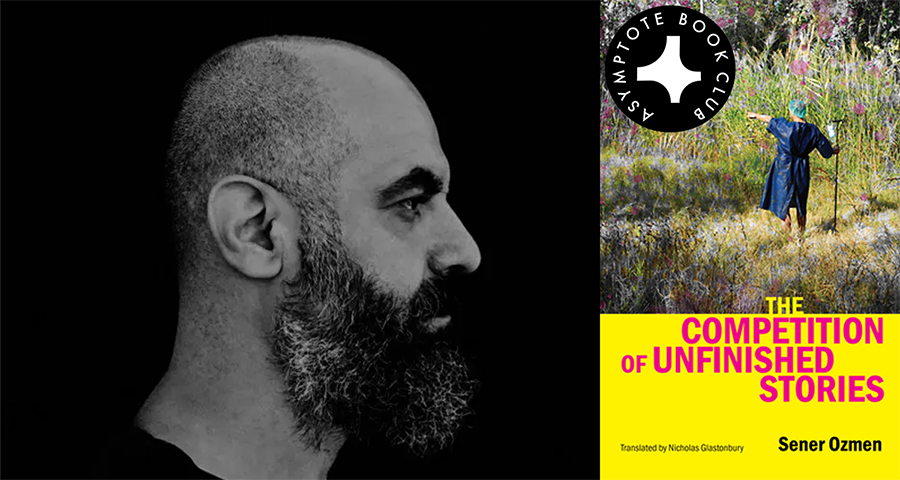
Announcing Our November Book Club Selection: The Competition of Unfinished Stories by Sener Ozmen

From a Turkish perspective, there is no Kurdistan . . . . Ozmen’s novel meditates on what this effacement does to someone’s subjectivity.

Dizzying, furious, scathing, and absurdist—artist and writer Sener Ozemen’s The Competition of Unfinished Stories is a testament to an identity, region, and language under siege. The novel, with its many layered narratives, confronts the Turkish state’s enduring violence against its Kurdish minority, illustrating the psychic and physical fractures of oppression with intellectual complexity and emotional clarity. In attempting to disentangle the knot of selfhood from a merciless assimilating power and a growingly fragmentary everyday existence, Ozmen builds the architecture of fiction to its most veering heights, capturing all the threads of reality’s illusions, and thus resulting in one of contemporary fiction’s most vivid portraits of psychological dissolution—that which still never turns away from the need to express its truths.

The Asymptote Book Club aspires to bring the best in translated fiction every month to readers around the world. You can sign up to receive next month’s selection on our website for as little as USD20 per book; once you’re a member, join our Facebook group for exclusive book club discussions and receive invitations to our members-only Zoom interviews with the author or the translator of each title.   

The Competition of Unfinished Stories by Sener Ozmen, translated from the Kurdish by Nicholas Glastonbury, Sandorf Passage, 2025

In her book Immemorial, Lauren Markham notes that “the feeling of grieving something that isn’t yet gone, and whose disappearance isn’t fully certain . . . is an eerie, off-putting one.” This liminality and its disquieting effect are what animates Sener Ozmen’s The Competition of Unfinished Stories, deftly translated by Nicholas Glastonbury. This is not only the author’s debut in the Anglosphere, but one of the first works written in Kurdish’s northern Kurmancî dialect to receive an English translation.

Ozmen is a prolific Kurdish writer and multimedia visual artist, the author of numerous books of poetry, novels and short stories, criticism, and artist books. Across his written oeuvre and artistic practice, he has drawn attention to both the urgency and difficulty of speaking from a position of marginalization; The Competition of Unfinished Stories, originally published in Kurmancî as Pêşbaziya Çîrokên Neqediyayî in 2010 and translated into Turkish as Kifayetsiz Hikâyeler Müsabakası in 2015, follows in this spirit. The novel dramatizes—in a challenging and disorienting way—that the stories one tells are always co-authored and situated, demonstrating the interrelatedness and imbrication of the self. As Judith Butler observes in Giving an Account of Oneself, “When the ‘I’ seeks to give an account of itself, an account that must include the conditions of its own emergence, it must, as a matter of necessity, become a social theorist.”  READ MORE…

Weekly Dispatches From the Frontlines of World Literature

Updates from Mexico and Palestine solidarity around the literary world.

This week, our editors share news of solidarity, legacy, and cross-cultural connection. Around the world, the literary world is showing up to express support for Palestine, with the Palestine Festival of Literature continuing their crucial work of uplifting work that urges us towards compassion, the Palestinian struggle, and a condemnation of violence. In Mexico, some of the greatest writers in Latin-American history are celebrated for their efforts in connecting their nation to a greater, global heritage of letters. Read on to find out more!

Carol Khoury, Editor-at-Large, reporting from Palestine

In a historic demonstration of solidarity, the Palestine Festival of Literature (PalFest), Writers Against the War on Gaza, and Amplify Palestine have come together to organize the event “Freedom to Write for Palestine,” held on May 7 at Judson Memorial Church in New York City. This significant gathering brought together writers who had withdrawn from PEN America’s World Voices Festival and the PEN America Literary Awards, condemning the organization’s failure to support Palestinian writers facing violence and displacement in Gaza. The unprecedented withdrawal of dozens of authors led to the cancellation of both PEN America events just weeks before their scheduled dates.

The program featured opening remarks by Nancy Kricorian and an introduction by Derecka Purnell, and included powerful readings and stories from Michelle Alexander, who read the work of Haya Abu Nasser, and Mohamed Arafat, who shared his family’s harrowing experiences. Evie Shockley read pieces by Fady Joudah, while Nicholas Glastonbury presented an insightful commentary on the Palestinian struggle. The event can be watched in full here. READ MORE…