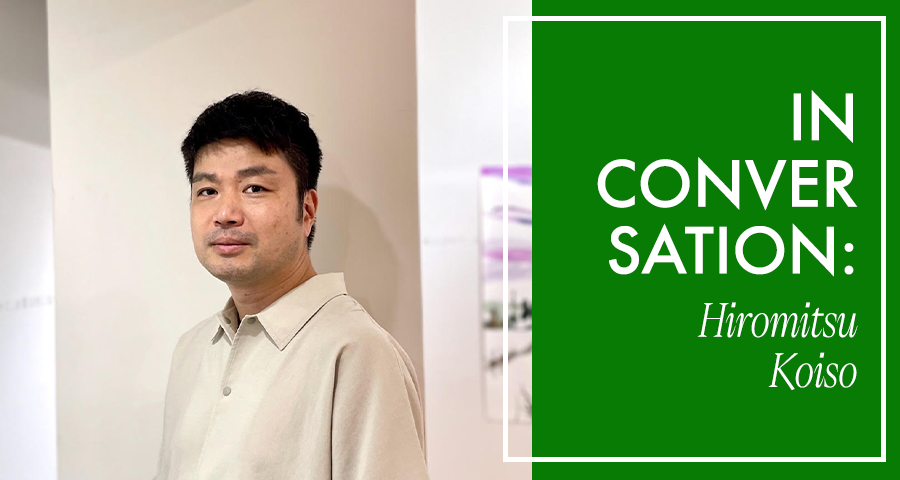
Hiromitsu Koiso’s path to becoming one of Japan’s most ruminative literary translators was anything but linear. It began, as he recounts, in the second-hand bookshops of western Tokyo, poring over paperbacks and comparing translations by seasoned Japanese translators, a sort of discipleship that would later lead him on a peripatetic route to the MA in Literary Translation and MA in Creative Writing (Poetry) programmes of the University of East Anglia in Norwich, United Kingdom. His body of work reveals a translator who is attuned to works of hybridity and gravitas, from the Sebaldian solivagant of Teju Cole’s Open City to the mythopoetic vestiges of Anne Carson’s Autobiography of Red. This extends to the works of Ocean Vuong, Isabella Hammad, Grayson Perry, Noor Hindi, and Ursula K. Le Guin, as well as more recent translation projects like Carson’s Wrong Norma (published on 10 January by honkbooks’ thoasa) and Bryan Washington’s Memorial (forthcoming in Spring 2026). He has also co-translated Japanese poets Kamiyu Ogyu, Naha Kanie, and Ayaka Satō into English.
When asked about influence, Koiso speaks less of particular poetic lineages and more of situating himself within and against literary history, and of navigating the orientalising gaze directed at Asian writers: a “gaze [that] shapes both how we are read and how we respond, creatively and intellectually.”
In this interview, I spoke with Koiso (who is in Tokyo) about his unorthodox career trajectory, the immersive craft behind recasting specific genres and texts, and the poetic reflection underpinning his work as a poet and translator who seeks to meditate on “how one’s present moment can be placed in relation to a much longer history.”
Alton Melvar M Dapanas (AMMD): Koiso-san, I want to begin with how you started as a translator. As a university student, you pored over Paul Auster and J.D. Salinger paperbacks at the second-hand bookstore Nishi Shoten in Kunitachi. By comparing your early attempts with the translations of seasoned practitioners like Motoyuki Shibata and Takashi Nozaki, you developed an appreciation for the craft. Yet you didn’t pursue translation right after university. So, what were the key moments that ultimately led you here?
Hiromitsu Koiso (HK): After graduating from university, I wanted to work in literary translation, but I had no idea how to enter the profession. Throughout my twenties, I worked various jobs while studying and trying to find my way into the field. I took temporary positions, worked in offices, saved money, and eventually decided to pursue postgraduate studies at the University of East Anglia in the UK.
I first learned about UEA’s MA in Literary Translation program and a particular centre for literary translation through the Japanese translations of W. G. Sebald. Discovering that Sebald had taught at UEA and helped establish the translation centre made a deep impression on me. I felt strongly that I wanted to study Literary Translation in the very place where he had lived, taught, and built a community for translators. READ MORE…