
Posts featuring Božena Němcová

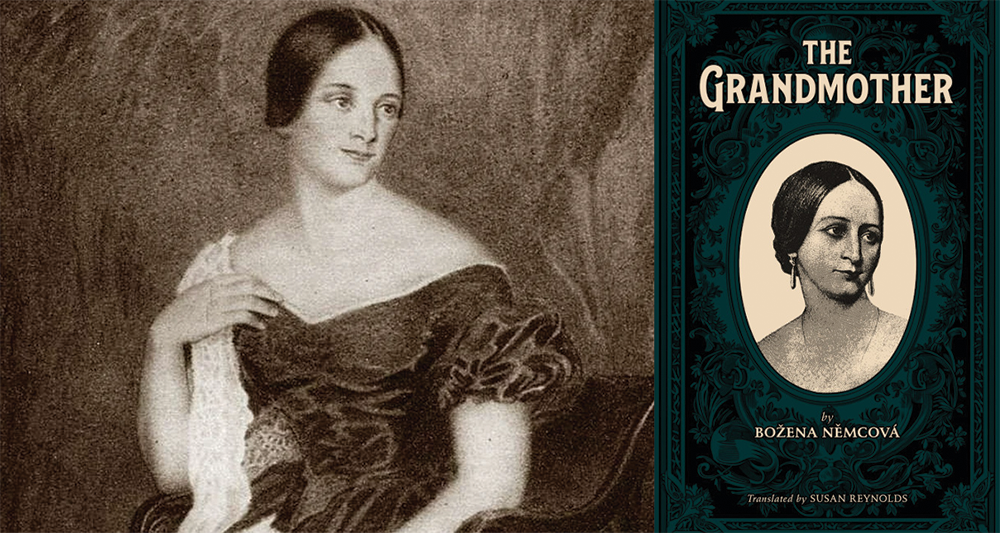
The Reclamation of Culture: A Review of The Grandmother by Božena Němcová

The Grandmother is an extollation of a whole people whose language, identity, and existence has withstood a subterfuge erasure.

The Grandmother by Božena Němcová, translated from the Czech by Susan Reynolds, Jantar Publishing, 2025

Just over two years ago, Professor Libuše Heczková, director of the Institute of Czech Literature and Comparative Studies at Charles University, Prague, delivered a seminar spotlighting the life, activism, and legacy of Milada Horáková, a Czech politician and staunch resistance member against both the Nazi Germany and Communist Czechoslovak regimes. Horáková’s advocacy was rooted in preserving democracy and women’s rights, defining a feminist as ‘a woman . . . who . . . consciously and responsibly chooses and cultivates chiefly those [qualities] in which there is a genuine, objective contribution to the broadest existing community in human society’. It is precisely this nuanced outlook which is present in Božena Němcová’s Babička, brought to us in English by Susan Reynolds as The Grandmother and released by Jantar Publishing late last year—some one hundred and seventy years after the novel’s first publication.

The Grandmother follows the life of the titular woman who leaves her natal village to go live with her daughter and her family, comprising of four children and a German, non-Czech-speaking husband. The novel’s plot is by no means linear, resembling more a collection of vignettes, with each chapter focusing on a particular episode in the characters’ lives, or imparting a story either from Grandmother’s past or from Czech legend. READ MORE…
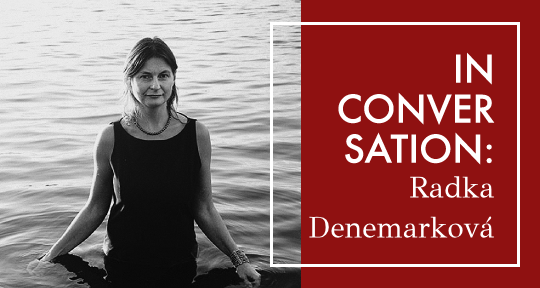
Small Streams That Grow into the Main Flow of the Novel: An Interview with Radka Denemarková

I just want to speak the truth because I cannot stay silent about the pain affecting others.

Radka Denemarková is a unique phenomenon on the Czech literary scene. A true polymath, she has written plays, scenarios, short and long novels, a double novel that can be read from both ends, translations, and essays. On April 7, she was awarded the Book of the Year award at the Magnesia Litera ceremony, making her the only four-time winner of the most prestigious literary award in the Czech Republic. Her most noticeable works include Money from Hitler (2006), which tells the story of a Holocaust survivor who returns to her home village in Czechoslovakia only to be denied existence; Sleeping Disorders, a humorous play featuring Virginia Woolf, Sylvia Plath and Ivana Trump; and A Contribution to the History of Joy (2014)—of which Asymptote published a partial translation—a reflection on violence disguised as part essay, part crime novel. Finally, her most recent novel is Lead Hours, a major work expanding over 700 pages, spanning China and Europe, and exploring the fate of a series of characters witnessing the crumbling of their value system as they face life crises. Denemarková was also featured in Asymptote as a translator, and is now translated into over fifteen languages, including Chinese. She is currently working on her next novel.

Filip Noubel (FN): Your latest novel, Hodiny z olova, which can be translated as Lead Hours, just came out in January. What does the title refer to, and why is China such a prominent theme in this 700 page-long major work? 

Radna Denemarková (RD): The reason for China being the center stage of my novel comes out of a series of trips I made to that country, the first in 2013. I was literally shocked by what I experienced there: the breaking down of a socio-political system combined with the consequences of globalization, and how all of this affects us in the most intimate way. Initially, I had a very idealized notion of China, shaped by the little knowledge I had about its poetry, calligraphy, and philosophy. What I hadn’t expected at all was the brutality of daily life.

The main issue in China we face concerns how economic pragmatism changes the human soul, and how we can bring back the notion of humanism in our daily language. While the world seems to embrace new forms of totalitarian ideologies, we need a new language. People are afraid to speak openly. People report on each other even within the family circle. In Beijing, in the case of a car accident, people accepted as normal the fact that the male driver of an expensive car hit a woman because she was poor and uneducated and had no business ‘getting in the way.’

READ MORE…