
Place: Mexico

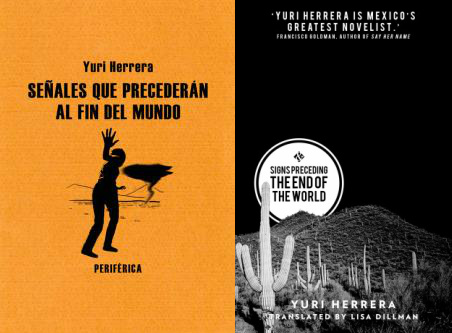
In Review: “Signs Preceding the End of the World” by Yuri Herrera

Ethan Perets reads a new novel sure to be considered "an enduring document of world literature."

What kind of journey begins without the possibility or intention of return? And what kind of person sets out, all the while knowing this to be the case?

Tales of the epic quest often take such questions as starting points. But the latest novel from contemporary Mexican writer Yuri Herrera, titled Signs Preceding the End of the World, rejects each of these questions from the outset.

Recently translated into English by Lisa Dillman for And Other Stories, Signs Preceding the End of the World focuses on Makina, a young Mexican woman, as she travels from her rural village across alien towns, ice-green rivers and black mountain passes searching for her brother north of the U.S.-Mexico border. Equipped with the determination to return home after a short trek across the border, she leaves with few provisions, which include, among other things, “one white blouse and one with colorful embroidery, in case she came across any parties.”

As Makina meets up with the “top dogs” in her town who arrange for her trip, Herrera offers a glimpse of the men that loom behind Mexican organised crime: Mr. Double-U, “a joyful sight to see,” the hustling Mr. Aitch, who hangs with his gang of misfits at the literarily-named drinking establishment Pulquería Raskolnikova, and the tight-lipped Mr. Q, who “never resorted to violence—at least there was nobody who’d say he did.” Besides adding a touch of Tarantino-esque flair to these shady characters, Herrera essentially establishes a novel of personalities. Biggest among them is Makina herself. READ MORE…
Octavio Paz New York Centennial: Perpetually Creating Rhythm

A dispatch honoring one of Mexico's most celebrated poets

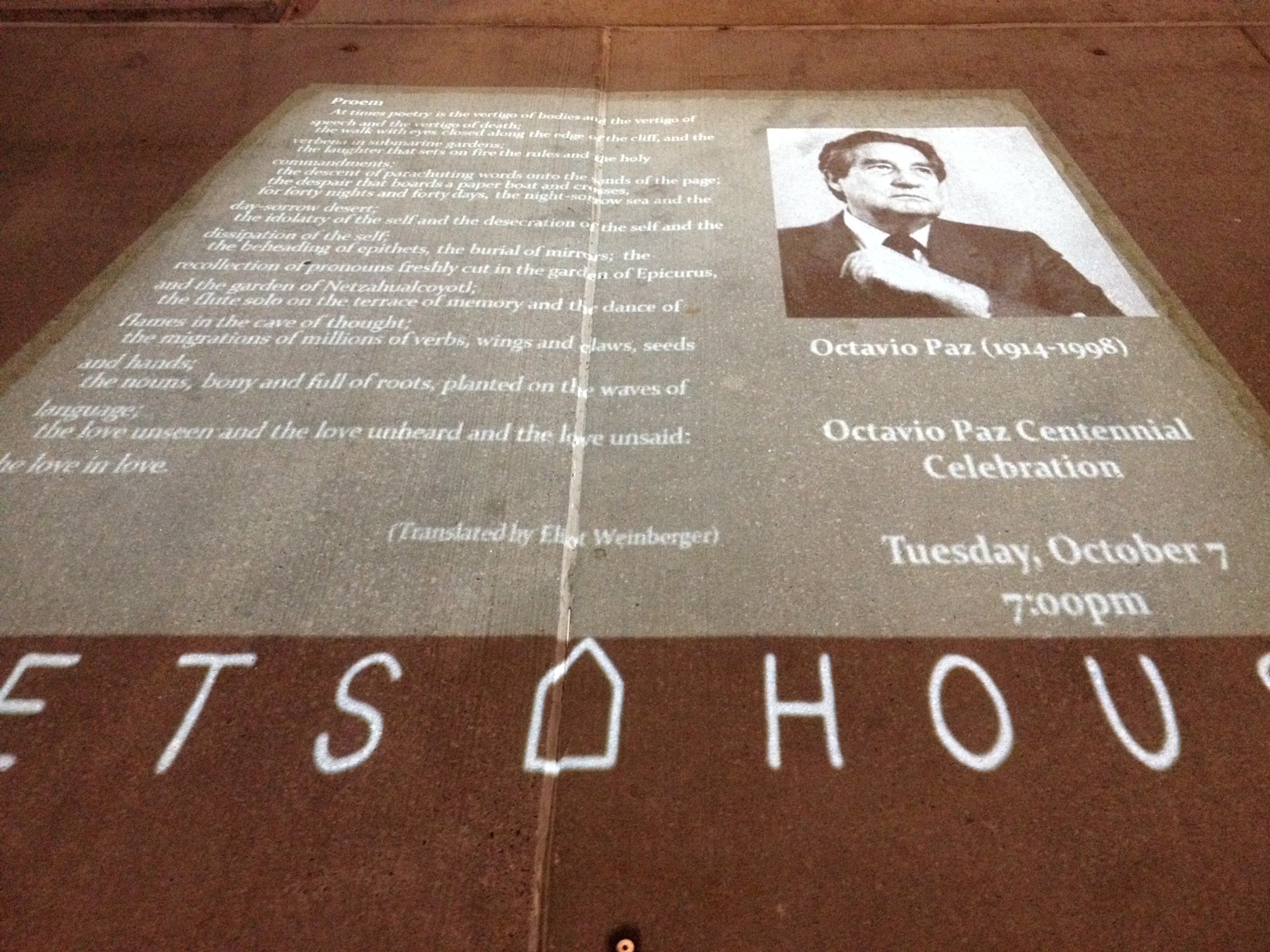
From October 1st to the 8th, the Mexican Cultural Institute of New York paid tribute to the centennial of Octavio Paz’s birth with a series of discussions, readings, concerts, and film screenings. A prolific poet, essayist, intellectual, translator, editor, publisher, and diplomat, Paz published his first poetry collection, Luna Silvestre (Wild Moon, 1933) at 19 years old, penning over 26 volumes of poetry until his death in 1998. Paz was also an accomplished essayist: his 1950 treatise on Mexican identity, El laberinto de la soledad (The Labyrinth of Solitude) is considered a seminal work of literature. The recipient of the Cervantes award in 1981, the American Neustadt Prize in 1982, and the Nobel Prize in Literature in 1990, Paz founded three literary magazines, Taller, Plural, and Vuelta; Vuelta is still published as Letras Libres.

Now that we’ve gotten that dry but necessary introduction out of the way, let me truly begin.

The centennial celebration was a sumptuous banquet I wanted to gorge myself on until I developed gout, like those rich men of old. I eagerly chased Paz throughout New York City, from the second-floor gallery of the Mexican Consulate in Midtown to the ornate ballroom of the Americas Society in the Upper East Side, and finally to where the river meets the city, the “navel of the poetic universe,” as Paz’s translator Eliot Weinberger playfully referred to the Poets House in TriBeCa.

READ MORE…

Say Ayotzinapa

A special feature in 20 languages: presenting David Huerta’s “Ayotzinapa” with an introduction by Faces in the Crowd-author Valeria Luiselli

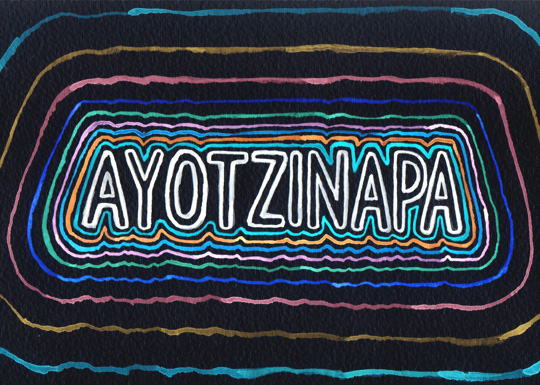
David Huerta wrote “Ayotzinapa” on November 2, 2014, “in anger, outrage, and horror.” It has already formed an installation at the Oaxaca Museum of Contemporary Art, been printed by Juan Nicanor Pascoe’s letterpress, and been read and excerpted in protest banners from Berlin to Xalapa. When I read it two weeks ago, I realised there was a very practical way for Asymptote, as a journal of international literature, to communicate Mexico’s rallying cry for change and justice in multiple languages. Juana Adcock’s English translation was the first in a chain that now stretches from Mexico to Scotland, China, Romania, Israel, Indonesia, Brazil, Greece, and beyond. Asymptote’s global “Ayotzinapa” has become a poetic event, an audible coming-together, which is one constructive way of responsibly renewing the word Ayotzinapa, as Valeria Luiselli suggests we must do in her introduction to the poem. All of the translations begin with the same, untouched word, Ayotzinapa; like David, all of our translators took pains to get across—rephrasing the Greek poet C. P. Cavafy—what these Ayotzinapas mean.

Below you can read and listen to David Huerta’s original Spanish-language poem. You can also use the drop-down menu like a map to read translations of his poem in 20 languages. Listen, too, to our translators’ audio recordings, and particularly to their pronunciation of the unchanged title, “Ayotzinapa.” Above all, this global translation is about resisting the state of speechlessness that is easy to fall into when what you are witnessing is beyond imagination; about learning how to say Ayotzinapa; about stopping the word Ayotzinapa from being a strange, unrelated Mexican sound. #WeAreAllAyotzinapa #WritersWithAyotzinapa — Sophie Hughes, Editor-at-large, Mexico

READ MORE…