
Posts featuring Walid Daqqa

Weekly Dispatches From the Frontlines of World Literature

The latest literary news from Palestine, India, and Bulgaria!

This week’s dispatches from our editors-at-large make clear the power of literature in translation to cross borders and enlarge perspectives. From a report on a beloved literary festival that feels like a trip around the world, a breakout hit that is bringing local literature to a global stage, to an award ceremony honoring a novel that will reach millions held while its author was in solitary confinement, read on to find out more.

Shatha Abd El Latif, Editor-at-Large, Reporting on Palestine

Basem Khandakji, freed Palestinian prisoner and Arabic Booker Prize winner, is set to release the first translation of his novel A Mask, the Colour of the Sky in English come March 2026. Khandakji won the Arabic Booker for this work back in 2024 while he was still imprisoned by the Zionist authorities before his was freed as a part of prisoner exchange deal and exiled to Egypt in 2025. In the wake of the Booker Prize win, Khandakji was punished with solitary confinement for twelve days. (Khandakji is not the first imprisoned Palestinian writer to be the subject of colonial torture following a historic achievement; Walid Daqqa, author of The Oil’s Secret Tale, and his family were attacked by Israeli police after his work was published from prison.) Khandakji’s family, radical bookshop owners in the eastern side of Nablus, Palestine, received the award on his behalf in Abu Dhabi.

Translated by Addie Leak and published by Europa Editions, the prison-born 2023 text will become available to Anglophone readers for the first time three years after its publication by Dar Al Adab in Beirut, Lebanon. Khandakji’s novel is the first in a trilogy, the final book of which will become available to readers in Arabic early this year. Khandakji’s epic work, concerned, in entangled ways, with ruthless and wresting truths about language, identity and the terrors of Zionism in Palestine, is coming out in English at a boiling point in history. As states and institutions become more hostile against Palestinians by the hour, one wonders what new trajectory will Khandakji’s work take in this light. READ MORE…
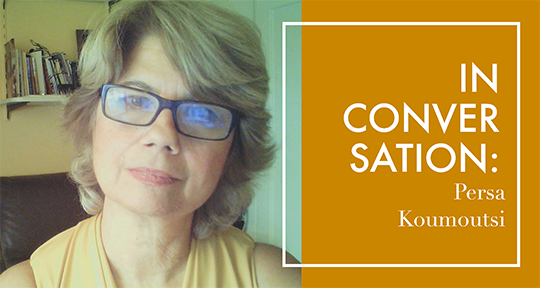
Towards a Greater Social Consciousness: Persa Koumoutsi on Translating Arabic Literature Into Greek

If a text is written simply to express our personal wants or concerns, it is not literature, in my view, but a form of self-centered expression.

Born and raised in Cairo, Persa Koumoutsi is a literary translator and a writer. Having returned to Greece after completing her studies at the Faculty of Arts at Cairo University, she began focusing solely on translating Arabic literature into Greek in 1993. She has since worked on the works of many distinguished authors, including fourteen novels by the Nobel Prize-winning Egyptian author Naguib Mahfouz, as well many Arab poets. Her bibliography includes the first Anthology of Contemporary Arabic Poetry in Greek, for which she received the First Prize of the Hellenic Society of Literary Translators in 2017. Among her other works, the Αnthology of Modern Arabic Female Poetry was also widely lauded in 2022. She has also published the Αnthology of Palestinian Poetry and the Anthology of Egyptian Poetry.

In this interview, originally conducted in Greek, I spoke with Persa about the renewed interest in Palestinian literature in times of genocide, the importance of translation as a means to make struggles known and build solidarities beyond human borders and language barriers, prison literature, as well as the future of Arabic translation in Greece. The latter concerns not solely translation for the sake of itself, but as a powerful tool to bring forth voices of those marginalized.

Christina Chatzitheodoru (CC): Since October 7 and the ongoing genocide, several young Arab writers and poets have been translated into Greek, including your recent translation of Najwan Darwish. There is a renewed interest in Palestinian literature in particular. Can you tell us more about this?

Persa Koumoutsi (PK): Of course there is a renewed interest, not only in Greece but all over the world, especially in Europe. The tragic events in Gaza have brought to the fore an unspeakable tragedy, and thus many of my colleagues and translators around the world—and in Greece—have devoted themselves to translating works that highlight this problem and its dimensions, as well as its impact on our collective and individual consciousnesses—especially those of whom are concerned with contemporary Arabic culture and its literature. One such work is a collection by the renowned Palestinian poet Najwan Darwish entitled, in Greek, I Kourasi ton Kremasmenon (Exhausted on the Cross), which, as the title suggests, alludes to the enduring pains of the Palestinian people, the irredeemable trauma, and the grievous injustice they have been inflicted upon them. Poetry, in my opinion, is the most powerful literary genre in these cases, since everything can be said and highlighted through the condensed word of poetry. . .

CC: The Palestinian writer and revolutionary Ghassan Kanafani once stated: “My political position springs from my being a novelist. In so far as I am concerned, politics and the novel are an indivisible case, and I can categorically state that I became politically committed because I am a novelist, not the opposite.” How does this view relate to your own approach to translation? READ MORE…