
Posts featuring Alice Oswald

Weekly Dispatches From the Frontlines of World Literature

The latest literary news from Palestine, India, and Bulgaria!

This week’s dispatches from our editors-at-large make clear the power of literature in translation to cross borders and enlarge perspectives. From a report on a beloved literary festival that feels like a trip around the world, a breakout hit that is bringing local literature to a global stage, to an award ceremony honoring a novel that will reach millions held while its author was in solitary confinement, read on to find out more.

Shatha Abd El Latif, Editor-at-Large, Reporting on Palestine

Basem Khandakji, freed Palestinian prisoner and Arabic Booker Prize winner, is set to release the first translation of his novel A Mask, the Colour of the Sky in English come March 2026. Khandakji won the Arabic Booker for this work back in 2024 while he was still imprisoned by the Zionist authorities before his was freed as a part of prisoner exchange deal and exiled to Egypt in 2025. In the wake of the Booker Prize win, Khandakji was punished with solitary confinement for twelve days. (Khandakji is not the first imprisoned Palestinian writer to be the subject of colonial torture following a historic achievement; Walid Daqqa, author of The Oil’s Secret Tale, and his family were attacked by Israeli police after his work was published from prison.) Khandakji’s family, radical bookshop owners in the eastern side of Nablus, Palestine, received the award on his behalf in Abu Dhabi.

Translated by Addie Leak and published by Europa Editions, the prison-born 2023 text will become available to Anglophone readers for the first time three years after its publication by Dar Al Adab in Beirut, Lebanon. Khandakji’s novel is the first in a trilogy, the final book of which will become available to readers in Arabic early this year. Khandakji’s epic work, concerned, in entangled ways, with ruthless and wresting truths about language, identity and the terrors of Zionism in Palestine, is coming out in English at a boiling point in history. As states and institutions become more hostile against Palestinians by the hour, one wonders what new trajectory will Khandakji’s work take in this light. READ MORE…
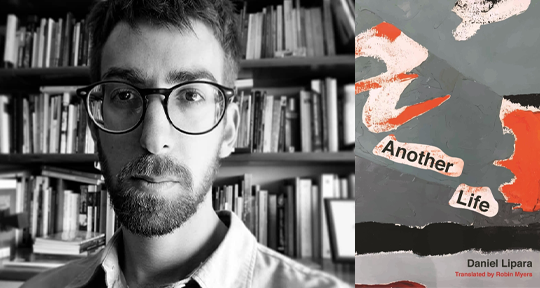
Of the Quotidian and the Epic: On Daniel Lipara’s Another Life

"Another Life" is a tiny cosmos, a subtle and refined explosion, a bursting ocean with waves crashing on a nearby and familial shore . . .

Another Life by Daniel Lipara, translated from the Spanish by Robin Myers, Eulialia Books, 2021

The first poem in Daniel Lipara’s debut collection Otra vida, released in English as Another Life (Eulalia Books, 2021), is a page and a half long. Entitled “Susana, lotus flower,” it lasts a lifetime. Many lifetimes. The poem is sweet and painful, excruciating and grotesque, charged with fragility and hope and tenderness and memory (“her father the son of a butcher who fled the pogroms all the way to Argentina”), visceral with pain (“they shrank her stomach with a belt the belt snapped open scratched her innards”), and void of commas. It’s as vivid as it is memorable, and it sets the tone for the rest of the book.

Another Life is a family album laced with beautiful writing; I like to think of the poems as spotless, multichapter vignettes, quickly spun by a well-oiled stereoscope. In Lipara’s ranging collection, we follow a family—a very real and flawed family—moved and motivated by love, grief, and hope, as told to us by a narrator in awe with his surroundings.

After pious aunt Susana of the opening poem, we read about Jorge—the father, “the tiller (. . .) and master griller,” and later Aeolus, the god of the wind. As personal and intimate as Lipara’s work feels, the narrator also becomes preoccupied with what plays out in the greater background, with its history, characters, tales, and myths. In this, Another Life feels both quotidian and epic. Soon after, we meet Liliana, the mother, who is “five foot nine she has big bones and bleach blond hair” and is dying of cancer, though we don’t learn about this until later. (It is hinted at subtly, however, during her first appearance: “(she) lays her hands onto my mother’s vengeful cells.”)

After this introduction, we meet Sai Baba of India; Liliana will travel to his ashram looking to cure her cancer. This journey is first introduced as a premonition: “I dreamed we went to India and your mother was healed,” says Susana. Then we see the family waiting at the airport, on the plane, and reaching Indira Gandhi Airport. We see water buffalos. We see rice fields. We see India through the eyes of a young Daniel, and we see him experiencing the country, silently amazed by its colors, odors, sights, and sounds—again being drawn into the background with its world of fascination, again merging the quotidian and the epic.

READ MORE…