
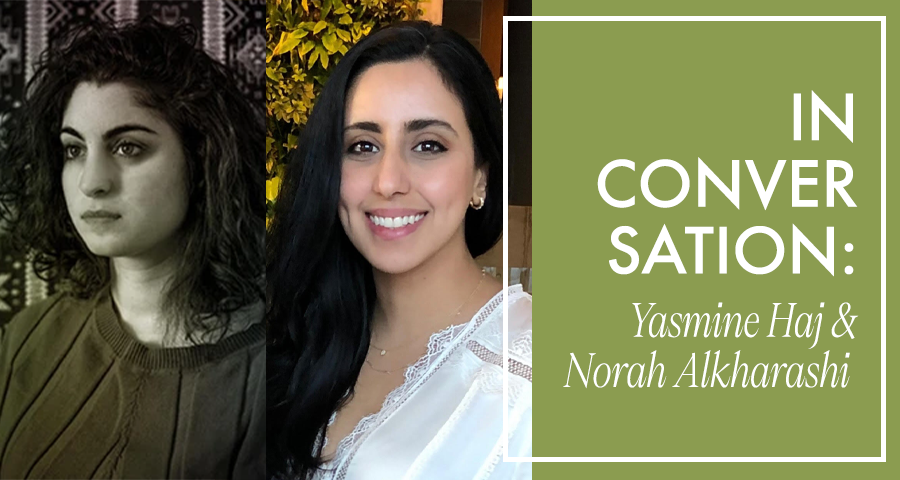
In Arabic, the word for ‘love’ (حب) is nearly identical to the word for ‘war’ (حرب), differing by just one letter. The nearness and linguistic kinship between these two words is a felicitous metaphor for the tropes examined in the poetry anthology Arabic, between Love and War, published by Tkaronto, Canada-based trace press.
Arabic, Between Love and War assembles important voices from across the Arabophone world, such as Nour Balousha of Palestine, Najlaa Osman Eltom of Sudan, Rana Issa of Lebanon, Qasim Saudi of Iraq, as well as diasporic Arab poets in Canada, the United Kingdom, Sweden, and the United States. Edited by Palestinian poet Yasmine Haj and Saudi translator-scholar Norah Alkharashi, the anthology features poems translated from Arabic into English and vice versa, a number of which have garnered accolades such as the Lambda Literary Award, Atheer Poetry Prize, Arab American Book Award, and appeared in poetry collections published in Damascus, Beirut, Juba, California, Basrah, Algiers, and beyond.
In this interview, I spoke with both Haj (in Paris, France) and Alkharashi (in Ottawa, Canada) about the anthology and the ways in which the poetry of love and poetry of war converge.
Alton Melvar M Dapanas (AMMD): Congratulations to both of you on this riveting anthology, Arabic, between Love and War! How did this book come to be, and how is it particularly relevant and urgent today?
Yasmine Haj (YH): Thank you, Sam. This book is the epilogue to a workshop organised by trace press, ‘translating [x]’, in which Norah and I co-facilitated six online sessions on literary translation from Arabic. As we structured the workshop, we were drawn to the aesthetic of the words love and war in Arabic, and how the removal of one letter throws one word into its apparent opposite. We discussed the idea with the participants, some of which mentioned how tired they were of our world being discussed through the prism of war. This was in late 2022, early 2023, before Zionism heightened its genocide of Gaza and any reminder of indigeneity. We had no idea we would be editing this volume, with all its submissions, as we watched Palestine oscillate between those very two words, and other genocided lands fluctuate right along with it. Love of land, of people, and war waged upon that very existence, have been ongoing for more than a century, adding to the six hundred years of imperial annihilation and substitution.
The poets were selected by the contributing translators themselves. As editors, we simply tried to arrange a potential conversation that would hold them all together. When contexts like our own become unfathomable to their contemporary subjects, seeking past texts can help reframe them, to offer solace through such untranslatable times, or perhaps usher in a word or two to help us understand, interpret. In the context of a neoliberal freefall, being able to interpret reality is a gem of a parachute: para, as protection against; chute, as fall.
Norah Alkharashi (NA): Arabic, between Love and War emerged from a shared desire to listen more closely to how translators, writers, and readers from the Arab world are speaking to our times—through tenderness, resistance, and the small acts of care that sustain language in difficult conditions.
The anthology took shape during a period marked by displacement, when the question of how Arabic travels between regions, between exiles, between loves, between wars, felt both personal and collective. As editors, we wanted to create a space where translation isn’t just a bridge but a form of companionship, between poets, readers, and the worlds they inhabit, between languages that hold memory.
Its urgency lies in that. These voices remind us that translation is not only about moving words across borders, but about holding space for what resists translation, what trembles between beauty and loss. In that sense, the book is also a document of solidarity, an archive of presence amid fragmentation.
These ‘translating [x]’ sessions mentioned by Yasmine were not conventional translation workshops but collective experiments in reading, translating, and thinking together across languages and geographies. During them, we noticed how the words love and war kept recurring, in different registers and intensities; love appeared as tenderness, care, and the fragile commitment to language itself; war as fragmentation, loss, and the structures that silence or displace. We began to see how these two poles shaped much of the Arabic literary and political imagination—not as opposites, but as intertwined forces. The title, Arabic, between Love and War, felt like a natural reflection of what the workshops revealed: that to translate, to listen, and to stay attentive to one another is, in itself, a form of resistance.
AMMD: As for this idea of translation as a space for conversation that goes both ways, the bidirectional translations in this anthology are commendable. We have Arabic poems by Lamia Abbas Amara and Nour Balousha recast into English by Hiba Moustafa and Nashwa Nasreldin respectively, and English poems by Lena Khalaf Tuffaha rendered into Arabic by Mariam Naji. What prompted this editorial choice which, I must say, is quite unconventional among bilingual titles published in the North Atlantic? How do you think these translations elevate the anthology and the conversations that it impels?
NA: The bidirectional structure felt essential to the anthology. From the beginning, we didn’t want Arabic to appear only as the source text, nor English as merely the target language. The workshops themselves were multilingual and reciprocal spaces where translators moved freely between Arabic and English, often translating both ways. That fluidity mirrored how many of us live and think across languages, in translation, always negotiating meaning and belonging.
Including poems that travel in both directions within the same book was a way to honour that reality. It acknowledges that Arabic and English—or any languages for that matter—are not hierarchically related but in constant dialogue. Translating Arabic into English allows certain histories and emotions to find new readers. Translating English into Arabic returns that gesture, expanding the conversation and unsettling the unidirectional flow that so often defines global publishing. This reciprocity, I believe, elevates the anthology by making it less about representation and more about relation—about what happens when languages meet on equal terms. It invites readers to feel translation not as an act of transfer, but as a form of correspondence and care.
The bidirectional translations deepened our understanding of love and war as relational forces rather than fixed themes. When we brought Arabic and English into reciprocal movement, we began to see how each language carried a different emotional, ethical charge. Translating Arabic into English, as in Hiba Moustafa’s work on Lamia Abbas Amara’s ‘For Love I Sing’, revealed how tenderness and endurance coexist in the same breath, where love becomes an act of remembering amid loss. In English, this tenderness reads almost liturgical. In Arabic, it pulses with defiance.
Meanwhile, translating English into Arabic, as in Mariam Naji’s rendering of Lena Khalaf Tuffaha’s ‘Water and Salt’ and ‘Time Travel’, reversed that current. Through Arabic, Tuffaha’s language of diaspora, resilience, and survival found a new rhythm of belonging. The Arabic versions return English to a landscape of memory and resistance, reminding us that love and war are lived not as metaphors but as conditions that demand translation into words and lives.
This process also reframed war as a form of intimacy. In Nour Balousha’s ‘Feet Unable to Arrive’, translated by Nashwa Nasreldin, the longing for return merges with the ache of displacement. The Arabic original speaks from the interiority of loss, while the English translation invites readers to inhabit it empathetically and physically. Similarly, my translation of George Abraham’s ‘Field Notes on Terror & Beginnings’ into Arabic turns a poem written about occupation, grief, and body into something unsettlingly proximate—war rearticulated through an Arabic lexicon of tenderness and mourning.
Through these pairings, we realised that love and war are not opposites but parallel grammars, each shaping how the other is imagined. Anthologising both directions in one book revealed that translation itself is an act of survival: to love through the violence of history, to write across the wounds of language. I hope both Arabophone and Anglophone readers receive this approach as an invitation to listen differently, to encounter translation as a shared dwelling, a living space in the in-between.
AMMD: Yasmine, you translated the Mostafa Al-Hosseiny Prize-winning Iraqi journalist and poet Omar Aljaffal’s ‘The Living is Hard’ into English. Norah, you translated the Lambda Literary Award-shortlisted Palestinian poet George Abraham’s ‘Field Notes on Terror & Beginnings’ into Arabic. Could you walk us through your respective translation processes?
YH: With every text I’m about to translate, I imagine the music it might hold and I try to match it in another language, or at least converse with it as the language requires. The process is usually about maintaining rhythm. The rest is trying to pick, from a myriad of words, the one that seems to want to stay the most. Omar Aljaffal’s poem, for instance, follows a nonchalant rhythm superimposed over an arpeggio of sombre freedom in Arabic. In English, I tried to maintain a matter-of-fact rhythm and the baritone it choreographs. Bari, as heavy; tone, as resonance.
NA: Translating Abraham’s ‘Field Notes on Terror & Beginnings’ was an intimate and humbling experience. The poem’s movement resists the act of pause; it is anti-lyrical in a sense, unfolding like a continuous breath. There’s no rhythm in the conventional sense, but rather a momentum that sweeps you into the fields of violence and tenderness grounded in Palestinian street life.
My task wasn’t simply to translate meaning, but to listen closely to the cadence, the way grief and beauty of expression coexist in each image, in each line. Arabic, with its expansive metaphorical range, offered room to navigate this layered terrain, though not without tension. Some phrases had no parallel. Others needed to be gently reimagined to resonate. Throughout, I remained in conversation with George, and Yasmine as my editor. The process felt less like a solitary act and more like a quiet, ongoing dialogue and a lot of active listening.
AMMD: That brings me to the different lenses you each offered in your introductory essays. While Norah’s inquisitive foreword (‘Between Impossibility and Necessity’) presents translation as a bridge for mutual understanding, Yasmine’s lyrical preface (‘To Speak to Each Other’) frames translation as a means of resistance and liberation. How do you think these varying approaches intersect, and perhaps reconcile, in practice?
NA: I think they meet precisely in the space where translation becomes both an act of care and an act of contradiction. My reflection approaches translation as a bridge, one that acknowledges the limits of language yet insists on crossing anyway, trusting that understanding is made not through equivalence but through presence and attention. Yasmine’s, in turn, reclaims translation as a political and artistic practice, a refusal to remain silent, a way of speaking back to systems that shatter or erase.
In practice, these two approaches are not contradictory; they form the tension that gives the anthology its verve. When Hiba Moustafa translates Lamia Abbas Amara’s ‘For Love I Sing’, she bridges the distances of time and culture, yet her act is also one of reclamation, ensuring that a woman’s voice from mid-century Iraq continues to speak to our present. When Mariam Naji renders Lena Khalaf Tuffaha’s ‘Water and Salt’ into Arabic, she performs the reverse. She restores an English poem about occupation and endurance to the linguistic terrain from which its emotion originally draws strength.
What unites our two perspectives is a shared belief that translation is about inhabiting distance, which is where language becomes sometimes tender, sometimes confrontational, to depend on the same commitment: to listen deeply and to refuse disappearance.
YH: One way to ensure continuity and resist forced disappearance is building collective bridges. The more we bridge our languages, the more effective our collective resistance can be. To me, it is a musical creation, in which the less in unison people are, the less they can do. Uni, as one; sono, as sound. A passage forged between people across struggles can pave the way for coordinated, but locally tailored, liberations. In the Book of Genesis 11:6, it is written: ‘Indeed, the people are one and they all have one language . . . now nothing that they propose to do will be withheld from them.’ In a Babylonised world, to speak to each other is the first step towards building together. Translation can help articulate collective proposals.
AMMD: Norah, in a previous trace press anthology River in an Ocean, you’ve written about translating the works of Haitian-American novelist and short story writer Edwidge Danticat for Arabophone readers. Could you share the challenges you were forced to contend with while translating her collections? And what significance did her writings hold for you on a personal level, as a woman and an immigrant from the Global Majority, like Danticat?
NA: Translating Danticat was a turning point for me. When I first encountered her story ‘Seven’, I was drawn to its quiet intensity and how it holds migration and separation in small gestures. That encounter would eventually shape the course of my literary life. It was through Danticat that I fell in love with translating longer works of fiction and with the layered, sensuous world of Caribbean literature: its cadence, its syncretism, its ability to hold beauty and violence in the same breath. My relationship with literary translation began here, with her sentences that seemed to breathe and break at once.
The challenge was not in the words themselves but in what they carried: history, culture, and lived experience of the collective. Danticat’s text offered a kind of directness not always available in Arabic. I needed to translate not only emotion but the world around it—the foodways, trees, household remedies, and personal names that are part of a community. If flattened or replaced with generic terms, the story would lose its texture and truth.
At the same time, translating Danticat as a Saudi woman also introduced an intersectional dimension. I was translating across geography, gender, and history: from the Caribbean to Arabia, from Creole-inflected English to Arabic, from one Global Majority woman to another. The act felt less like translation across difference and more like translation across kinships, amidst colonial afterlives. Her stories echoed those of women in my own world who live between silence and expression, rootedness and exile. That intersection, between a Haitian American author and a Saudi woman translator, became a quiet dialogue on how we inherit memory, how we write pain, and how we remake belonging. It was also a realisation that translation is inseparable from movement and desire, the desire to make a home in language.
Translating Danticat taught me that these crossings are never neutral. They are marked by race, gender, and history, by who gets to speak and who must carry the silence. For translators of the Global Majority, our task is not only to bridge cultures but to question the power relations that decide which stories travel and which remain unheard. At its most honest, translation becomes a way of writing ourselves into a global conversation built on reciprocity rather than hierarchy.
AMMD: Yasmine, in your poetic essay from River in an Ocean, I love how you named certain complexities by questioning:
How does desire translate? How is it delineated? Or does it rather delineate? How do you pin a place on a map, pick up, and leave, headed there, toward that pin? When escaping war, poverty, or facing forced displacements, how does one go east or west? Is it political, religious, linguistic, or something completely different? A guiding energy of sorts for a certain time and place? An era?
When a translator renders the lived experiences of the displaced from one language to another, what are the questions that should be asked?
YH: I think the questions would depend on the ‘source’ and ‘target’ regions from and into which that displacement takes place. The violence of displacement is determined by who enforces it, under which conditions, and for how long, among others. In a sense, translation is an act of dis/misplacement, moving words and syntax around, superimposing target sounds onto source languages, with punctuation shaping the duration. The violence therein should then be considered as dual: both the lived experiences of the displaced, and the violence of transposing them into a whole other cultural and historical register.
One question to ask would be how that violence can be mitigated, or even hidden, through words. How do they indigenise the music of displacement, how can they sustain, rather than embellish it? And perhaps most important of all is whether those experiences should be rendered at all. Some displacements are best left untranslated, lest their violence turn into voyeuristic excess.
AMMD: So, in light of the rising Islamophobia, anti-Arab racism, and Zionism in global literary spaces marked by persistent settler-colonial sympathies (e.g. Frankfurt Book Fair) and those with histories of deliberate censorship (e.g. PEN America), how do we move from this ethical caution in translation to active praxis of challenge? What should that mean for where we publish, who we platform, and how we engage with these compromised spaces?
YH: Palestinian liberation is not exceptional. It has and will continue to converse with past liberation models, though in its own nuanced way, and will be entwined with the liberation of the Global South. Palestine is one of the latest, and hopefully final, chapters (along with Sudan and Congo, to name two) in a time and space continuum of empire’s enslavement, annihilation, colonisation, and exploitation of the guardians of the Earth, and Earth itself.
Popular education, resistance, financial independence, collective exchange, and ancestral knowledge remain key in countering these narratives and hostile isms. How each of these is carried out remains tied to the specificities of each sea, mountain, river, and valley, to the context of each and every village, town, city, and region. It would depend on the privileges people have or lack there, their access to resources, and the strength of their local and international networks of solidarity, which they would aim to grow. Strategies would be adapted locally in tandem with the broader interregional ones, and regularly questioned, examined, and reshaped to align with the arising truths. The same would apply to strategising and organising in cultural and literary spaces and creations.
NA: It begins, I think, with naming things honestly. What we are witnessing is not simply a series of political disagreements in the arts but the active normalisation of colonial violence, selective empathy, and the systemic silencing of Arab and Palestinian voices. The global literary field, shaped by Euro-American institutions, often disguises its exclusions under the language of neutrality or universal ‘values’. As editors, writers, and translators from the Global Majority, we cannot afford that illusion.
Challenging these structures means refusing to participate in frameworks that thrive on our displacement or tokenisation. It means building and strengthening our own networks such as independent presses, collectives, translation circles, and art spaces that centre our languages, solidarities, and political consciousness. For me, working with trace press and projects like Arabic, between Love and War is part of that resistance. We are creating spaces where translation does not sanitise reality but insists on empathy and truth.
Our creative practices must also become more deliberate: to write and translate as acts of witnessing, to choose collaboration over competition, and to publish with institutions that align with our ethics. Solidarity with Palestine is not separate from literature. It is a measure of whether our cultural work truly engages with justice and humanity.
When institutions such as PEN America or the Frankfurt Book Fair choose silence or complicity, our response should not be despair but reimagining what global literary exchange could look like beyond colonial, imperialist gatekeeping. This means redistributing visibility, translating horizontally across the Global South, and trusting that our communities in the Global Majority world can sustain each other. Another literary future is possible!
AMMD: Both of you speaking about communal care and collective action makes me wonder about your own critical and creative lineages. Which thinkers, poets, or writers from the Global Majority, particularly within Southwest Asian and North African, and Arab traditions, have shaped your ethos?
NA: There are many, and I’m a slow reader. I return to the poetics of Etel Adnan and Mahmoud Darwish as much as to the classical voices of Al-Mutanabbī, Ibn al-ʿArabī, and Rābiʿa al-ʿAdawiyya. From them, I learned that writing is political not because it declares a position, but because it insists on existing, on speaking, on remembering.
I also love to read or rather, keep up with, contemporary writers and translators. I often find new gems through them: Mona Kareem, Yasmine Seale, Bothayna Al Issa, Moneera Al-Ghadeer, Michelle Hartman, Robin Moger, Marilyn Booth, and the wonderful translators in the anthology, to name a few.
The philosophical grounding of my work draws from the understanding that language, power, and identity are never separate—that writing, translating, and being are all relational acts shaped by différance and hospitality. In the Derridean sense, différance reminds us that meaning and identity are never fixed but always formed through shifting relations, while hospitality gestures to the ethical openness, and tension, in encountering others.
AMMD: Norah, I’d love to get a sense of how those influences might translate into pedagogy. If you were to design a course on Arabic Poetry of War and Love, which poetry collections and anthologies would you consider essential to include as key texts?
NA: I would begin by noting that few anthologies capture these intertwined traditions. In Arabic poetry, war and love have long mirrored each other: longing and loss, devotion and resistance, the beloved and the homeland. Yet much of what appears in translation into the Anglophone world severs these connections, flattening the historical and emotional continuities that give them meaning.
The course would approach these themes through intersectionality, examining how gender, historical moments, geography, and class shape who speaks of war and love, and how those voices circulate. It would move across regions and eras: from Bedouin oral traditions, where voice and landscape are inseparable, to Levantine and North African revolutionary poets like Mahmoud Darwish, Saadi Youssef, and Fadwa Tuqan, who turned love poems into acts of resistance; and to contemporary feminist, diasporic, and experimental poets from the Arabian Peninsula to the Maghreb, who challenge the boundaries between body, language, and nation.
These works, I believe, reveal poetry as a relational act, shaped by history and open to the Other, where love and war continually redefine one another across time and place.
Yasmine Haj is a Palestinian writer, editor, and translator. A co-editor of Arabic, between Love and War (trace press, 2024), she completed her master’s degree in comparative literature at the University of Toronto with a focus on modern Arabic literature and French New Wave cinema. She served as a co-editor of Mïtra Magazine and has translated a number of film scripts and films, as well as academic and literary texts. Her original writings and translations have appeared in Assafir, Assafir Al Arabi, Asymptote, Fikra Magazine, K-oh-llective, Romman Magazine, Specimen: The Babel Review of Translations, Best American Experimental Writing (Wesleyan University Press, 2020), and River in an Ocean: Essays on Translation (trace press, 2023). She is a cofounder of the Dalaala, a translation collective of literature, art, cinema, and critique. She has written articles for the Palestine supplement of the Lebanese Al-Safir newspaper.
Norah Alkharashi is an academic, literary translator, and artist born in Jeddah, Saudi Arabia. A co-editor of Arabic, between Love and War (trace press, 2024), she is a PhD candidate in Translation Studies at the University of Ottawa. She holds an MA in Discourse Studies from Carleton University (Ottawa) and an MA in Linguistics from Imam University (Riyadh). Her translations have introduced the Haitian American author Edwidge Danticat’s writing to Arabic readership, in particular, Danticat’s short story collections The Dew Breaker and Everything Inside, which received grant from the Banff International Literary Translation Centre. Her works appeared in River in an Ocean: Essays on Translation (trace press, 2023), Arab Lit Quarterly, Jadaliyya, Translation and Minority, and CLINA Journal’s Special Issue on Arabic Literature in Translation.
Alton Melvar M Dapanas (they/them), essayist, poet, and translator from the southern Philippines, is Asymptote’s editor-at-large for the Philippines and author of three books of prose poetry and lyric essays including M of the Southern Downpours (Australia: Downingfield Press, 2024). Their original writings and translations (published from South Africa to Japan, France to Singapore, and translated into Chinese, Damiá, German, and Swedish) appeared in World Literature Today, BBC Radio 4, Michigan Quarterly Review, Sant Jordi Festival of Books, Wasafiri, and the anthologies Infinite Constellations (University of Alabama Press) and He, She, They, Us: Queer Poems (Macmillan UK). Formerly with Creative Nonfiction magazine, they’ve been nominated twice to the Pushcart Prize for their lyric essays. Find more at https://linktr.ee/samdapanas.
*****
Read more on the Asymptote blog: