
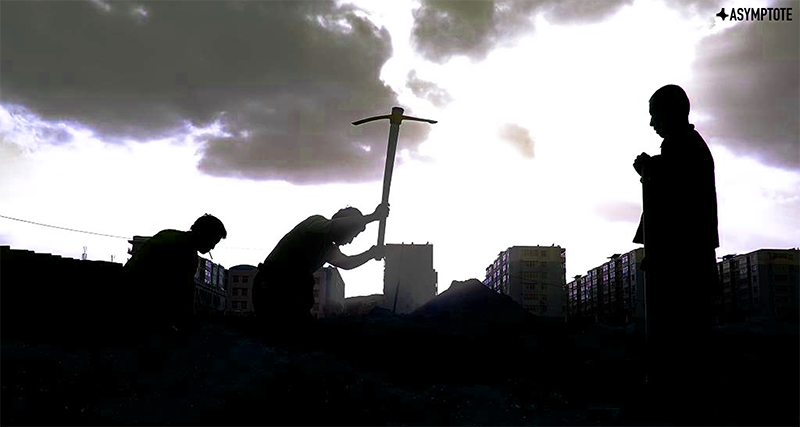
Posts featuring Zhang Huiyu

Notes on the Literature of Migrant Workers

While it remains unclear if these migrant workers’ voices will enable significant social reform, their visibility is a promising start.

Chinese literature has recently experienced a boom of “migrant workers’ writing”—largely autobiographical works produced by individuals involved in the nation’s sprawling gig and service economy. From deliverypersons to housekeepers to drivers, these marginalized laborers reveal in their writing the hardships and intersectional complexities that their positions make them vulnerable to, testifying to the thanklessness and extreme demands of their essential roles, and thus giving a pivotal view as to what constitutes the nation’s varied and persistently hegemonic social fabric. In this essay, Jianan Qian gives background to this rise and its unveiling of public secrets—the truth of what it takes to keep the enormous engine of China humming.

1.

I first heard the voices of the migrant workers not through literary works, but through popular songs. In 2010, a music video of two men singing Wang Feng’s “In the Spring” went viral on Chinese internet; in the shaky images captured by a handheld camera, the singers—later known as the duo Xuriyanggang—stood bare-chested in a cramped rented room. They were tanned, their faces and necks reddish from long hours of outdoor labor. In raw voices, they sang the chorus:

If one day, I grow old

and have nowhere to turn,

Please bury me,

Bury me in the heart of the spring.

In the original music video, Wang—a Beijing native and now an established musician—is looking nostalgically back on the spring of his youth, when he was a nameless music school student dedicated to his dream. The line “having nowhere to turn” sounds melancholic in his voice, perhaps signaling the common anxiety of aging, but in Xuriyanggang’s version, it indicates a future of being aged and homeless, speaking to the literal reality of the migrant workers looking towards it. The hukou, or household registration system in China, restricts its citizens’ access to education, healthcare, and pensions to their place of birth; thus, for many rural-born Chinese whose truncated education have forced them to take up labor jobs in major cities (turning them into “migrant workers”), they may still be deemed illegitimate residents after spending most of their lives in the cities they helped build, and thus are subject to displacement.


2.

Around the same time in the early 2010s, the voices of migrant workers also began to gain attention in the literary world. By committing their raw experiences to writing, they introduced the reading public to a stream of narratives that outline the deprivation, denial, and reduction consequential to the hukou system. Amongst them was Xu Lizhi, a young assembly-line worker at the Foxconn factory in Shenzhen, who recorded his angst in poetry. In one of his most circulated pieces, he wrote:

I swallowed a moon made of iron

They called it a screw

I swallowed the industrial sewage, the unemployment files

and youth cut short by bending over the machines

I swallowed the hustle and the displacement,

the pedestrian overpass, and life overgrown with rust
READ MORE…

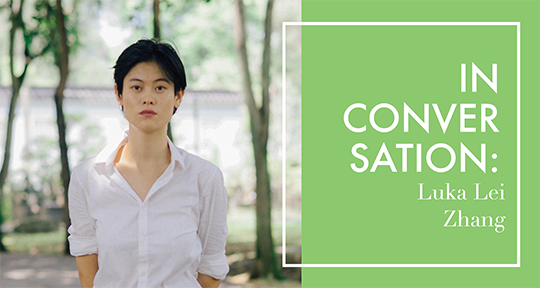
A Long and Winding Way to Go: Luka Lei Zhang on Working-Class Writings from Asia

I want to use the framework of ‘working-class literature’ to explore the transformations and tensions in literary texts.

Through the lens of comparative literature, the ancestry of working-class writings and the literature of labour trails from Russian novelist Maxim Gorky’s Maть (Mother, 1906) to South Africa’s Black migrant theatre, from the oeuvre of Argentine poet Elías Castelnuovo to the biographies of working-class Irish writers, and includes the many proletarian writers collectives springing up in response to the social moment: France’s Socialisme ou Barbarie, Japan’s Puroretaria bunka undō and Nihon Puroretaria Sakka Dōmei, Sri Lanka’s Dabindu, and United Kingdom’s ‘The Fed’ or the Federation of Worker Writers and Community Publishers.

As Macau-based Chinese scholar-translator Dr. Luka Lei Zhang writes in The Routledge Companion to Working-Class Literature (2024), the literary production of contemporary Asian workers ‘are often subjected to intricate social forces and power dynamics’, and it ‘would be a mistake to reduce these contradictions to simple good/bad, political/apolitical, and individual/collective oppositions’. It is this simplistic dichotomy that is contested by Asian Workers Stories, an anthology of fiction and nonfiction prose produced outside the fortresses of the canon, the middle-class literati, and the academe. Dr. Zhang, the anthology’s editor, brings her expertise as a scholar (and at-times translator) of working-class writers Chong Han, Tan Kok Seng, and Md Sharif Uddin of Singapore, as well as Mengyu, Wan Huashan, and Shengzi of China. In a 2023 interview, she confessed: ‘Personally and politically, working-class literature holds a special place in my heart’, going on to name Gorky, Annie Ernaux, Xu Lizhi, Takiji Kobayashi, and Filipino migrant worker-poet Rolinda Onates Española as her favourites.

In this interview, I spoke with Dr. Zhang on migrant workers writing from East Asia, Southeast and South Asia, and the Middle East, as well as the expansion of working-class writings within the larger body of the Asian literary canon.  

Alton Melvar M Dapanas (AMMD): Cheers to the anthology Asian Workers Stories! Apart from wanting to contribute a new dimension to Asian working-class literature (considering most existing books are either scholarly or poetry collections originally written in English), what are other motivations that impelled the creation of this anthology? 

Luka Lei Zhang (LLZ): I’ve worked on workers’ writings for several years and have encountered many great storytellers. Although several anthologies of workers’ poetry exist, short stories are translated and collected on a lesser basis. My main goal was to organise the writers in this region and, in this way, show that their work is valued and that they do not write alone. I am fortunate to know many Asian worker writers personally, which had allowed me to approach them and discuss the project, and their interest and encouragement motivated me to pursue the work further. I met Hard Ball Press’s publisher, Tim Sheard, at the Working-Class Studies Conference in 2019. He invited me to publish working-class writings with him—and that’s how it happened. READ MORE…