
Posts by Ria Dhull

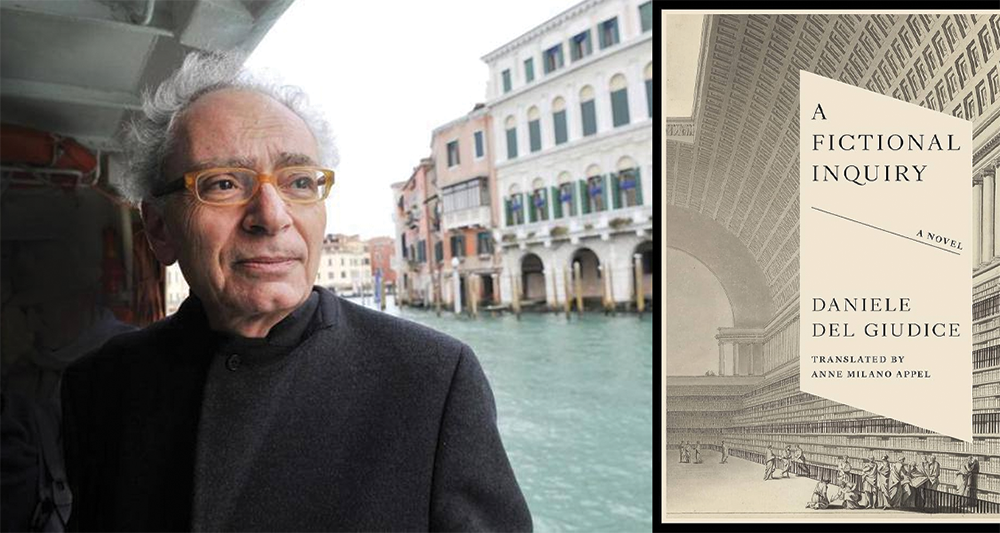
The Choice to Write: A Review of A Fictional Inquiry by Daniele Del Giudice

Del Giudice recreates an existing landscape in miniature to play around with his protagonist.

A Fictional Inquiry by Daniele Del Giudice, translated from the Italian by Anne Milano Appel, New Vessel Press, 2025

A Fictional Inquiry, Daniele Del Giudice’s first novel, is called Lo Stadio di Wimbledon (Wimbledon Stadium) in its original Italian—a reference to the end, when the protagonist journeys to Wimbledon to finish his, as translator Anne Milano Appel puts it, “inquiry.” The English title is clever; it places the conundrum of Del Giudice’s story right on the cover.

The titular inquiry is regarding the Triestean writer Roberto Bazlen, whose novels were published posthumously. The unnamed protagonist of A Fictional Inquiry travels first to Trieste and then to London, trying to understand why Bazlen did not or could not write while he was alive: “‘How did he hit upon the fact of not writing?’ I ask. ‘I mean the fact that he only wrote in private?’” Obviously, this inquiry concerns a writer of fiction, but it is not solely a question about what it means to write fiction; in a double meaning, the man’s inquiry is itself fictional, tossed out to the reader to cover up the protagonist’s (or Del Giudice’s) other, hidden, purpose.

This character arrives in Trieste with the supposed goal of interviewing Bazlen’s surviving friends and colleagues. He claims, during these encounters, to be gathering information in order to figure out why Bazlen never revealed himself as a writer, and as a result, these conversations map out his subject’s literary life. For some reason, however, the man is continually uninterested in the conversations he’s having. While speaking to a poet in her hospital room, he thinks: “I don’t care to listen to anymore; I want to leave, but I’m anxious about the formalities.” Before and during other meetings, he is just as hesitant. When asked if he is available to see a person of interest on that day, he responds: “Yes of course,” even while admitting to us that: “Truthfully I don’t know if I want to.” READ MORE…
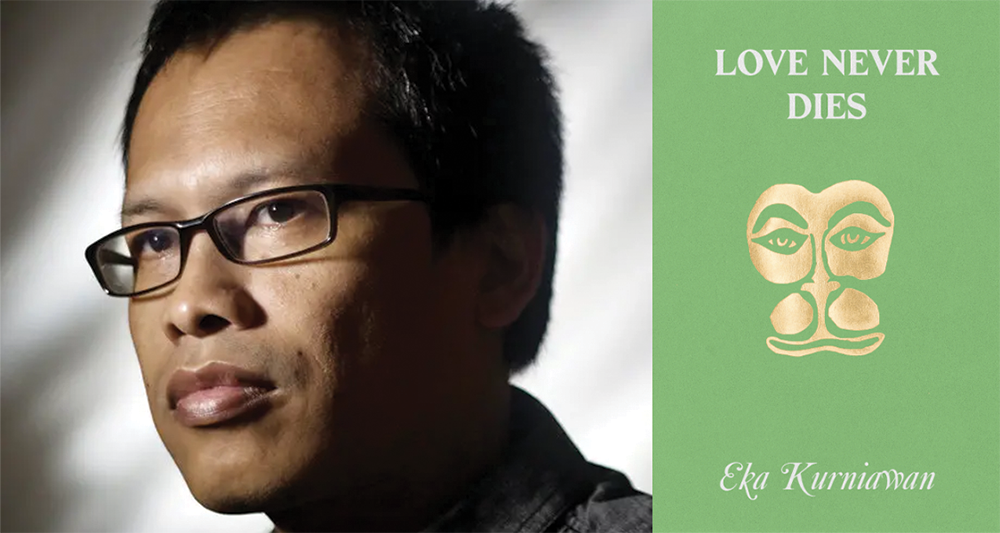
Violence and Devotion: A Review of Love Never Dies by Eka Kurniawan

Kurniawan portrays heterosexual love at its patriarchal, misogynistic extreme.

Love Never Dies by Eka Kurniawan, translated from the Indonesian by Annie Tucker, Hanuman Editions, 2025

The Indonesian writer Eka Kurniawan has been prolific in the novel form, having looked at the forces that negate death in Beauty is a Wound, translated by Annie Tucker, and the forces that create death in Man Tiger, translated by Labodalih Sembiring. However, while working on his third novel, Vengeance Is Mine, All Others Pay Cash (also translated by Tucker), the gifted author published two collections of short stories—the second of which begins with the novella Love Never Dies. Stripped of its surrounding stories, this novella is now appearing in English as a standalone volume.

Perhaps the choice to publish Love Never Dies separately was a choice made by Tucker, Kurniawan’s long-time translator, or perhaps by the publisher, Hanuman Editions—but either way, the text now appears more important in its English edition, as a volume on par with Kurniawan’s novels and a distinct step in the author’s career. Indeed, Love Never Dies should be considered as such. It cleanly synthesizes the themes of Kurniawan’s first two novels, determining that the forces creating and negating death are the same thing, and names that force “love”—or specifically, a man’s love toward a woman. From the first pages, it will be clear to any reader familiar with Kurniawan’s work that Love Never Dies is in conversation with its predecessors; Mardio, the seventy-four year old protagonist, seems to recall Margio of Man Tiger, and although the characters are different, the association between their names hints at the former’s future, and the murder predestined to take place at the novella’s end.

READ MORE…