
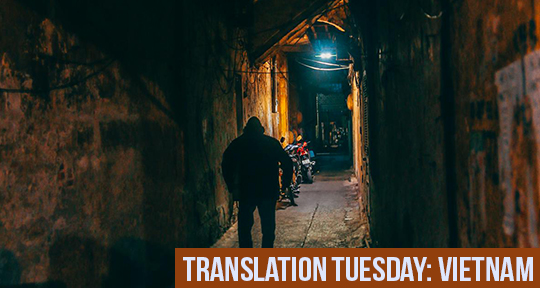
For this week’s Translation Tuesday, we bring you a short story by Vietnamese writer Nam Cao, translated by Brett Wertz. Detailing the twilight years of an old woman, it lays bare the brutal calculus of a life spent in poverty, where maternal labor is an investment that yields few returns. Betrayed by her aging body, and unable to make a living in a world that has no use for her, she slowly gives into starvation. Nam Cao’s unflinching style, with its refusal to moralize or dole out happy endings, can make for a discomfiting read—but it presents a realistic portrait of the harshness of village life. A year after “A Full Meal” was published, the worst famine in modern Vietnamese history would begin, eventually claiming the lives of up to two million people, including one of the author’s own children.
The old woman cried out for her dead son all through the night. It was always like that—whenever she came to the end of the road, with no more ways to make ends meet, she would cry out for him. She wailed as if it was his fault she should be hungry now. And indeed it was. Her husband had died just as the boy slid from her womb, and so she raised the tiny little toddling thing on her own. It was her hope that she might be able to rely on the boy when she was old and weak. But before she had the chance to ask for even the smallest thing, he up and died. Her labor had been wasted.
The boy’s wife was inhuman. She had no compassion at all for her old mother-in-law! She remarried at once, hardly pausing to mourn her dead husband. Then, she abandoned their five-year-old daughter, leaving her with the old woman to raise, stooped and bent as she was. Thus, at nearly seventy years old, the old woman had no choice but to take her granddaughter in. She’d already given both flesh and bone for her son, and now would give all that was left for her granddaughter. What more could she hope for?