
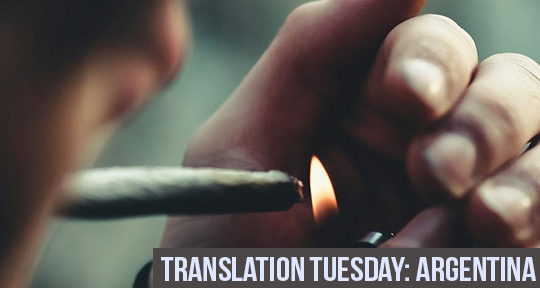
A languid summer vacation takes a distressing turn in this short story by Argentine writer Ju Donzelli, translated from the Spanish by Grace Penry. A group of high school friends abscond to a nearby town to swim, drink, and hang out, but the relaxed atmosphere slowly grows more tense, leading to an altercation between two boys—one of them being the slender, soft-spoken Flaco Luna, an anomaly among the guys and beloved by the girls. The sudden outbreak of violence reveals the unspoken tensions of adolescence, when masculinity must be achieved through publicly dominating others, including your own friends. Between the electrifying fascination of otherness and the terrorizing brutality of conformity, the boys’ fragile ecosystem is fiercely shaken by the incident.
I don’t go on vacation with the guys from high school anymore, but with Flaco, I’d go again. The last time we were all together we went to Guayamba, one of those towns where we Santiagueños will spend a couple of days because it’s nearby, because there’s a river, because it’s cool and cheap.
In the evening, the giant cicadas started getting on our nerves. It’s always like this, but on this day in particular they screeched and screeched. They look like other cicadas, only much bigger and rounder, the area around Santiago is full of them because of the carob trees. They’d zoom past us and hit things like projectiles, making a dry sound when they slammed into the wall. That’s what’s so funny about them: they sound empty when they bang into something and they’re always acting like they want to kill themselves. If there’s a pool, the first thing they do is head straight into the water and buzz their wings until they drown and die. And if you take them out, they’ll jump right back in. It’s an infinite loop lasting half the summer.
Whenever we’d go to Guayamba, we’d stay in Manso’s parents’ house because it’s pretty big and has a pool. Us guys had taken our clothes off, it wasn’t that hot out, but we were drunk, the humidity made the air dense, and during the siesta we’d sunbathed at the river. Plus, the power kept cutting out because it had rained, and the fans kept turning off. The girls were still in their shorts and bikinis, with their feet in the pool and hair dripping with the smell of chlorine.
Flaco Luna was the only one dressed. He was embarrassed that we’d stare at his ribs. Especially because the other guys were pretty big. Half played rugby; the other half ate like horses. So, Flaco Luna is the only one whose absence in photos makes him stand out, taking up only a third of the space we do. And because he’s tall, the poor guy’s always put in the back. At most, he’s a floating head in the background.
It doesn’t matter. Flaco always had it together. Because he’s intelligent. And even though he looks half-starved, with this kind of androgynous, alien thing going on—his cheekbones stick out, his eyes are big and almost phosphorescent—all the girls turn their heads to look at him. There’s always a guy like that, distinct, magnetic. You’d think that the girls would run away shitting themselves when Flaco talked, with that voice like a hoarse cat. You’d think that the girls would say it’s kind of gay, but no, they go even crazier when they hear him talk and gesture with his slender hands, or when he rolls his vanilla-flavored cigarettes. It doesn’t matter that his T-shirt drapes off him or that he looks like a scarecrow when he lifts his arms in his jean jacket. Flaco Luna talks to them, makes them laugh, holds their hair when they throw up, paints their nails. He’s one of the girls.
This time, things got heated. Almost all of the guys were playing truco. From a distance, we caught Iturbe’s girlfriend, a blond girl, talking to the Flaco Luna real close, as if he was playing hard to get. She grabbed his arm, laughing hard, throwing herself at him. I don’t know if she was super drunk and I don’t know if Flaco was paying any attention to her. He’s not a very sexual being. The opposite, actually.
Iturbe had started to get hot. He took off his shorts, wearing his boxers. It’s not like I was looking at his crotch, but I think he was hard. No one thought anything of it, we were so drunk, and it was late at night.
Flaco Luna sent Iturbe’s girlfriend to go to bed. You’re so wasted, girl, he told her. He nudged her and went to light a joint. His T-shirt was soaked around his his butt and his pants around the bottom because, like always, he was with the girls doing whatever the girls did. He wasn’t drinking fernet or playing truco like the rest of us.
Flaco’s green eyes and cigarette glowed from a few feet away. He had bent over and with a little stick poked at a toad or something moving around in the grass. Iturbe’s girlfriend walked clumsily over to him. Flaco put his cigarette out on the ground, got up without glancing at her, and walked back to the other girls who were scooping the bugs from the pool, tossing out one after the other.
After causing repeated scenes, the blonde had Iturbe’s nostrils flaring and his temple pulsing. He had started to throw his cards angrily down on the table, to place his bets wrong, to complain loudly about the shitty hands he kept getting.
In her drunkenness, the blonde got that there was no point in pursuing Flaco Luna and went off to the room with her eyes red and making that noise girls make when they’re crying but don’t want you to know. Behind her, the other girls followed suit, single file, yawning and picking the grass off their feet. Last in line was Flaco, wringing his t-shirt and leaving a trail of water.
But Iturbe stopped him, blocking the path with his body. I would’ve run—would’ve peed myself. Only someone like Flaco Luna could’ve had Iturbe in boxers, twenty centimeters away, and remained so calm. Iturbe, angry, plastered, jealous. What’s up with you? Iturbe said, practically breathing on Flaco’s face. He stuck out his chest and pushed Flaco, not very hard, because then Flaco Luna would’ve fallen on the floor or flown against the stairs.
Flaco didn’t answer. He kept his head held high and his gaze steady. He seemed pretty clearheaded. Maybe he hadn’t drunk as much as we had. What’s up? You a virgin or something? You’re always with the girls. Are you a fag? Iturbe said.
Stop busting my balls, Flaco Luna answered without much emphasis. Above his head, the giant cicadas flew around, going from here to there, gathering on the lightbulb that illuminated them. You know, I wouldn’t care if you fucked her. You have my permission, spat Iturbe. I don’t like your girlfriend. Not even a little, Flaco said, and if I did, I wouldn’t ask you for permission. Iturbe wasn’t listening.
Do you even have a dick? Iturbe said and made a move as if to size Flaco up, but I couldn’t totally see. Everything turned ugly then. Iturbe pushed him, threw him on the ground, sat on him, and tore his shirt off. Flaco Luna was pinned under Iturbe’s mass, with his ribs visible, his stomach caved, his collarbone sticking out, his eyes inexpressive. The cicadas seemed to go berserk around the light, flying erratically.
He’s going to rape him in front of us, Iturbe’s going to rape Flaco, I thought. I wasn’t the only one, because Manso, a big guy, but peaceful, freaked. He got up running. Stop fucking around, Iturbe, pervert, he yelled. He tried to move Iturbe with his body, as if to tackle him. Iturbe shoved him and Manso fell back several steps on his ass.
I tried to get up to help Flaco, but I was stumbling drunk. Iturbe threw me to the ground with a light elbowing and I fell flat. I couldn’t move. I was afraid. I thought I saw him reaching to take Flaco’s jeans off and I closed my eyes hard.
The weird thing is that Flaco was calm. In the middle of my drunk, shit-faced state, I even thought that maybe Flaco liked Iturbe, that he wanted to be under him, have him take his clothes off in front of us, fuck him, and that’s why he wasn’t moving or screaming.
But then I heard something that I hadn’t noticed before, a buzzing sound like a whining fridge. A cicada landed on Iturbe’s chest. He cursed and swatted at the air. And then another one landed on his head. And another. And another. Suddenly, there were six or seven black stains on his sunburnt skin.
He tried to pull them off, but they came back. Each time, more. The power cut out again. The speakers turned off and the lights too. I saw Iturbe’s shadow abruptly stand up and get off Flaco. The giant cicadas came and went, hurling themselves at Iturbe. He kept waving his arms, trying to scare the bugs off. I didn’t see them, but I heard them hitting his chest, his head, the hollow sound they make when they crash into something.
The lights came back and Manso shot me a look somewhere between relieved and confused. We had both stayed on the floor, paralyzed. Where the fuck is Flaco? He said, gripping my arm. He was yelling because the music had started up again.
Iturbe shook himself off, but the bugs were stubborn. Fucking bugs, he was saying, going in circles like an ogre. I thought I heard the sound of a branch breaking and I looked at where it came from. I found Flaco Luna, not too far away, lost among the trees, his eyes phosphorescent. Every now and then, he lit his joint and the lighter’s flame outlined his face in orange. He was squatting down with a cigarette in his mouth as if all this had happened to someone else.
At noon the next day, all the guys were like zombies. No one looked each other in the face or talked. Everyone avoided Iturbe and looked at Flaco with fear. Manso and I kept our mouths shut because the air was still charged.
The girls got tired of waiting on us and lit the grill, salted the meat. They didn’t even ask us what was going on, they assumed we were just hungover. The Flaco Luna came and went with them. He fanned a newspaper to get the flames going and drank mate. All around him on the ground of the quincho lay the cicadas, dead, green, dry as casings. Iturbe’s girlfriend swept them up, pushed them into the grass, and said something to Flaco that I couldn’t hear. I got up to cut tomatoes for the salad.
Translated from the Spanish by Grace Penry
Ju Donzelli (b. 1994) is an Argentine writer born in Santiago del Estero and livi in Córdoba, two cities in the interior of the country. They received both their BA and Teaching Degree from the Letras Modernas at la Universidad Nacional de Córdoba. They dedicate themselves to teaching and coordinating literary workshops. “Lo verde los coyuyos” is part of their debut collection of short stories El Verano que no llovió (Elemento disruptive 2024). This story was recognized in the Bienal Arte Joven (2021/2022) and published in the anthology Tan Diversa (Mardulce 2022).
Grace Penry (she/her) is a writer and translator from Arizona, USA. Her work has been featured in Kitchen Table Quarterly, Thimble Literary Magazine, Black Works mag, among others, and has been nominated for Best of the Net (2023). She is a current associate poetry editor at The Offing and Reviews Editor for the Arkansas International. She is a candidate in the MFA program at the University of Arkansas.
*****
Read more from the Asymptote blog: