
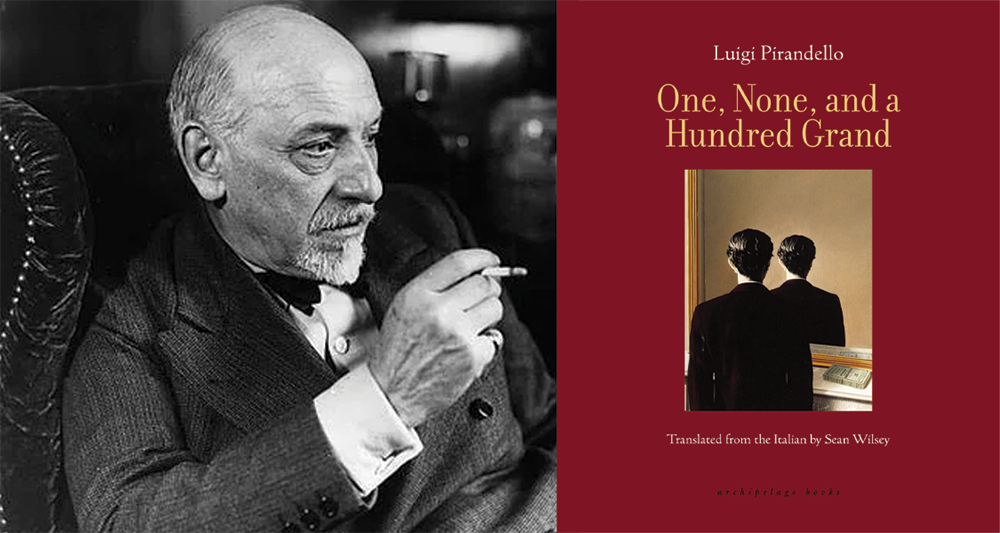
One, None, and a Hundred Grand by Luigi Pirandello, translated from the Italian by Sean Wilsey, Archipelago Books, 2025
Luigi Pirandello’s final novel, One, None, and a Hundred Grand, begins with a nose; the slight tilt of it, casually noted by a wife, sets off one of the most vertiginous descents into selfhood in all of literature. For Vitangelo Moscarda (meaning maggot, one of the many signifying names in this book), this offhand observation shatters a presumed unity: if his wife sees him differently from how he sees himself, who—or what—is he? What follows is a tragicomic unraveling of identity that, nearly a century later, reads with the vitality of a modern parable. In Sean Wilsey’s supple and stylish new translation, published by Archipelago Books, Pirandello’s masterpiece finds new life in an era that is just as fragmented as Moscarda’s mirror.
Though best known in the Anglophone world for his revolutionary plays—especially Six Characters in Search of an Author, which famously broke the fourth wall and dismantled the illusion of coherent identity onstage—Pirandello began his career as a philologist and prose writer, and this training in dialect and etymology shaped his understanding of identity as both an artifact of language and a performance of speech. In the theater, he would go on to stage this view with uncanny force: characters who refuse their scripts, actors who rebel against the author, spectators forced to confront their own role in meaning-making. But it is in One, None, and a Hundred Grand that Pirandello turns inward, eyeing the abundant fragments that compose each of us. READ MORE…