
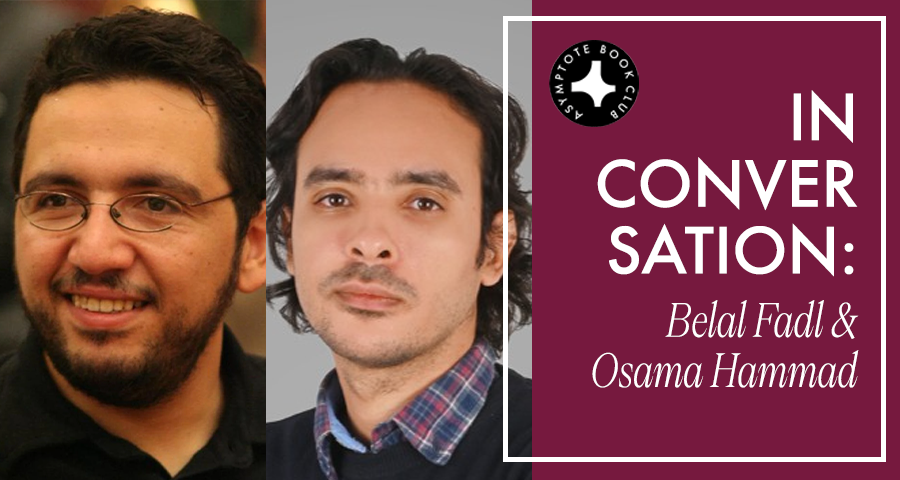
Posts featuring Belal Fadl

Cairo Without Euphemism: An Interview with Belal Fadl and Osama Hammad

Don’t even think about taboos, or moral values. If you do . . . you’ll stop focusing on the act of storytelling.

In The Completely True Tales of Um Mimi and Sharawi the Adulterer, Egyptian screenwriter and author Belal Fadl introduces the underground of Cairo with fierce humor and unbridled intensity, drawing on the vividity of vulgarity and the frenzy of the marginalized to capture the explosive nature of the capital. The book was banned in Egypt, though achieved notoriety beyond the nation for both its style and content, lauded for its refusal to censor or sanitize. In this interview, Fadl and translator Osama Hammad speak to us about authorial honesty, the book’s colorful reputation, and about what it means to face reality in fiction.

The Asymptote Book Club aspires to bring the best in translated fiction every month to readers around the world. You can sign up to receive next month’s selection on our website for as little as USD20 per book; once you’re a member, join our Facebook group for exclusive book club discussions and receive invitations to our members-only Zoom interviews with the author or the translator of each title.

Ibrahim Fawzy (IF): Belal, how did The Completely True Tales of Um Mimi and Sharawi the Adulterer first come into being?

Belal Fadl (BF): It grew out of my personal experience as a student at Cairo University in the 1990s—though I wasn’t thinking of it as a novel. Like many other writers, I believed my first novel had to be epic, something like Dostoevsky’s Crime and Punishment. You start with imitating the works that impress you, and only later do you discover your own voice. García Márquez’s greatest tip is to write what you know.

When I started writing short stories during my journalism work in 1995–96, I tried—unsuccessfully—to write a story about a barber called Sharawi (from the Arabic word for hair). I don’t know why I chose him, but maybe because a barber can be such a distinctive character. I failed, but I felt that the material belonged to something longer and deeper. READ MORE…

Announcing Our December Book Club Selection: The Completely True Tales of Um Mimi and Sharawi the Adulterer by Belal Fadl

Here, language tells the truth without mitigation, even when that truth is ugly.

Upon the premiere of Youssef Chahine’s Cairo at Cannes, the Egyptian critics in attendance resented its unflinching portrayal of the city’s poverty and density, claiming it as a derogatory and inciting the film’s eventual ban. In The Completely True Tales of Um Mimi and Sharawi the Adulterer, author and screenwriter Belal Fadl takes a similarly undaunted look at the capital: its swarming underbelly, its suffocating divides, and its unrelenting pressures that bloom both tragedy and absurdity. Written in a captivating style that listens carefully to the city’s manifold ranges, Fadl is determined to pull back the curtains, putting a middle finger up to politeness or grandeur, and drawing instead on chaos, comedy, and linguistic richness to portrait a Cairo full of adrenaline, be it from laughter, thrill, or the sheer will to survive.

The Asymptote Book Club aspires to bring the best in translated fiction every month to readers around the world. You can sign up to receive next month’s selection on our website for as little as USD20 per book; once you’re a member, join our Facebook group for exclusive book club discussions and receive invitations to our members-only Zoom interviews with the author or the translator of each title.   

The Completely True Tales of Um Mimi and Sharawi the Adulterer by Belal Fadl, translated from the Arabic by Osama Hammad, DarArab, 2025

Belal Fadl’s The Completely True Tales of Um Mimi and Sharawi the Adulterer announces itself with a provocation and never retreats from it: “Whenever I tell my story, I say that what led me to live with Um Mimi were two Polish breasts with unparalleled nipples.” From this opening confession, the novel signals that nothing sacred will be protected from language, and nothing obscene will be softened for the reader’s comfort. But this is not bravado for its own sake—Fadl’s novel is built on a wager: that obscenity, vulgarity, and excess are not moral failures of language, but its most truthful registers when class humiliation, bodily precarity, and institutional contempt are the subject. To read The Completely True Tales of Um Mimi (or to be more accurate, to read it in translation) is therefore to confront an ethical question: how does a translator render a voice whose truth depends on its refusal to be clean?

The novel’s narrative arc is deceptively simple (almost cliché). It’s 1991, and a young man from Alexandria arrives in Cairo to study media at Cairo University, determined to escape an abusive father and a suffocating household. His grades win him admission, but his finances dictate his fate. Having endured a humiliating stay in a flat with “decent, pious, and religious young men who knew God and had learned the Quran by heart,” he is evicted for attending an R-rated film, and ends up renting a room in the ground-floor flat of Um Mimi, a retired madam, on a nameless lane known only as “the street behind Casino Isis.” READ MORE…