
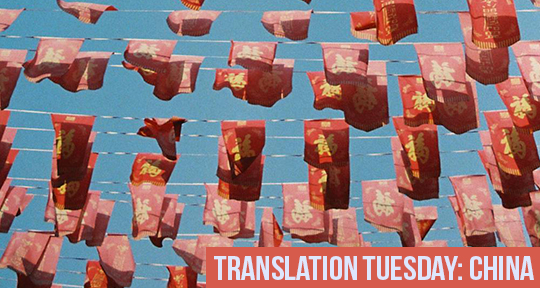
Happy Lunar New Year to readers who celebrate! For those of you from Chinese-speaking parts of the world, who have just spent your first day visiting relatives, today”s Translation Tuesday showcase from China focussing on familial relations will surely strike a deep chord. In Feng Jiqi‘s short story, translated by George Dudley, a man on the cusp of marriage faces an ultimatum from his fiancée: buy a house, or consider the relationship over. Without any financially viable way to fulfill this demand, he despairs—until his mother comes to him with a proposal. Should he accept and allow her to once again sacrifice her happiness for his own, or refuse and protect her? Feng Jiqi eschews a simple conclusion, instead giving us several options for how the story ends. The six possible endings form a kaleidoscopic exploration of filial piety, maternal love, romantic love, fate, and the many faces of happiness.
The Story
My mother is the subject of this incident, so I’ll start with her.
She’s a sturdy kind of woman—tall and brown-skinned, with a bun of thick, shiny black hair that dazzles the eyes like a flash of sunlight each time she unties it. Whenever she talks to anyone, there’s always a smile in her eyes that ripples like water in spring. She’ll use her gaze to send warmth to the other person, and never douses bad feelings on them (even when she’s not in a good mood). Anyone who meets her (including small-talkers) finds whatever irritation, sadness, or disappointment they’re carrying disappear as quickly as smoke in the air. She’s a kindhearted, frank, and optimistic person, but she was given a poor lot in life. My father passed away when she was only 40 years old. Though she’d never been considered a beauty in our little mountain village, her wholesome appearance made her very likable. Once she became a widow, all the old bachelors in the village started chasing after her. Some doted on her, some flirted with her, and some made formal marriage proposals. She refused them all. She didn’t drive them off with vulgar tongue-lashings or wave a hoe and sickle at them to prove her commitment. Her answer came through her soft, graceful gaze, her dark eyes slowly turning once, then twice, until they fixed firmly on the man in front of her. Then, with that ever-so-slightly husky mezzo voice she gave only one reply: I won’t marry again.
I’m getting married.
She was saying this at 56 (my father had been dead for 16 years, and this was this first time she’d suddenly said anything like this).
Her eyes had lost their soft gleam and gained more toughness and resolve (as if to say there was no way she wouldn’t marry). I figured the years must have swept the warmth from her gaze and left her just enough strength to grab onto the tail end of life. I assumed now that she’d entered old age, she couldn’t take being alone anymore. Then I thought more carefully and realized, no, this wasn’t like that. My mother had changed after coming to the capital: she’d become spacey and gotten lost in her own world where she began taking stock of the city, the people living in it, and her own life. Maybe the city had brought her to a revelation that stirred her heart and made her restless. Getting married wasn’t some impromptu thought; it was a decision she’d made after careful consideration.
I’m getting married—she’d of course meant this for me to hear.
So why don’t I say something about myself.
I come from a mountainous county in the Guanzhong region of western Shaanxi, and made my way to the province’s capital by testing into college (I won’t go into detail about the hardships along the way). After graduation, I spent six years in the city trying to make a living, changing jobs over a dozen times. Eventually I found one with some stability (I’m a property manager at a community of over 300 residents on Guangming Road north of the city and have 13 people working under me). I brought my mother out of our mountain village to the capital so we could live together in the house I rented (from then on, I stopped ordering delivery every day because I could eat her homemade cooking). I felt like days filled with hope were hobbling their way toward me. At 29 years old, the dawn of my life was slowly emerging and breaking through the dark clouds. Even though happy times had arrived late, I was still excited, and I rejoiced at how my luck was turning—I had found a girlfriend; her name was Zhou Junqian, and she was 23 years old. She had graduated the year before and was an accountant at the same property management company where I supervised. Zhou Junqian was a tender girl, fair-skinned and petite with a quiet personality, though somewhat sullen. I’d call her Junjun or Qianqian, and she’d reply with a bashful smile and flirtatious eyes as soft as catkins. Maybe since I was nearly 30 and still unmarried, I had a kind of craving, a scorching anxiety to be with her, and it seemed inevitable that I’d be unable to keep myself from acting on my desire. But she must have seen the excitement written all over my face. She warned me: before marriage, I wasn’t allowed to be intimate with her, let alone do anything unfaithful. Since I was fond of her, I wanted to respect her, so I never forced her to cuddle or kiss me. I told her, Qianqian, I’ll do whatever you say. I asked if she would marry me, and she agreed. She only asked that I do one thing: buy a house. She didn’t want a car or bride price (she had talked this over with her parents, who had taken the idea reasonably and agreed to it). Since we were getting married, her wanting a house was only natural. My annual salary was just 80,000 yuan (actually a considerable income in our capital, where plenty of college graduates earned only three to four thousand yuan a month), and I knew that buying and furnishing even a 500-square-foot house wouldn’t be possible without at least 700,000 yuan. The only way I could pinch together enough money was if I gave up eating and drinking and worked another ten years.
I brought my restlessness and anxiety into the house my mother and I were renting. Even though I never mentioned a word to her about my troubles, she could sense the oppressive and gloomy atmosphere I was creating in the house. I deliberately put on a stiff smile to try to look happy around her (she had worked herself to the bone to send me to college, so I couldn’t bring myself to complain to her). But she must have seen through the flaws in my act, or perhaps I overplayed my part, laid it on too thick, and she smelled it out. While we were eating, she placed a bit of food in my bowl, lifted her head and fluttered her eyes with a look filled not with warmth, but excitement, and said my name: Zhao Shushan (she’d never addressed me like this before; she’d always called me “son” or “Shanshan”). She looked unusually serious, and I figured she was about to talk some sense into me. I had no intention of hiding anything from her; I was going to come right out and say I had no money to buy a house for my future wife. But before I had a chance to speak, her eyes softened again, like moonlight on the Mid-Autumn Festival. What was with her? None of you could understand, but my mother’s change in expression was conveying her state of mind. She opened her mouth, and as she spoke, the story of my life took an enormous turn—one entirely of her own making.
Shanshan! She called out my name with her usual affection. She was back to normal. My mood naturally relaxed.
I’m getting married.
She tossed this out, then buried her head in her food. I immediately pushed aside my bowl and chopsticks and sprang to my feet as if shot out of my seat. I was almost 30, still single, and without a house—if you didn’t want to share your son’s worries, then alright, but what were you doing getting married? Wasn’t this totally ridiculous? Wasn’t this throwing a wrench into everything? Which was more important: your son getting married, or you? Couldn’t you weigh the two and see which one was more pressing? Alright, Ma, you really were getting more confused as you aged. My eyes beat down on her for a moment, until I sat down, helpless. I stayed silent. What was there to say?
I put down my unfinished food and started to leave. Before I reached the door, my mother called out to my back: It’s the security guard who watches the community entrance, Guo Jingxian! Whether his name was Guo Jingxian or Wang Jingxian or whatever, I didn’t care. Oh, Mother, how did you manage to get tied up with the community security guard? What was all this nonsense?
I didn’t go back to our apartment to eat the next day and slept in my office that night. I was trying passive resistance to put pressure on my mother and make her give up the idea of getting married.
She called a few days later asking me to come home. She didn’t say she missed me or anything like that. She only said nonchalantly, We have a guest. I asked her, A guest from where? My mother replied, Come home and you’ll see. I figured she must be trying to trick me into coming back. But even if it was a trick, I couldn’t go on hurting her feelings, so I went.
When I got there, I discovered the guest was Guo Jingxian. As the property manager, I of course knew who he was. He was lean but had a seasoned look, and was younger than my mother by five years (that’s all I’ll say about his appearance). I was always satisfied with Guo Jingxian’s work and never had any problems with him. But to me he could only be my employee, not my stepfather. When he saw me, he addressed me respectfully as Manager Zhao, to which I point-blank asked him, What’s the problem? (I was purposefully pretending not to know what was going on between him and my mother). He didn’t mind that I was being cold and indifferent. He took a sip of tea, cleared his throat (as if trying to suppress his excitement), pulled out two rings of keys from his pocket (five keys on each ring), and placed them on the tea table. Then he took another sip.
That afternoon, I learned Guo Jingxian was from the western suburbs of the capital and, after having his old neighborhood demolished and relocated, had received two houses from the government as compensation. Each house was 1,200 square feet, which at current real estate prices meant they were each worth at least 1,400,000 yuan. He put down his teacup and told me sedately he was offering the houses as a betrothal gift to my mother. I was confused and unsure how to react. It was like my life’s story was being cut off by a knife and a period placed at the end. What was I supposed to do? Accept the gift, or refuse it? I hesitated. What should I do? I didn’t know. I truly didn’t know what to do.
I can’t go on telling any more of my life story. I’ll leave the ending for the author to tell.
Ending (1)
Zhao Shushan refused Guo Jingxian’s betrothal gift.
I can’t give away my mother! She can’t be bartered off; I won’t do it. Wouldn’t this just be a sly way of selling her out to get a house for my own marriage?
Zhao Shushan tossed and turned in his bed, unable to sleep all night. He saw his mother in front of him carrying a bundle of firewood on her back, climbing her way up a ravine: her tall figure stooped over in a bow, the sound of her panting as rough as the wood of an ancient tree and loud enough to be heard far and wide. Beads of sweat trickled down like rain from her forehead to the dirt. The mountain path was too steep. She dug her toes in tightly to the ground’s surface. Each time she stretched her leg forward to take a step, her throat panted more heavily, and her back bent more crooked. The mountain path, as thin as a ribbon, seemed to be pushing her back. She didn’t stop. She continued on until she hauled the 100-pound bundle of firewood out of the ravine and into the courtyard. She put it down and tossed aside the sickle in her hand, then stretched her waist and sighed with a lengthy “ahhh.” The call of relief echoed in circles around the courtyard.
At the sound of her sigh, two cows stopped in their tracks for a moment too brief to rest, then begrudgingly resumed dragging their heavy plow forward. His mother grasped a whip, but she couldn’t bring herself to hit them knowing their lives were just as unfortunate as hers. She held onto the plow handle as she walked from the wet, plowed soil at the edge of the field and onto the furrows (the field was on a hillside with a steep slope, so she had to walk from the lower edge to reach the furrows). As a few exhausted stars descended and the morning sun opened its drowsy eye above the mountains, his mother strapped the plow on herself and headed down to the field to plant corn. His father followed behind her scattering seeds, already so hungry he could barely stand (he was in poor health, so his mother did all the physical labor). His father urged her repeatedly to take off the plow and head home to eat, but each time she only had one reply: one more row. Not until his father was lying facedown in the wet earth, his mouth half-open as if eating bites of dirt did his mother finally set down the plow. Her endurance was astonishing. She never got discouraged; she was always filled with longing for life. Zhao Shushan knew that his mother’s one desire was to raise him and his older sister into adults that would escape the mountains and lead happy lives. Mother was home, and home was Mother. She’d used her sweat to nourish her feeble family and fill it with life and energy. In Zhao Shushan’s eyes, his mother was the family’s bedrock (not his father). If she ever were to be taken away, their entire household would collapse immediately. His mother felt that all her wishes had come true: her daughter had graduated from college and married in Guangzhou (and even though she hadn’t come home in years, she never complained), and her son had a job in the capital. She was perfectly content. Why, then, did she want to get married? Zhao Shushan couldn’t wrap his head around it no matter how hard he tried.
Suppose I accept Guo Jingxian’s betrothal gift and marry off my mother. All our friends and relatives in the village would hear about it and know that I was trading her body for a house.
Wouldn’t they all revile me then? Selling my own mother for a house—what a humiliating thing to do. I couldn’t carry that bad name. Even if no one accused me directly, I’d never feel right about it. As long as I’m alive I’ll simply never have my own house or get married; I can’t live off my mother’s body (accepting Guo Jingxian’s gift would be akin to eating her). I’m a man—I have to rely on my own two hands to support myself. I can’t be like my father nibbling away at her my whole life. Zhao Shushan’s self-reproach turned into remorse. He felt guilty for having had the idea in the first place. After pondering it over, Zhao Shushan refused Guo Jingxian’s betrothal gift of two houses. His mother never mentioned the idea of marriage again. His mother’s attempt to marry the security guard Guo Jingxian fizzled out. The story ends rather uneventfully, without any sudden surprises.
Ending (2)
Zhao Shushan accepted Guo Jingxian’s betrothal gift.
Before making the decision, he wavered back and forth, too anxious to eat or sleep. He weighed each option over, musing their pros and cons. Acceptance would fulfill his material need, but wouldn’t be morally right, would damage his character, and most of all, wasn’t what his heart wanted. Refusal meant being trapped in his dilemma—he and Zhou Junqian would never have a house to spend their marriage in (and, he thought, his mother remarrying simply wasn’t a possibility, if only because he didn’t want it to happen). What was he supposed to do? Stuck between a rock and a hard place, he went to Zhou Junqian (he’d originally planned on not telling her about the situation at all). When she heard that there were two houses waiting for him, she was over the moon. She asked, Why haven’t you accepted? Zhao Shushan replied, I can’t go on “eating” my mother—whether for a house or for my own happiness. He said that to accept Guo Jingxian’s houses would be the same as selling his mother off. He told her his moral integrity would fall into the gutter, and it would weigh on his conscience (plus there was the possibility of being reviled and mocked). Zhao Shushan felt that since his mother had toiled most of her life for him and his sister, she ought to have it free and easy in her golden years. To use his mother once again for his own benefit—each time he thought about it, he loathed himself, felt he was despicable, a loser, an unfilial son. Zhao Shushan said he would improve his situation through his own hard work. He believed the day would come when he could buy his own house. Zhou Junqian asked him, When might that day be? In ten years? Twenty? Housing prices go up each year. The average price now has gone up to 1,200 yuan a square foot. Your yearly salary isn’t even enough to buy a bathroom. Are you living in a dream or reality? Zhou Junqian said, You need to look at this a different way. Don’t get tangled up in the words “betrothal gift.” If your mother and Guo Jingxian get married, then he’ll be your stepfather, you’ll be his stepson, and a stepfather giving his son a house to live in is completely normal and reasonable. And another thing—if you become family, you’ll have the right as his son to inherit his estate. Don’t you remember? Guo Jingxian has no children (he’d said both his son and daughter had settled abroad years ago, with no plans to return). When he passes away, won’t all his property become yours? Not agreeing to their marriage—that’s what’s really unfilial. Zhao Shushan said, My mother’s already 56; what is she doing getting married? Zhou Junqian said, What’s wrong with 56? Do you ever read the news? There’s women in their sixties who are having babies; 56 isn’t old. But even if your mother was 66 or 76, she could still remarry if she wanted. Didn’t you say that when your mother and father were married, your father was always sick? Your mother spent most of her life beholden to a man—you’re not a woman, you can’t understand this—but to put it bluntly, a woman needs a man not just emotionally, but physically. If you accept the houses, you’ll be giving your mother everything she wants. She’ll be able to spend the rest of her life in domestic bliss. How can you say you’re selling her off? Zhao Shushan said, So, according to you, I won’t be given a bad name for betraying my own mother? Zhou Junqian said, Why would you? A person can’t go through life caring about the looks on people’s faces or listening to what they say; they have to live for themself and walk to the beat of their own drum. Accepting Guo Jingxian’s gift—that’s immensely filial. Getting remarried is your mother’s wish; who cares what busybodies say? Zhao Shushan said, You’re thinking that by accepting the two houses, you and I will have one for when we’re married. Zhou Junqian said, Of course. Isn’t that getting the best of both worlds? It’s all perfectly justifiable and out in the open; why should I hide it? And anyway, the houses are just a byproduct of the love between your mother and Guo Jingxian; you’re not snatching them out of their hands. Don’t tell me that while they’re enjoying their marital bliss, they’re not also hoping their son will… Zhou Junqian’s face went red as she trailed off. Zhao Shushan could guess what she’d wanted to say. Don’t be so cheeky, he said.
Zhao Shushan followed Zhou Junqian’s advice and accepted Guo Jingxian’s betrothal gift.
A short time later, his mother and Guo Jingxian married.
And right after, Zhao Shushan and Zhou Junqian also married.
A big happy ending—nothing seems original about that.
Ending (3)
Zhao Shushan accepted Guo Jingxian’s generous betrothal gift. Soon after, he lost it all. We all hope that we’ll be lucky and our lives will go smoothly. Zhao Shushan was no different. Midway through his life, he had a stepfather, a house, and a satisfied wife. He should have been riding high, but after marrying Zhou Junqian, he was always on pins and needles and he didn’t know why. He felt uneasy whenever the two were intimate, like he was sowing seeds in someone else’s field. Maybe the house had come too suddenly, too easily, and it made him worried. Each night before he slept, a thought would suddenly pop into his head: the world is fickle. Fortune follows disaster, and disaster follows fortune. Suppose I lose this house and everything with it—what would I do? Perhaps Zhao Shushan’s subconscious was hinting at something.
Finally the day came when that hint turned into reality. That reality—the story of life— had been foreshadowed by Guo Jingxian.
Guo Jingxian did indeed have a son, but he hadn’t settled abroad. He was working in a factory in Dongguan. He hadn’t been back to the capital in twenty years and had no contact with his father. This was because Guo Jingxian had been a lecher in his youth, and his son had seen firsthand the vile things he’d done with his mistresses. He’d witnessed his father and mother’s endless trading of insults, their screaming matches, and even physical fights. He’d left home after losing all hope in his father. When Guo Jingxian and his wife divorced, he was given custody of his son. But he only provided money each month for him to live on, and the two remained without contact.
Suddenly Guo Jingxian’s son was back from Dongguan. The foreign enterprise he’d been working for had left the country and he’d lost his job, so he’d brought his family back to the capital. He made a request to his father that was hardly unreasonable: he wanted a house. His son asked him, In all your nearly sixty years, did you ever buy any property? The place you live in now was left by my grandfather, and that other place you were compensated belonged to our ancestors. You bought neither of them. The two houses and 500,000 yuan you were compensated are all part of granddad’s estate. Zhao Shushan has no business living in our family’s house. He went on making a fuss, but his father ignored him. The son didn’t bother going through legal procedures to rectify the situation. He called a locksmith to open the door of the house Zhao Shushan was living in, threw all the furniture outside, then moved in with his wife and child. Guo Jingxian had a pretty good idea that if he took the matter to court, he’d likely lose the case. He could only grit his teeth and bear it.
The situation having come to this, Zhao Shushan knew he had no leg to stand on. He couldn’t fight over the house with Guo Jingxian’s son, so his only option was to live with his mother. With no house of their own, Zhou Junqian began grumbling about a divorce. Zhao Shushan also felt awkward living with his mother and Guo Jingxian. His stepfather was a loafer who didn’t bother with niceties. In the summer, he’d wander around the house without a shirt on. Even worse, when Zhao Shushan and his wife were trying to sleep, his stepfather and mother would toss around in bed in the next room. Sometimes the noises they made irritated Zhou Junqian so much she would make crude and sarcastic remarks. Frustrated, Zhao Shushan and Zhou Junqian had no other choice but to move out and rent an apartment.
Ending (4)
When Zhao Shushan found out that this was a scam, he gnashed his teeth, pounded his chest, and seethed with the desire to chop Guo Jingxian to bits.
After Zhao Shushan and Zhou Junqian married and moved into the house they had been gifted, the two enjoyed their honeymoon in high spirits. Obtaining a house worth over 1,000,000 yuan in the provincial capital was no easy accomplishment. Zhao Shushan rejoiced at the fact that he had such a good mother—and such good luck. After his mother and Guo Jingxian got married, her new husband took her to Beijing, where they had a wonderful time visiting Tiananmen Square, climbing the Great Wall, and touring the Forbidden City. Both pairs of newlyweds, old and young, were happy and content.
It often happens in life that bad luck is lurking behind a door that opens at the wrong time. Less than two months after Zhao Shushan, his wife, and his mother moved into Guo Jingxian’s houses, they were all kicked out.
One gloomy afternoon, Guo Jingxian was on duty at the community’s main entrance when the police showed up and took him away in handcuffs. The following day, they summoned Zhao Shushan and his mother to the station and ordered them to vacate their homes within three days. The two houses they’d moved into were not Guo Jingxian’s property.
Zhao Shushan learned from the police that Guo Jingxian wasn’t actually from the capital’s western suburbs. He was a peasant from northern Shaanxi who had drifted into Xi’an, then shacked up with a woman in the western suburbs for two years. He’d later been convicted of fraud and sentenced to three years in jail. Shortly after his release he went back to his old tricks. His method wasn’t particularly sophisticated—he’d rent a house from somebody, create a fake deed, and rent it out to a third party that he could defraud. The betrothal gift he had given to Zhao Shushan’s mother wasn’t his house at all, but one he had rented.
Zhao Shushan’s mother had never in her life surrendered in the face of difficulty. She was a strong woman—even when her husband got sick and passed away, she hadn’t bawled her eyes out or let go of her dignity and given up on life (even when some men were offering impressive betrothal gifts, she’d still refused to remarry). For the sake of her children she’d been willing to remain a widow (despite only being 40). Then she’d followed her son to the capital, where the bustle of the city must have roused something within her, and she’d gotten involved with a security guard without telling her son. She’d felt her heart awaken after it had lain dormant for 16 years and she’d somehow fallen in love with this man (for nearly her entire life she’d gone without experiencing romantic love). She’d even spent the night with him in a hotel. Her body and spirit had both been invigorated. She thought she’d been given a second chance at love—like a plum blossom blooming twice in spring. Not even in her wildest dreams could she imagine that the man who gave her so much happiness in bed could deceive her. On the day she moved out of the house, she burst into tears. Zhou Junqian was completely humiliated after being kicked out of someone else’s home and, in a fit of anger, moved back in with her parents. When they learned the reason why, they were livid— convinced that they and their daughter had all been tricked. They figured Zhao Shushan and his mother had something wrong with their characters. Zhou Junqian’s parents pestered their daughter endlessly to get a divorce. After many arguments, the two finally did so. Zhao Shushan’s mother felt she had lost too much face to continue trying to scrimp by in the capital and moved back to her mountain village.
Ending (5)
Zhao Shushan refused Guo Jingxian’s betrothal gift.
But Guo Jingxian and his mother moved in together anyway.
Not long after, tragedy struck.
The police pried open the door of the room where the two were living to find a half-naked man and woman sprawled out on the bed. They had been brutally murdered—Guo Jingxian stabbed five times, Zhao Shushan’s mother three.
The murderer had left no trace at the crime scene, and the neighborhood surveillance cameras had failed to catch any suspicious persons. The Guangming Road police department suspected the murderer was someone close to the couple, but they had no evidence, and thus far the case remains unsolved.
This ending is the kind no one could predict.
Ending (6)
There is no ending.
Only life. Only stories.
Translated from the Chinese by George Dudley
Feng Jiqi (冯积岐) was born in the Qishan County countryside of Shaanxi Province in 1953. He began publishing fiction in 1983, and has since published more than 300 short stories and novellas in over a dozen Chinese literary magazines. He has also published 15 novels. He lives in Xi’an.
George Dudley is a translator of Chinese fiction to English. His previous translationsof Chinese short fiction have appeared in The Southern Review, ReadPaper Republic, and The World of Chinese. After 12 years living in Beijing and Tianjin, he now lives in the United States.
*****
Read more from the Asymptote blog:
- Translation Tuesday: Three Poems by Wen Yiduo
- Translation Tuesday: “Katherine” by Ling Shuhua
- Translation Tuesday: “Yongfen Zhang, Female, Central Plains” by Yiran Li