
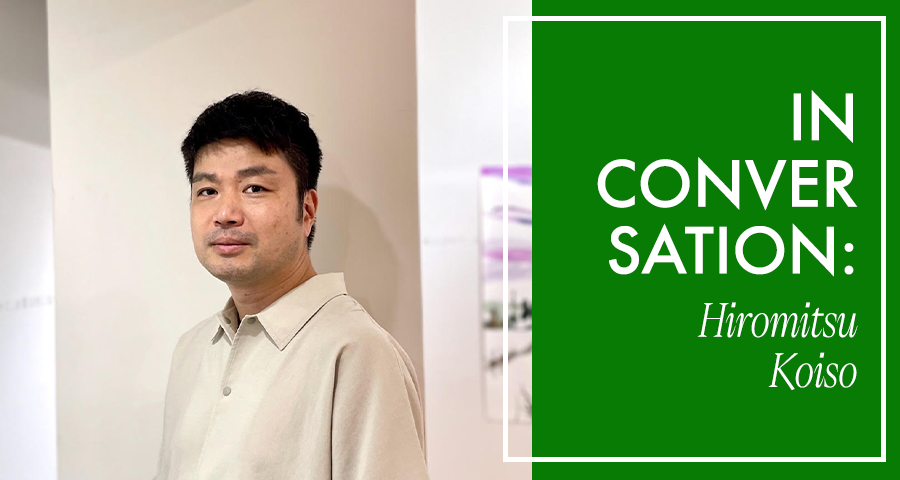
Hiromitsu Koiso’s path to becoming one of Japan’s most ruminative literary translators was anything but linear. It began, as he recounts, in the second-hand bookshops of western Tokyo, poring over paperbacks and comparing translations by seasoned Japanese translators, a sort of discipleship that would later lead him on a peripatetic route to the MA in Literary Translation and MA in Creative Writing (Poetry) programmes of the University of East Anglia in Norwich, United Kingdom. His body of work reveals a translator who is attuned to works of hybridity and gravitas, from the Sebaldian solivagant of Teju Cole’s Open City to the mythopoetic vestiges of Anne Carson’s Autobiography of Red. This extends to the works of Ocean Vuong, Isabella Hammad, Grayson Perry, Noor Hindi, and Ursula K. Le Guin, as well as more recent translation projects like Carson’s Wrong Norma (published on 10 January by honkbooks’ thoasa) and Bryan Washington’s Memorial (forthcoming in Spring 2026). He has also co-translated Japanese poets Kamiyu Ogyu, Naha Kanie, and Ayaka Satō into English.
When asked about influence, Koiso speaks less of particular poetic lineages and more of situating himself within and against literary history, and of navigating the orientalising gaze directed at Asian writers: a ‘gaze [that] shapes both how we are read and how we respond, creatively and intellectually.’
In this interview, I spoke with Koiso (who is in Tokyo) about his unorthodox career trajectory, the immersive craft behind recasting specific genres and texts, and the poetic reflection underpinning his work as a poet and translator who seeks to meditate on ‘how one’s present moment can be placed in relation to a much longer history.’
Alton Melvar M Dapanas (AMMD): Koiso-san, I want to begin with how you started as a translator. As a university student, you pored over Paul Auster and J.D. Salinger paperbacks at the second-hand bookstore Nishi Shoten in Kunitachi. By comparing your early attempts with the translations of seasoned practitioners like Motoyuki Shibata and Takashi Nozaki, you developed an appreciation for the craft. Yet you didn’t pursue translation right after university. So, what were the key moments that ultimately led you here?
Hiromitsu Koiso (HK): After graduating from university, I wanted to work in literary translation, but I had no idea how to enter the profession. Throughout my twenties, I worked various jobs while studying and trying to find my way into the field. I took temporary positions, worked in offices, saved money, and eventually decided to pursue postgraduate studies at the University of East Anglia in the UK.
I first learned about UEA’s MA in Literary Translation program and a particular centre for literary translation through the Japanese translations of W. G. Sebald. Discovering that Sebald had taught at UEA and helped establish the translation centre made a deep impression on me. I felt strongly that I wanted to study Literary Translation in the very place where he had lived, taught, and built a community for translators.
Meeting emerging translators working on Japanese literature, as well as other Japanese students passionate about translation studies, was incredibly encouraging as I tried to find my own path. At UEA, I especially enjoyed the classes taught by Jean Boase-Beier and Cecilia Rossi, where we studied translation theory and practice through poetry. In fact, it was through those classes that I first came to understand the real pleasure of poetry. Translating poems allowed me to engage with the richness of the genre. That experience made me want to devote myself to translating poetry. It even led me to start writing poems myself. During a later stay in the UK, I studied creative writing and strengthened my footing as a poet, feeling a fresh sense of joy in creating in a second language. But that is another story.
AMMD: Your first book-length translation was Teju Cole’s debut novel, Open City (2011), published in Japanese as オープン・シティ with Shinchosha in 2017, somehow bringing your journey full circle. Given that your decision to study at UEA was inspired by Sebald, could you share more about how that same connection later led you to Open City? Cole himself visited Sebald’s grave in Norwich, where UAE is located.
HK: It was the summer before the MA in Literary Translation programme began, and a bookseller at the Waterstones bookshop on the UEA campus recommended Teju Cole’s Open City to me. I told them I had come to UEA to study literary translation because of Sebald, that I was looking for interesting books, and that I hoped to translate and publish one in Japan. The fact that Cole had just visited Sebald’s grave at the time was not a direct influence on my translation project. It was simply a coincidence. Still, I think it was a wonderful one.
If Sebald influenced my approach to translating Cole’s prose, it was in my handling of dense, weighty language. I looked to the register of the Japanese translations of Sebald—particularly of Austerlitz (2001) and The Rings of Saturn (1995)—as a reference, and I believe they exerted a subtle influence on my work. Still, I felt Cole’s prose was slightly more poetic, and I tried to render that difference in the translation.
AMMD: Following on from that, I’d like to ask about the novel’s materiality. Open City is inextricably rooted in place: New York and Brussels in the flâneur-narrator Julius’s present, and Lagos from his past. Its rhythm is slow, almost photographic, like a sequence of still-life scenes. Given your approach to the prose, how did these elements (such as the specific atmospheres of those cities and the novel’s pacing) modulate your translation?
HK: For a translator, the source text is ultimately everything. That said, I was so deeply interested in the Manhattan depicted in Open City that I flew there and walked through the places described in the novel. During that visit, Teju Cole was kind enough to meet with me, and we even went to Chinatown together.
We tried to find the shop in Chinatown that appears in the novel but couldn’t locate it. It was then that Cole realized it was something he had invented. It was a memorable and rather amusing experience.
I wasn’t able to visit every location that appears in the novel, not only in the U.S., but also in Brussels and Lagos, so I relied on Street View on Google Maps to check the atmosphere of specific places, trying to experience them as if I were actually there.
When translating realistic, descriptive passages, I paid close attention to word order. In the English original, the narrator notices various elements within a scene sequentially, and I tried to reproduce that same order of perception in Japanese. Because English and Japanese differ significantly in grammatical structure and word order, this kind of adjustment is especially important in visually driven passages. Otherwise, the reading experience for Japanese readers could become quite different from that of readers of the original English.
AMMD: Your mention of fine-tuning word order to sustain a semblance of perception makes me wonder how this applies to a text that is hybrid. When you translated Anne Carson’s verse novel Autobiography of Red (1998), a work that was described as a ‘poet’s novel,’ into 赤の自伝 (Shoshikankanbou, 2022), what was your ethos in evoking its distinctive texture, especially since Carson was one of the first poets you explored when you began translating poetry?
HK: Carson is a fascinating poet because her work is not simply poetry. It is grounded in a deep love of classical literature, her use of language is inventive, she is herself a translator, and her writing unfolds through an ongoing dialogue with other texts. I’m particularly drawn to this hybrid quality: the way her work breaks down existing genre boundaries. Not only Autobiography of Red, but many of her works resist easy classification, and that resistance is part of their appeal.
Carson frequently uses quotation and allusion, and as a translator I had to trace the sources of these references. Given the breadth of her knowledge, tracking them down was a challenge, but it was also immensely educational. Translating her wordplay was especially enjoyable. There are relatively few works within the Japanese literary tradition that attempt something on this scale within the realm of poetry, so I feel I was able to introduce a truly remarkable work to Japanese readers and to the literary scene.
AMMD: I’d like to turn to another multivalent work: your translation of Grayson Perry’s The Descent of Man as 男らしさの終焉 (Film Art Co., 2019). When you first came across Perry’s nonfiction book in 2017, what compelled you to translate it? Was it the ethnocultural lens on masculinity, its relevance to contemporary Japan, or something else that made you feel it was a must-translate?
HK: In the 2000s, Japan experienced an extremely high number of suicides, averaging around 30,000 annually. This did not feel like a distant or abstract problem to me. I had already been interested in issues around masculinity for some time: ideas like men feeling the need to compete constantly, to win, or to believe they have to earn more than women. I kept asking myself where these assumptions come from. I began to wonder whether the reasons many men take their own lives might be directly tied to problems surrounding masculinity itself.
So when I came across the paperback of The Descent of Man in the late 2010s and read it, I immediately knew I wanted to translate it. At the time I discovered the book, there were very few titles in Japan, outside of academic writing, that addressed toxic masculinity directly, which was another reason I felt compelled to translate it myself.
AMMD: You translated a couple of Ocean Vuong’s poems, including ‘immigrant haibun.’ Given that some of your own English-language poems also pay homage to the haibun, what was it like to bring a haibun (written in English by an Asian poet in the diaspora) back to Japanese, the language where the literary form originated?
HK: Vuong’s ‘immigrant haibun’ is, as the name suggests, a haibun, and it includes haiku. In the original, the haiku is written in three lines, but I rendered it as a single line in my translation.
Attempting to carry all the information contained in the English-language haiku into Japanese would have been extremely difficult. I would have had to either abandon the 5-7-5 syllabic form or reduce the amount of information. I chose to stay committed to the 5-7-5 structure, which meant the Japanese version inevitably carries less information than the original.
Not only in this case, but when translating poetry in general, I think the translator inevitably engages with the text in a more active—or even subjective—way than when translating prose fiction. I find that mode of being a translator extremely interesting.
AMMD: The translator’s engagement with the text is indeed active, even subjective, and your journey as a translator has notably moved in both directions. You primarily work from English to Japanese, but you’ve also co-translated Japanese poets like Kamiyu Ogyu (with Polly Barton for Hanatsubaki), Naha Kanie (with Eluned Gramich for Cha: Asian Literary Journal), and Ayaka Satō (with Corey Wakeling for Asymptote). How does working solo on translations from English into Japanese compare to collaborating on translations from Japanese into English?
HK: Co-translation offers a very different experience from working alone. I find it especially enjoyable when translating poetry, as I can learn new ways of reading from my collaborator’s interpretations. They often introduce vocabulary and expressions I wouldn’t have thought of myself, which can be quite eye-opening.
It is also true that co-translation can sometimes lead to disagreements or even conflict, so it does require a certain amount of care and mutual trust.
AMMD: How have other poets and writers influenced your creative and intellectual approach?
HK: Influence is difficult to judge directly. I believe my writing has been shaped by all the writers and poets I’ve read closely over the years.
For example, during my MA in Creative Writing (Poetry), someone remarked that my writing possessed something like Wisława Szymborska’s ironic precision. When I wrote haibun, I was told it echoed both Matsuo Bashō and Lydia Davis. These are not lineages I consciously set out to follow, but they suggest how reading across languages quietly enters one’s work. Writing poetry in English, my non-native language, also gives me a sense of freedom. Linguistically and formally, I feel less constrained, and I think I learned that kind of formal freedom above all from Anne Carson.
Rather than being shaped by any single figure, I’m more interested in how one’s present moment can be placed in relation to a much longer history and how I might situate myself within that history, or against it. I’m also deeply interested in the orientalizing gaze directe toward Japanese and Asian writers, and in how that gaze shapes both how we are read and how we respond, creatively and intellectually. These questions, rather than specific models, continue to guide my work.
AMMD: Let’s dive into dream translation projects. Are there any authors you’d like to translate?
HK: I would love to translate Poems from the Edge of Extinction (edited by Chris McCabe, 2019)—an anthology featuring 50 poems originally composed in endangered languages, curated in English—into Japanese.
AMMD: Two of your latest translations are Anne Carson’s intertextual, multimodal poetry collection Wrong Norma (out since January 2026) and Bryan Washington’s queer romance novel Memorial (coming out this Spring 2026). Could you talk about these two varying books, and what initially attracted you to them?
HK: I felt that Wrong Norma was a poetry collection that distilled everything Anne Carson has been working toward over the years. It is both monumental and humorous, classical and yet strikingly new, with poems unfolding across a wide range of forms.
Memorial, on the other hand, is set partly in Japan (in Osaka) and includes Japanese elements, but it felt different from other novels set in Japan. It felt fresh! I was drawn to the way it explores intimacy between people and questions of family. The novel moves between two kinds of conversation: face-to-face dialogue and exchanges conducted through text messages and photographs. The differing speeds and dynamics of these modes felt especially new to me.
Hiromitsu Koiso (小磯洋光) is a Japanese literary translator and poet based in Tokyo. He obtained his MA in Literary Translation and MA in Creative Writing (Poetry) degrees, both from the University of East Anglia in the United Kingdom. Writing and translating in both English and Japanese, his original poems have been published in prestigious journals such as Poetry Magazine (USA) and Gendaishitecho (Japan). He has translated Anne Carson, Teju Cole, Ursula K. Le Guin, Grayson Perry, Isabella Hammad, and Ocean Vuong into Japanese. He was one of the guest editors for the 102nd issue of British literary magazine Wasafiri: International Contemporary Writing, which was a special issue on Japanese literature. Most recently, he received the inaugural Toshizo Watanabe Democracy Fellowship from the Japanese American National Museum.
Alton Melvar M Dapanas (they/them), essayist, poet, and translator from the southern Philippines, is Asymptote’s editor-at-large for the Philippines and author of three books of prose poetry and lyric essays including M of the Southern Downpours (Australia: Downingfield Press, 2024). Their original writings and translations (published from South Africa to Japan, France to Singapore, and translated into Chinese, Damiá, German, and Swedish) appeared in World Literature Today, BBC Radio 4, Michigan Quarterly Review, Sant Jordi Festival of Books, Wasafiri, and the anthologies Infinite Constellations (University of Alabama Press) and He, She, They, Us: Queer Poems (Macmillan UK). Formerly with Creative Nonfiction magazine, they’ve been nominated twice to the Pushcart Prize for their lyric essays. Find more at https://linktr.ee/samdapanas.
*****
Read more on the Asymptote blog: