
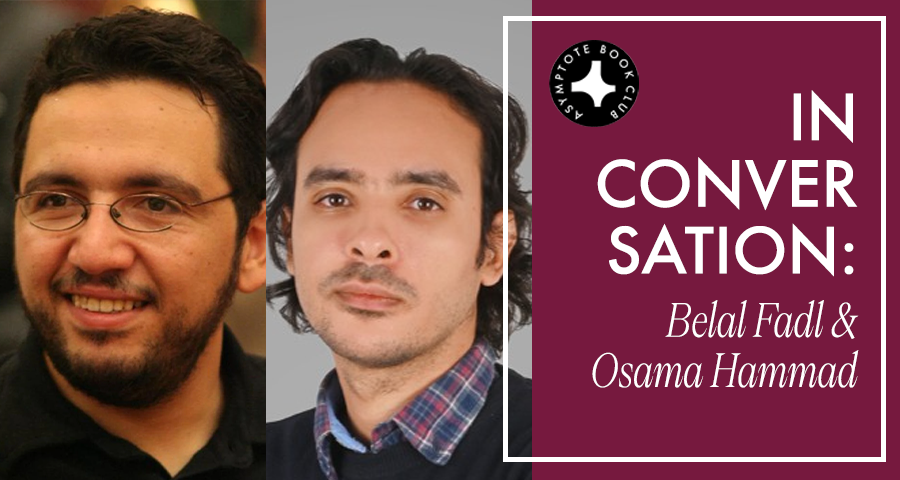
In The Completely True Tales of Um Mimi and Sharawi the Adulterer, Egyptian screenwriter and author Belal Fadl introduces the underground of Cairo with fierce humor and unbridled intensity, drawing on the vividity of vulgarity and the frenzy of the marginalized to capture the explosive nature of the capital. The book was banned in Egypt, though achieved notoriety beyond the nation for both its style and content, lauded for its refusal to censor or sanitize. In this interview, Fadl and translator Osama Hammad speak to us about authorial honesty, the book’s colorful reputation, and about what it means to face reality in fiction.
The Asymptote Book Club aspires to bring the best in translated fiction every month to readers around the world. You can sign up to receive next month’s selection on our website for as little as USD20 per book; once you’re a member, join our Facebook group for exclusive book club discussions and receive invitations to our members-only Zoom interviews with the author or the translator of each title.
Ibrahim Fawzy (IF): Belal, how did The Completely True Tales of Um Mimi and Sharawi the Adulterer first come into being?
Belal Fadl (BF): It grew out of my personal experience as a student at Cairo University in the 1990s—though I wasn’t thinking of it as a novel. Like many other writers, I believed my first novel had to be epic, something like Dostoevsky’s Crime and Punishment. You start with imitating the works that impress you, and only later do you discover your own voice. García Márquez’s greatest tip is to write what you know.
When I started writing short stories during my journalism work in 1995–96, I tried—unsuccessfully—to write a story about a barber called Sharawi (from the Arabic word for hair). I don’t know why I chose him, but maybe because a barber can be such a distinctive character. I failed, but I felt that the material belonged to something longer and deeper.
The stories I wrote were far removed from the world of Um Mimi and Sharawi, and I became preoccupied with screenwriting from 1998 onward. Still, Um Mimi remained present in my mind. I even put her name into a line of dialogue in a very popular comedy film, El-Basha Telmeez (The Student Cop). I didn’t intend her as an Easter egg or anything like that; she was simply an obsession resurfacing.
Later, I started writing a column for the newspaper Al-Dustur entitled “The Native Inhabitants of Egypt.” Around that time, I also began writing directly about my experience in Cairo and Giza, and I started publishing the first draft of this novel in Al-Dustur in 2005. I didn’t expect tremendous success, especially since it was only a first draft, and it still took another fifteen years for the novel to finally see the light as a book.
IF: I’ll move to Osama now, to talk about the translation. Why did you decide to translate this book?
Osama Hammad (OH): For me, it was one of the best impulsive decisions I’ve made. At that point, I was still hesitant about moving into full-time translation. I was doing small gigs, but literary translation had been a dream for a long time. I then started a translation course at the American University in Cairo and began pitching books to publishers.
While I was reading the novel, it felt relatable. I came to Cairo as a student; I lived in shared apartments with other students until I moved to the student dorm; sometimes five of us lived in one room; sometimes two of us lived in what used to be a bathroom. I once lived in a building where there was an old woman—ninety-something—who sat in the street all day. Kids would provoke her, and she would fire back with the sharpest insults, with an entire arsenal of swear words.
So, for me, there was the familiarity of the language, as well as of certain aspects of the novel’s world. I hadn’t lived the exact same experience—the full adventure—but parts of it really were part of my life. I knew I should translate it into English.
But if I had read it when I was twenty, I don’t think I would have made the same decision. At a younger age, you have a different perspective on life, you think of morality differently. You want a cleaner version of reality; you want everything you read to reflect a rosy vision of the present and the future. But the more I lived and saw, the more I became a proponent of Belal’s type of writing.
IF: What did you think about the novel making it to the longlist of the International Prize for Arabic Fiction in 2022?
BF: I’m not a big fan of literary prizes. I think they’re silly, and I have strong opinions about the surrounding culture too. But my Iraq-based publisher, Mada, asked me to submit the novel to the International Prize for Arabic Fiction. I told them I wasn’t sure, but they said: “Since we published the novel, nobody has written a line about it because you’re banned in Egypt. The novel didn’t even appear in the universe.” So I agreed.
I was lucky that year, because the chair of the judges was the great Tunisian writer Chukri Mabkhout, the author of The Italian. There are similarities in language and environment between his writing and mine—and I was also lucky because the jury wasn’t dominated by Egyptians, so maybe there was less local pressure.
When the longlist was announced, Al-Ahram—the biggest newspaper in Egypt—published the entire longlist except my book. It was absurd, but I was happy for my publisher. Suddenly many websites and newspapers abroad started covering the book. People began asking how an “obscene” or “vulgar” novel ended up on that list. For me, honestly, it felt like a gift from heaven.
IF: At what point does realism risk becoming complicit in the violence it depicts? Did you ever feel you were crossing a line?
BF: Honestly, as a writer, it’s impossible for me to think about taboos and reservations while working. Of course there’s a conscious part to the process, but if that part takes control, the work becomes filtered, sanitized, and inauthentic. I believe the most important thing is to be honest—with yourself, with the world you’re writing about, and with the characters. Don’t worry about reactions, whether positive or negative. Don’t even think about taboos, or moral values. If you do, you’ll become more preoccupied with them than with the characters, and you’ll stop focusing on the act of storytelling. And once the novel is published, you have to accept your fate.
I don’t think the novel shocked those who have lived in the environment it depicts. They didn’t feel that it contained exaggeration or violence. But for those who haven’t seen that world, it’s natural to be shocked. I understand that, but I can’t do anything about it. I tried my best to be honest, and once I delivered the novel to the publisher, I cut my ties with it. I don’t worry about what happens afterward.
IF: The narrator survives Um Mimi’s world, but doesn’t redeem it. Was that refusal of redemption an ethical decision, a political one, or simply the most honest ending you could allow?
BF: That’s one of the good things about literature: you don’t write in order to satisfy readers. And honestly, I think you answered this in your excellent review. If you were a seventeen-year-old student with the same psychological, social, and cultural formation, you would probably do what the narrator does: run away and save your own life.
When I started writing, I was in my late twenties, and when the novel was published, I was almost forty-seven. I faced the cruelty of reality with writing. If I didn’t confront it then as a young student, I can confront that history now through literature. I refuse to look away from what I’ve seen—what Osama saw, what many people saw. Maybe that, in itself, is a kind of redemption, a way of facing reality without denial.
IF: This leads to a follow-up question for Osama: in this process, were you a witness, a co-conspirator, or a shield between languages?
OH: I think “co-conspirator” is right because people treat texts like this as secrets, but the moment you translate it, you’re already complicit in making it public. Also, I made a conscious choice. I pitched the translation; I wasn’t commissioned. So, I decided to translate it and to keep the language as much as I could, so that an English reader could have an experience as close as possible to the Egyptian reader—even taking into account that perceptions will differ.
IF: The flat that the narrator finds himself in functions like a microstate. Belal, did you consciously design it that way, or did it emerge organically from memory?
BF: My arrogance wants to say I did, but honestly, no. That never crossed my mind while writing. What made me happy was reading interpretations like yours about the characters, the environment, the structure. That’s the greatest success a writer can hope for. The novel is a mixture of events I witnessed in my own life, and other events that happened to different people in different years. It’s not a memoir of my youth. But I tried to be honest to the story as it formed in my imagination.
Maybe this comes from moving across genres. I wrote for cinema, TV drama, and journalism, so I’m always aware of the differences. And for this kind of storytelling, I wanted it to feel as if I were speaking to a passenger sitting beside me on a train. You don’t explain the political structure to that passenger; you keep them listening for the whole journey. Maybe because of that, you found a political structure in it. I’ll take the credit, but it wasn’t on my mind.
IF: And what about the namelessness of the street?
BF: Several reviewers assumed that was a deliberate artistic choice. In reality, it’s simply factual. In Egypt, you can find streets without names; people in other countries sometimes don’t believe it, but it happens. All I did was change the casino’s name for legal reasons. In the novel, it’s “the street behind Casino Isis.” In reality, the casino has another name, but as a writer, I recognized the power of that detail and made sure it stayed in the book.
IF: Was there ever any self-censorship going on while working on this book?
OH: One of the benefits of translating into English is that it’s different from translating into Arabic. When you translate into Arabic, you often do a lot of self-censorship because you anticipate the publisher’s expectations of “cleanliness.” In English, audiences are generally more accepting of language, no matter how vulgar or expressive. So no, I didn’t feel the need. Doing so would also be a betrayal of the novel’s essence. One of its main characteristics is the obscene language, and it’s integral to the characters’ personalities and their daily life.
BF: When English audiences watch a Samuel L. Jackson movie, they count the f-words. As a screenwriter, I always envied that, because we can’t do the same in Egypt. I worked ten fruitful years as a screenwriter, and I had constant clashes with censorship. They treated my movies as obscene, even in their portrayal of everyday conversations. When I started publishing the novel weekly, one chapter at a time, I wanted to challenge the audience, to test how people would react to the events and the language—but I couldn’t publish the real profanities in the newspaper. There would be legal consequences, not only for me, but for the publication. So, I put the vulgar words in parentheses, sometimes with only the first letter, because I wanted to tell readers that they know profanity exists. They know the word, and they know I can’t publish it, as we live in a society of hypocrisy and double standards. Every week the newspaper received letters complaining about profanity and vulgarity, even though I hadn’t clearly written them. So, when I published the whole novel, I resolved to write it as it should be written. But honestly, moving outside of Egypt at the end of 2014 encouraged me to write more freely. If I were still living in Egypt, I might end up in prison, like Ahmed Naji.
I want to also add that the profanity is calculated. Not every character uses it, and not in the same situations, so I’m open to being judged on how the curses operate. Would someone from this background use that specific word at that moment? Judge me on that, not on some fantasy of how Egyptians should speak. I’m not responsible for society’s behavior. I’m responsible for my characters and my world. Judge me on that.
OH: Also, in Egyptian society, language becomes the main tool for measuring morality. People really do judge you by the words you use; they categorize you as good or bad based on speech, regardless of what you do in private life. You might embezzle money, but if you don’t swear, you’re treated as respectable.
BF: Yes. I once said something like this in a video, and it got clipped and went viral: “Some have an issue with describing ‘pimping’ as ‘pimping,’ but they have no problem with the act of pimping out itself.” That contradiction is a major crisis in our society, and we must face it the way we face dictatorship. Otherwise, we will keep repeating the same mistakes.
IF: Is humor here a form of resistance, a survival mechanism?
BF: I don’t even like calling it “humor.” I prefer “absurdity.” In Egypt, the absurd isn’t just a tool of resistance or survival—it’s inseparable from the fabric of life itself. In my opinion, that’s why anyone who takes things too seriously in Egypt eventually fails, whether they’re rulers or opponents. If Hosni Mubarak had taken things seriously, he wouldn’t have stayed in power for thirty years. He would have died early, like Nasser or Sadat. The absurd is embedded in the structure of society.
IF: Osama, how do you handle humor that depends on local idioms, political satire, or culturally specific irony? Does translating humor become cultural negotiation rather than linguistic transfer?
OH: I tried to take a practical approach, to make the humor approachable for an English reader. You’re lucky if something can be translated closely, word by word. When you can’t, you have to find another route. At some points I tried footnotes, but I ended up not using them. I focused on preserving the humor itself, making it work in English while keeping the meaning intact.
IF: Imagine this book was written today—not about the 1990s Cairo, but present-day Cairo. What would be unsayable now that was sayable then?
BF: I left Egypt in 2014, and for years I followed what was happening closely. But when I turned fifty, I stopped out of concern for my health and energy. I don’t have unlimited time; I need to invest my remaining years in something useful. So, maybe I’m not qualified to answer precisely, but in general, the characters that the novel depicts are sadly no longer confined to certain streets or neighborhoods in Cairo, Giza, or Alexandria. They’ve become cancerously widespread, because poverty has expanded and social and economic discrimination against Egyptians has intensified.
Belal Fadl is an Egyptian journalist and screenwriter, born in Cairo in 1974. After graduating from the journalism department of the Media College of Cairo University, in 1995 he co-founded Al-Dustur newspaper, one of the most successful initiatives in journalism in Egypt in the 1990s. When it closed, he worked for several papers and TV channels. In 1999, he co-founded the Cairo newspaper issued by the Ministry of Culture and worked as a producer for the ART and MBC channels. He then worked as a screenwriter, writing scripts for a number of films and TV series, such as the series, People of Cairo, which won a prize for best Arab TV series in 2010. He has published twenty books, including four short story collections and The Completely True Tales of Um Mimi and Sharawi the Adulterer (2020), his debut novel.
Osama Hammad is a Cairo-based literary translator with a background in journalism, screenwriting, and audiovisual translation. He has translated fiction, essays, and screenplays between Arabic and English, with work appearing in ArabLit, The Antonym, and Progressive International. His translation of The Completely True Tales of Um Mimi and Sharawi the Adulterer marks his full-length debut. He holds professional diplomas in media and literary translation from the School of Continued Education at the American University in Cairo.
Ibrahim Fawzy is an Egyptian writer and literary translator working between Arabic and English. He holds an MFA in Literary Translation from Boston University and both a BA and MA in Comparative Literature from Fayoum University, Egypt. Fawzy’s translations have been featured in various literary outlets. His accolades include a 2024-25 Global Africa Translation Fellowship, a 2024 PEN Presents Award, and the 2024 Peter K. Jansen Memorial Travel Fellowship from ALTA.
*****
Read more on the Asymptote blog: