
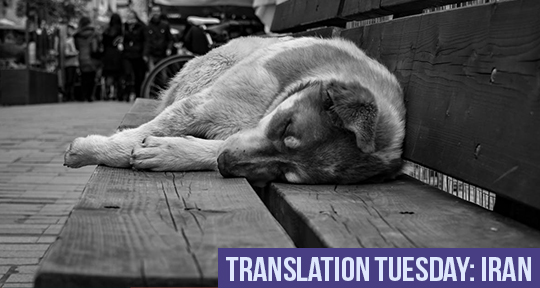
One person’s suffering is, very often, someone else’s joke. Pat, the dog at the center of this week’s Translation Tuesday, has never spoken with a human being, but he understands this well. Following an accident that separates him from his owner, Pat’s life is reduced to a pathetic spectacle in Varameen square, begging for scraps of food from a crowd of shopkeepers and street vendors who think it good luck to beat him often, their enthusiastic cruelty only escalating as Pat’s body and mind deteriorate. What follows is, at once, a powerful meditation on the suffering of non-human animals and an indictment of human cruelty in the face of nature’s capriciousness. Written in blunt, sensuous prose by Sadegh Hedayat and elegantly translated by Manoo Mofidi, “Stray Dog” is sure to haunt and alarm. Read on.
A few small stores—a bakery; a butcher shop; an apothecary; a coffee shop; and a barber shop, all of which there to halt hunger and provide life’s basic daily needs—formed Varameen Square. The Square and its people, under the brutal sun, half-burned, half-naked, longed for dusk’s first breeze and the evening shade. The people, the shops, the trees, the animals were all lethargic. The hot air weighed heavy, and a soft dust haze undulated in the cerulean sky, with the car traffic adding to its density.
On one side of the Square stood an ancient sycamore tree, trunk hollowed, bark frayed, but which, with ever more stubbornness, had stretched out its crooked and sickly branches. A wide platform had been set up under the shade of the dusty leaves of the tree, where a couple of kids were selling rice pudding and pumpkin seeds, lyrically beckoning passersby. A thick, muddy water toiled its way through the brook in front of the coffee house.
The only structure that stood out was the famous tower of Varameen, half of whose cracked cylindrical body could be seen with a cone on top. The sparrows nesting in the crevices of its fallen bricks were napping, having been silenced by the heat. Only the intermittent cries of an approaching dog broke the quiet.
He was a Scottish breed with a charcoal snout and legs covered with black spots, as if he had run through mud and been spattered with it. Amidst the fan-like ears, bushy tale, and wavy filthy fur, two eyes with human intelligence shone on his hairy snout. In the depths of his eyes could be seen a human spirit; in the half-light that engulfed his life, something infinite undulated in his eyes and carried a message, hard to discern but lodged behind his pupils. It wasn’t light or color; it was something implausible, akin to that manifest in the eyes of a wounded deer. It was more than just a resemblance between his eyes and human eyes; it was a kind of parity. Two hazel eyes full of pain, torment, and expectation which could only be seen on a lost dog. But it seemed like no one was seeing or understanding his pained, imploring eyes. In front of the bakery, the helper would hit him. In front of the butcher, the assistant would throw stones at him. If he took refuge under the shadow of a car, he would be greeted with the kick of the heavy cleats of the driver. And when folks would grow tired of tormenting him, the kid selling rice pudding took special delight in torturing him. In response to every moan, he would receive a stone to his side, and his groans were followed by the guffaws of the stone-wielding kid and a loud “son of a gun!” It seemed like everyone in that square had conspired to slyly encourage the laughing, tormenting kid; they would burst into laughter. Everyone was hitting the dog for God’s sake. To their eyes, and in their minds, it was quite natural to taunt and needle an unclean dog, cursed by religion, and reputed to have seven lives, for divine rewards.
The kid selling rice-pudding hounded him so much that the animal fled to a street that led to the tower, dragging himself with difficulty on an empty stomach and finding refuge in the drain. He laid his head on his paws, panting with his tongue out, half-asleep, half-awake, and watched the undulating green field. His body was tired, his nerves in pain. In the damp air hovering over the path of the water, a special tranquility suffused his entire body. The different smells of the wizened patch, an old soggy shoe, the smell of dead things and those still alive—all resurrected faded and jumbled memories for him. Each time he paid attention to the meadow, his instinctive desires would awaken and stir the past reminiscences in his mind. This time, though, the sensation was so strong, it seemed like a quiet voice in his ear was prodding him to jump and play. He felt an unrestrained desire to run and jump and tumble in the field.
This was his inherited sensibility, for all his ancestors in Scotland were raised and allowed to roam in the open grass fields. But his body was so beaten down, it didn’t give him permission for even the slightest movement. He felt a painful sensation, an admixture of helplessness and frailty. An array of forgotten and lost feelings erupted to the fore—his various obligations and needs. He felt duty-bound to be at the ready on his owner’s command, to chase away a stranger or an alien dog from the house, to play with his owner’s kid, how to act around familiar people, how to reconcile himself to strangers, to eat at the right time, when to expect to be petted and stroked. But now he was relieved of all these obligations.
All his attention was now focused on finding, with fear and trepidation, a morsel of food from the heaps of trash, and on being smacked around and howling from the beating. Howling had now become his only method of self-defense. Before, he was courageous, fearless, clean, vivacious. Now, he was timid, abased. Every sound he’d hear, or if something moved near him, he’d tremble; he was even afraid of his own sound. He’d grown accustomed to filth and squalor. His body itched but he lacked the patience or desire to nibble his fleas or lick himself clean. He felt he’d become part of the trash, that something had died in him, snuffed out.
Two winters had passed since he’d sunk into this hellhole, since he’d had a proper meal, a comfortable sleep. His appetites, his desires, his feelings—all were quelched. No one in that time had stroked him with a caring hand, had bothered to look into his eyes. Some folks in the Square resembled his owner, but his owner’s sensibilities, manners, and conduct towards him were worlds apart from those of the people in the square. It seemed to him that those people he associated with before were closer to his world, understood his pains and feelings, supported him more.
Of all the scents that wafted to his nose in that moment, the smell that made him most dizzy was that of the rice pudding sitting in front of the kid on the stand. That white delicacy, which looked so much like his mother’s milk and rekindled his childhood memories, suddenly benumbed him. He thought of the time he sucked that warm, nutritious liquid from his mother’s nipples, while his mother’s soft but strong tongue licked him clean. The strong scent he smelled while in his mother’s embrace and in the vicinity of his brother, that pungent and heavy scent of his mother and her milk awakened in his nose.
As soon as he’d become milk-drunk, his body would grow warm and ease up and a warmth would flow in his veins. Head-heavy, he’d latch off his mother’s nipple, and a heavy sleep, which sent exhilarating chills through his body, would overcome him. No more joy was possible when his hands would unwittingly squeeze his mother’s nipples, and milk would trickle. His brother’s soft fur, his mother’s voice—all of these were full of pleasure and worth caressing over. He recalled his wooden kennel and the games he played with his brother in the yard.
He’d nip his brother’s fan-shaped ears, they would wrestle, tumble, run, and then he would find another playmate, his owner’s son. He’d chase him around the orchard, yap, and nip at his clothes. He’d never forget his owner’s strokes and caresses, the sugar cubes he’d taken from his hands. But he liked his owner’s son more because he was his playmate, and he never spanked him. Later, and suddenly, he lost his mother and brother; only his owner, his son, his wife, and an old servant remained. He recognized the scent of each one, and he could make out the footsteps of each one from afar. At lunch- or dinnertime, he’d circle the table and smell the food, and occasionally his owner’s wife, despite her husband’s opposition, would give him a morsel full of kindness and affection. And then the old servant would come and call him, “Pat, Pat,” and pour his food in his special plate that sat next to his wooden kennel.
Pat’s intoxication was the cause of his misfortune. His owner didn’t let Pat leave the house and chase after the female dogs. It just so happened that one Fall day his owner, along with two others whom Pat knew and who had been to the house, sat in a car and called out to Pat and tucked him next to themselves. Pat had traveled in the car with his owner several times, but that day he was inebriated and felt especially anxious and agitated. After a few hours, they got out at this same Square. His owner and the two other passengers walked past this same alley next to the tower. In that moment, the scent of a female dog, the scent he was searching for, suddenly made him go crazy. He sniffed in various directions, and finally entered the orchard from the brook. At dusk, he twice heard his owner calling for him, “Pat…Pat! Was it really his voice? Or was it an echo of his voice that was circling in his ear?
Although the sound of his owner’s voice produced a strange effect inside him, for it reminded him of all the commitments and responsibilities he felt he owed him, but the supernatural force lying beyond the physical world had compelled him to stay with the female dog, so much so that his ears fell stone-deaf and dull to the outside world. Intense feelings had been aroused in him, and the scent of the female dog was so strong and pungent that it sent his head spinning.
All his muscles, his entire body, and his mind had escaped his command; he had no will to command. It wasn’t long before he was met and chased off with sticks and spades and forced to leave the area.
Dazed, confused, and exhausted, but light and relieved, Pat went looking for his owner when he came to. A diluted scent of his owner lingered in a couple of alleys. He searched them all by marking evenly spaced distances. He went to the landfill and came back because he sensed that his owner had returned to the square. But the weak scent of his owner would soon disappear among all the other scents. Had his owner left without him? Had he forgotten to take him? Fear and agitation overtook him. How could Pat live without his owner, without his god. He was sure, though, that his owner would come looking for him. Frightened, he started running in the streets. His efforts were in vain.
Finally, exhausted and alone, he returned to the square, with no sign of his owner. He walked a few more laps in and around the square before returning to the path near the stream that had taken him to the female dog. This time, though, the path had been blocked with rocks. He tried digging the ground to enter the orchard, but it was impossible. Disappointed, he laid down and napped.
Around midnight, the sound of his own wailings startled Pat out of sleep. Frightened, he got up. He prowled a few alleys, sniffed the walls, and aimlessly wondered the streets. He felt strong hunger pangs, and when he returned to the square, the piquant smell of various foods hit his nostrils: leftover meat from the previous night; fresh bread and yoghurt. All these smells mixed together. He felt responsible, blamed himself for trespassing onto someone’s property. He now had to beg from these people who looked like his owner. He thought that if a rival doesn’t appear, prompting the people to chase him away, gradually he could assume the right of ownership over this territory and perhaps one of the people with foods in their hands would take care of him.
With trepidation, hesitation, and unsure steps, he walked to the front of the bakery, which had just opened, filling the air with the sweet and sour smell of baked dough. A person holding bread under his arms beckoned him, “come, come!” How strange and unfamiliar that voice was to his ears. The man threw a piece of warm bread in front of him. After a little hesitation, Pat ate the morsel and wagged his tail for the man. The man placed the bread on a bench in front of the store and, with fear and reservation, petted Pat’s head. Then with both hands he removed Pat’s leash.
What instantaneous comfort he felt. It felt like he was at once relieved of all his responsibilities, obligations, commitments. But just when he wagged his tail again and approached the bakery’s owner, he was kicked on his side and he retreated, wailing. The owner carefully cleansed his hands in the nearby brook. Pat still recognized his leash, which was hanging in front of the bakery.
From that day, Pat received nothing but kicks, rocks and blows, of sticks from those people. It seemed to him that all were his blood-thirsty enemies and took pleasure in torturing him.
Pat felt he’d entered a strange, new world, one that he didn’t understand and one that did not understand him—his feelings, his world. The first few days of his new existence were hard, but then slowly he got used to it. In addition, at the turn of the street, on the right side, he’d spotted where trash was dumped. In that pile, he could find juicy and delicious items—bones, fat, skin, fish heads, and other foods he couldn’t quite make out. And then he’d spend the rest of the day in front of either the butchery or the bakery. His eyes were fixed on the butcher’s hands. His share of scrumptious bites always was worth his beatings. He’d grown accustomed to his new life. All he could remember, all that remained, from his past life were vague, faded feelings, certain smells. Whenever he had a difficult spell, he’d find in that lost heaven a certain comfort, an emotional escape route, and memories of those times would unconsciously form before him.
But what tortured Pat the most was his need for being stroked, comforted. He was like a baby who had been beaten and cussed at all his life, but whose diluted but still tender sensibilities and feelings had not yet been extinguished. With his new life laden with pain and suffering, he needed to be stroked more than ever. His eyes begged for this caressing, and Pat was ready to give his life for someone to show him kindness and pet his head. He needed to show his kindness to someone, to devote himself to someone, to show his sense of worship and loyalty to someone. But it appeared that no one needed him to express his feelings. No one supported or protected him. When he looked into people’s eyes, he detected nothing but rancor, spite, wickedness, and it seemed that any movement that he performed to grab these peoples’ attention only stoked their anger and disfavor even more.
In that condition, while napping, Pat moaned a few times and woke up. It felt like nightmares were slowly passing before his eyes. In that moment, Pat felt a strong pang of hunger; he whiffed the scent of kabob. Hunger was torturing his insides, so much so that Pat forgot his others pains and infirmities. He got up slowly, painfully, and went towards the Square with apprehension and dread.
*
There, a car noisily entered the Square, whipping up dirt and smoke. A man got out and went towards Pat and petted him. The man wasn’t his owner; Pat wasn’t fooled, for he knew well his owner’s scent. But how was it that someone appeared and was stroking him? Pat wagged his tail and looked at the man with doubt, hesitation. Had he been deceived? He no longer had a leash that would allow folks to pet him. The man turned and stroked Pat again. Pat followed him. His surprise only grew when he saw the man enter a room that he knew well and from where came savory scents of food. The man sat on the bench next to the wall. He was brought warm bread, yoghurt, eggs, and other foods. The man dipped the bread in the yoghurt and threw bites in front of Pat. At first hastily but then slowly, Pat ate the morsels, fixed his contented and pained hazel eyes on the man’s face in gratitude, and wagged his tail. Was he awake or dreaming? Pat had now eaten a stomach-full of food without once being interrupted by a beating. Was it possible he’d found a new owner? Despite the heat, the man got up and went to the street with the tower. He paused and then walked the winding side-streets and alleys until he left the populated part of town and reached that same dilapidated walled section that Pat’s owner had gone to. Maybe these people chased the scents of their own mate, too? Pat waited for the man in the shadow of the walls, and then they both returned to the Square from a different direction. The man again stroked Pat and, after walking the Square, sat inside one of the cars Pat recognized. Pat didn’t have the courage to climb in, so he sat next to the car, staring at the man.
Amid the flying dust, the car suddenly started moving, and Pat, without hesitation, started running after it. No, this time he didn’t want to lose this man. He was panting and, despite the pain he felt everywhere, galloped after the car. The car left the town and was passing fields. Pat reached the car a couple of times but then lagged behind. Pat had gathered all his strength and was jumping and leaping hopelessly. But the car moved faster than Pat did. He had miscalculated: not only did he not reach the car, but he had become broken and debilitated. He was faint from his exertions, and he suddenly felt that his limbs were no longer in his control, that he couldn’t move an inch more. All his efforts were in vain. He didn’t know why he’d run, where he was going. He’d now neither a way forward nor a way back. He stopped, panting, his breath ragged. His tongue was out; it had grown dark in front of his eyes. With his head stooped and with difficulty, he crawled off the road and went towards a ditch near a field and put his belly on the hot, damp sand. His instinct, which never deceived him, told him he couldn’t move from that place. He was dizzy; his thoughts and feelings had faded, dulled. He felt a searing pain in his belly. A sickly light shined in his eyes. During his convulsions and writhing, his limbs slowly became numb. A cold sweat coursed its way through his body and enveloped it entirely, a gentle, intoxicating coolness.
*
At dusk, three hungry ravens were circling above Pat. They’d picked up his scent. One of them landed next to Pat, hesitated, and looked at him carefully. When it realized Pat hadn’t died yet, it flew away. The three ravens had come to take out Pat’s hazel eyes.
Translated from Farsi by Manoo Mofidi
Sadegh Hedayat (1903–1951) is regarded as one of Iran’s greatest writers of the twentieth century. Hedayat wrote plays, novels, short stories, and criticism. He introduced modern European writers to Iran, translating works by Franz Kafka, Jean-Paul Sartre, and others. Hedayat translated many of Kafka’s works, including “In the Penal Colony,” for which he wrote a revealing introduction called “Payām-e Kafka” (“Kafka’s Message”). A pivotal figure in Tehran’s intellectual circles, Hedayat introduced modernist techniques into Persian fiction. his novel Blind Owl is considered to be the earliest modernist work written in Persian and one of the great Iranian novels of the twentieth century.
Manoo Mofidi was born in Iran, and, as a member of the Baha’i Faith, a persecuted religious minority, left the country in 1979 and came to the United States as a religious refugee at a young age. Manoo credits Ms. Terri Provenzo and Mr. Mark Tasch, his elementary school teachers in Buffalo, N.Y., for his deep love and appreciation of English. He credits and thanks his mom, a martinet par excellence, for his deep love and appreciation of the Farsi language and Persian culture, and for demanding the speaking of Farsi (and only Farsi) at home, for insisting on matching any piece of reading in English (required or recreational) with one in Farsi, and for prohibiting the mixing of the two languages to express a thought or even make a request! Manoo practices law at Thompson Coburn LLP in St. Louis, Missouri, and teaches at Washington University in St. Louis.
*****
Read more from the Asymptote blog: