
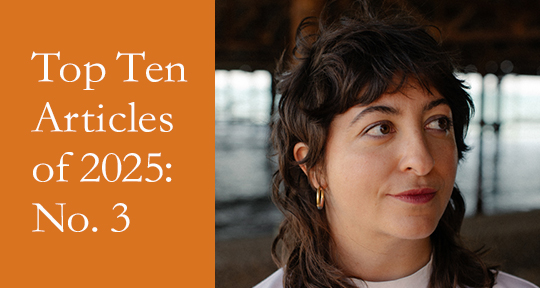
Our third most widely read piece of 2025 hails from our Fall issue: a fascinating interview with literary translator Jen Calleja conducted by Assistant Interview Editor Sarah Gear. Much of this discussion is anchored by Calleja’s experimental memoir, Fair: The Life-Art of Translation (Prototype, 2025), the summative advice of an industry veteran with a body of over twenty translated novels from German (including International Booker Prize nominee The Pine Islands by Marion Poschmann).
Needless to say, Calleja is a worthy mentor for aspiring translators. Here, she offers a deeply informative dive into the niche. The distilled life lessons in Fair are many, and as Gear says, it reads as both an “inspiration and manifesto.” This interview also spans the lives of translators in general, challenges of the field, and the implications of AI.
A key theme to anchor the discussion: What does it mean to be a translator? Calleja boldly takes this on, describing the core of it as “holding hope for dialogue and understanding that is face to face.”
Such a loaded question deserves further exploration. Literary translation is clearly not without challenges, Calleja goes on to point out. From the school-level, there is a lack of institutional support to encourage language learning. Structural challenges extend to predatory publishing practices that underpay translators and deep-set biases in acquiring work (Calleja has never been asked to translate a nonwhite author). The fight for fair pay is an ongoing, de-moralizing struggle.
It can feel very risky, and it feels more and more risky, and eventually I will stop. Other people will stop. Then there won’t be any experienced, passionate literary translators. Literary translators won’t exist unless they come from monied backgrounds or don’t have to rely on a job. That then perpetuates this idea that literary translation is just a hobby, when actually it should be properly paid.
The unfortunate reality is that literary translation is often underappreciated in the mainstream publishing world. With the current fearmongering surrounding AI, there is anxiety that clinical translations will undermine the value of this work.
Calleja offers this advice:
If you use AI there’s a loss of process—art process, theatre making, translation. I think we have to be the generation of talking about process. So just ignore the idea of product, and just obsess over how are we getting there, what do we gain from process, personally, creatively, what do you learn when you go through process? Process is where you build knowledge. Just going from A to B without process, you gain no knowledge, no human experience. You gain zero opportunity because you are not having to engage with anybody else—there’s no collaboration. That’s why in Fair it was really important to me to make process visible. For myself, it is also very fun to see that I have learned to do these things. I often get asked whether I can translate quicker—and the answer is no, but I know what options there are. I know the process, but I don’t know the answer . . .
I was having an interesting conversation with someone in the signing queue just now who was doing her A-Levels in the 1980s. She feels like that idea of patience and time to learn a skill has been eroded. I think that’s so true across everything—making, music, art and then languages. In Fair I was trying to describe the night hours of just trying to read German poetry. You have to go through a stage of hermitude and isolation. You can obviously do it with other people, but at the beginning you have to spend time doing something yourself in order to gain the skill.
The true art of literary translation is in the ‘how.’ One that despite industry signals, is a precious art form in its own right. Doing justice to a great work in translation is to create meaning of the same effective capacity, an ability honed by skill and intuition that cannot be copied ‘literally.’
Another fascinating element of this multi-dimensional discipline: literary translation as ‘fandom,’ or soft power. In line with the work published in Asymptote, translations are born out of deep admiration for a text, forming windows to their worlds of origin. Funders have enormous power to cherry-pick the image that gets projected to speakers of the target language, and translation becomes a medium of cultural influence. Funders’ roles as gatekeepers is reflected in institutional requirements for what gets translated.
Such intentions behind publishing priorities are no surprise. After all, the potential of literature to incite change has proven enormous; activism becomes unlocked by the important work of creating access to knowledge.
Calleja takes on the good, the bad, and the ugly of her life as a translator. Her memoir Fair made her “fall back in love with translation,” and its role as a precious guidebook is a reminder of how fulfilling this field can be, despite all the challenges inherent in this field.
If this message of activism reminds you of the labor of love that is also our mission to advocate for underrepresented voices in world literature, consider joining Asymptote as a sustaining or masthead member in honor of our upcoming 15th anniversary edition; or, if you prefer, you can also help us stick around by contributing a one-time donation of any amount you can afford. We’d be so thrilled, either way!
READ OUR THIRD MOST WIDELY READ ARTICLE OF THE YEAR
*****
Discover more on the Asymptote blog:
- Our Top Ten Articles of 2025, as Chosen by You: #4 Anthropocene by Caroline Brown
- Our Top Ten Articles of 2025, as Chosen by You: #5 Pickled by Johanna Sebauer
- Our Top Ten Articles of 2025, as Chosen by You: #6 from Elegies of the Earth by Ahmad Shamlou