

Coming in at number five is a matter of contentious debate, a real pickle. No, really. Winter 2025 gave us “Pickled” by Johanna Sebauer (tr. Lillian M. Banks and Aaron Sayne), a hilarious morsel of Austrian humor. This is a piece that distills the fanaticism of trends and the infectious capacity of unworthy opinions.
What comes first, milk or cereal? Toothpaste or water? Yes, there is a correct answer. Yes, it’s still wrong to someone, vehemently so. With a finger on the heated pulse of such disagreements, Sebauer adds to the genre with the identity crisis of a pickle—the question being, should it exist?
In a newsroom office setting, instigating character Pertak is burned by pickle brine while opening a jar. In total shock at the unchecked damage of this vicious snack, he takes it upon himself to raise the alarm. What should be a lone man’s subway take evolves into a national tirade against the pickle. Our unfortunate narrator becomes witness to a gag gone rabid.
Isn’t it time we took a closer look, he wrote, at pickles packed in vinegar? The liquid can rob a person of his sight, yet it is being sold on local supermarket shelves as-is, no warning labels, within easy reach of children! Who knows what damage accidents involving pickle juice have already caused? And what about our much-vaunted socialized health care system, already on shaky ground: shouldn’t we help save it by calling these liquids what they are? A menace!
The following escalation is, tense, absurd, and I must say, thrilling. It is also entirely realistic to anyone chronically online. To condense the matter:
Because suddenly, pickle talk was everywhere, and everyone you met wanted to know: were you for or against? The anti-picklers mainly cared about health—or so they claimed. How could you risk another person’s right to bodily integrity, they said, so a few über-capitalist pickle-bottlers could line their pockets? Human rights groups even claimed to have hidden camera footage of migrants toiling in inhumane conditions, most of them women. They handed out flyers at the pedestrian mall, decrying “the pickle in its bourgeois bun” as “the yoke around the neck of marginalized workers.” This uproar soon spread from our tiny local paper to major news outlets. From the capital, a nationally syndicated weekly traced the gherkin back to the Ming Dynasty in China, where it was fed to the workers forced to build the Great Wall. When a vegetable has such a problematic past, the paper wrote, the structural injustices it helped entrench are bound to perpetuate themselves if no one will bear witness. Society must confront the question: do we really still need the pickle?
. . .
The pro-picklists—among whom I was numbered because of my op-ed, not that I cared—saw things differently. They invoked history and tradition, proud things the radical anti-picklers were hellbent on destroying. That and freedom, because shouldn’t every consenting adult get to choose whether to expose himself to pickle risk, willfully or not? Common sense in this debate had gone straight out the window and it was time to restore sanity.
Hm. Do we still need the pickle, indeed? Not to give too much away from the glorious (and ridiculous) back-and-forth of the affair, but here’s the critical junction: accept the perversion of a perfectly good cucumber, or ‘live and let live’? The latter is seeming like a mantra for a different age. Echoes of this argument rage across the media; new vs old, left vs right, tradition vs change, and so on . . .
There are discomfiting implications to this not-so-petty debate. One is that fear of change unironically applies to everything (hence, the enduring offense at pineapples on pizza). Another is that ‘harmless’ opinions should not be platformed carelessly, as perhaps there is no such thing. The layers to peel are deep and my enjoyment runs deeper. With a circular ending to top it off, Pickled is a treat to relish.
Tune in as we encroach on the front-runners of our most widely read works—next up, number four!
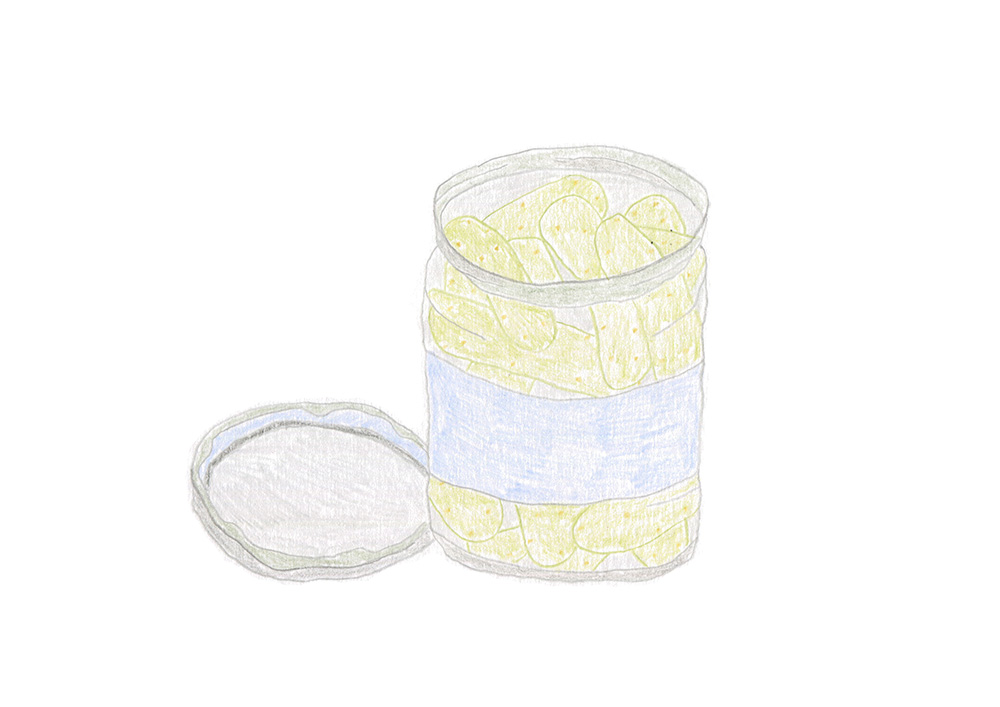
Illustration by Hugo Muecke
READ OUR FIFTH MOST WIDELY READ ARTICLE OF THE YEAR
*****
Discover more on the Asymptote blog:
- Our Top Ten Articles of 2025, as Chosen by You: #6 from Elegies of the Earth by Ahmad Shamlou
- Our Top Ten Articles of 2025, as Chosen by You: #7 Love and Mistranslation by Youn Kyung Hee
- Our Top Ten Articles of 2025, as Chosen by You: #8 The House of Termites by Ubah Cristina Ali Farah