
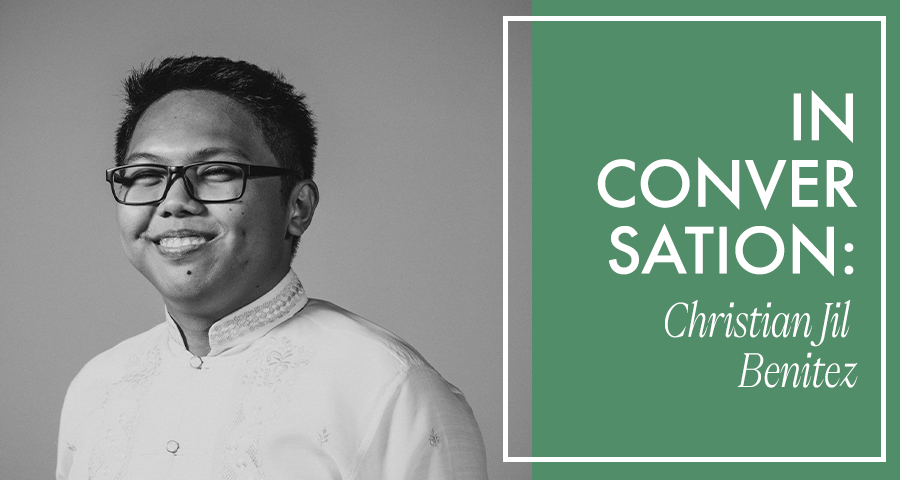
Named Poet of the Year in 2018 by the Komisyon sa Wikang Filipino (Commission on the Filipino Language), Christian Jil Benitez is a queer Filipino poet, scholar, and translator. His debut book, Isang Dalumat ng Panahon (A Theory of Time, 2022), was awarded the Best Book of Literary Criticism and Cultural Studies at the National Book Awards in the Philippines, substantiating his important work in codifying the cultural formation of ‘Filipino time’ via the material, the poetic, and the tropical, in addition to finding an equilibrium between Western critical theory and indigenous epistemologies.
Beyond his scholarship, from positioning the bugtong (or the Tagalog riddle) as ecopoetry to recasting vernacular oral traditions as matrices of queer world-making, Benitez’s translations maintain that their critical role is not merely linguistic, but also results in a creative rebirth, of ‘translation that acknowledges, and relishes even, the transfiguration of the material as it is carried over from one containing language to another’.
In this conversation, I spoke with Dr. Benitez, traversing Bangkok and Manila, about the pressures and prospects of translation in neocolonial, multilingual Philippines, as well as the ethics of barkadahan, especially when familiarity and friendship become central to the labour and logics of literary translation.
Alton Melvar M Dapanas (AMMD): Your debut, Isang Dalumat ng Panahon (A Theory of Time), excavates the construct of time through Philippine-language dictionaries, poetry, historico-colonial texts, metaphors, and indigenous orality, revealing it as ecological, discursive, and material. How does ‘Filipino time’, as you’ve theorised it, diverge from Western, capitalist temporality?
Christian Jil Benitez (CJB): We commonly use ‘Filipino time’ to refer to the tendency of Filipinos to be late: to start an event in ‘Filipino time’ means to actually start one hour after the initially agreed time. The term was supposedly coined by the Americans during their occupation in the country to shame Filipinos for this behavior, but this habit has also been observed in many Southeast Asian (as well as other non-Eurowestern) contexts, and can be understood as the persistence of polychronic sensibility in these cultures despite the imposition of Eurowestern, capitalist, and patriarchal monochronicity. READ MORE…