

Posts filed under 'feminism'

All Our True Stories: Feminist Language Diversity and Accessibility

On translating (and preserving) threatened women's stories—through image, sound, and text.

“So she’s asking the husband what his favorite vegetable is. And she’s cooking it for him,” a male teacher in Banswara District, Rajasthan is telling me in his home. I peer down at my notes. By the end of the session, I’ve realized a peculiarity: the lines he’s given me for the song being translated—grinning all the while—number far fewer than my lines of lyrics. A discrepancy calling for a more concerted effort, more translators, more women to tell their own tales.

Around this time last year, I was recording and just beginning to be enraptured by Bori Village women’s song-stories in Vagdi, an oral language under threat. As part of the EQUILIBRIUM artist’s residency at Sandarbh, working with women’s self-help economic groups as equals to create new artistic contexts, six songs were recorded by my friends from Bori in a studio—what became “The 12 Acres EP”—transcribed into Vagdi, then translated into English and Hindi, with the help of colleagues. The end goal, however, was to make these songs come to life in a wordless world, a picture book melange of visual imagery. READ MORE…
This is also a Center-Point

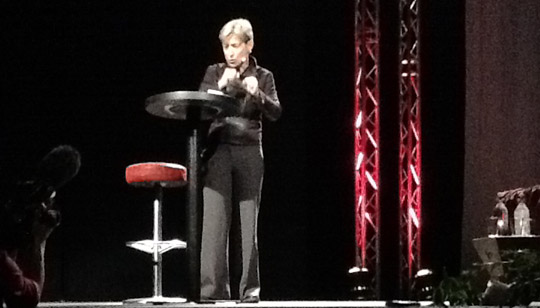
"Her presence, her voice and her body language when communicating, was the key I had been missing."

I confess: I thought the most interesting thing about Judith Butler’s Gender Trouble was the cover. My edition had an old sepia-toned picture of two children—“the [something] sisters.” One has a boy’s haircut, and looks very unhappy. The other stands sweetly beside her. I found it so much more eloquent than the book itself, which seemed to me denser than a loaf of pumpernickel bread, denser than a steel ingot, denser than a white dwarf star. I don’t think I made it through the preface. If I did, it made the same kind of sense to me as reading À la recherche du temps perdu backwards, in French, while drunk. That is to say: the occasional glimmers of understanding felt fabulous, but it was all so ephemeral.

So when Judith Butler, together with fellow feminist theorist Rosi Braidotti on Monday evening in Oslo, met two members of Russian punk band Pussy Riot for a talk about politics, art and feminism, I was not expecting fireworks. Except for Pussy Riot, of course, who spoke through a balaclava and a voice distorter the last time I saw them. This time, they had ditched the disguises and spoke only through a translator. But I’m getting ahead of myself. And ahead of Judith Butler. READ MORE…