
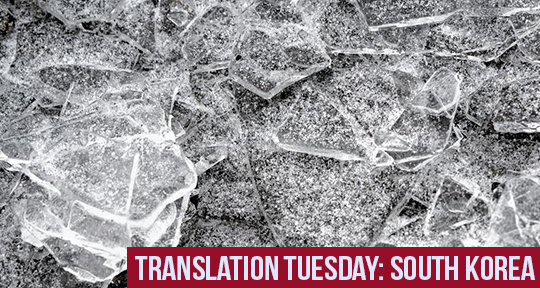
You might think you don’t change when other people look at you. But that sense of stability is an illusion—one that this week’s Translation Tuesday, two poems from multidisciplinary Korean writer Heeduk Ra, is quick to disabuse us of. In “Aftermath,” Heeduk’s verses call to mind a prison cell with the paradoxical image of a room whose doors are “closed yet open,” a haunting reminder of how constant surveillance can erode any sense of self a person might have. This experience is taken to the extreme in “Shards,” where the interrelated metaphors of broken glass and sand in a shoe vividly conjure a life lived without a stable identity, a human being broken down by an indifferent world. Rendered in blunt, bittersweet English by Kyunghwa Lee, these poems admonish us to remember the ultimate fragility of our personhood. Read on.
Aftermath
Where the knob of the main entrance once had been
Is now a huge hole
With the knob now gone
Has the door become wall?
A fist slowly pushed itself through the hole
And roughly grabbed my wrist
It dragged me away, then brought me back again
When I returned, the door was open
The room is now full of the gazes of others
The desk, chairs, and bed all tremble with shame
This room is no longer mine
Anyone can enter
But once inside, no one can leave
The terror of doors
Lies not in being unable to open them
But in being unable to close them
In the black hole of other people’s gazes
One cannot sit, lie down, or loiter
Who knows when another hand will thrust itself through that hole
And yet my feet are frozen to the floor
My voice cannot utter a sound
Eyes, eyes, eyes… are everywhere
I flop and flounder like a harpooned fish
In the open yet closed
Closed yet open room
Shards
1
I was cracked apart with a shattering sound
But the void swallowed up my screams
Water and oil quickly seeped into my wounds
I like to think of these long thin gashes
as erogenous zones of pain
Whose hands were these that broke me into shards?
2
I am no longer just a grain of sand on the shore
I creep into people’s shoes
Enter machinery nooks and crannies, make them screech
I make the world crumble
I make the world rumble
I leave behind tiny cracks and chips
And make machines stall
As a single grain of sand
3
Little by little I am liberated from invisibility
Day by day I become blunter
As I tumble together with dust and lint
There was a time I glistened like a razor sharp blade
But I am dangerous no more
I do not break anything
Nobody picks up shards of glass
Translated from the Korean by Kyunghwa Lee
Heeduk Ra was born in 1966 in Nonsan, Chungcheongnam-do, South Korea. She graduated from Yonsei University, where she later pursued graduate coursework in Korean literature. She made her literary debut in 1989 when her poem “To the Roots” won The JoongAng Daily’s Spring Literary Contest. She is currently a professor in the Department of Literature and Creative Writing at Seoul National University of Science and Technology. She has received numerous major literary awards in Korea, including the Kim Soo-young Memorial Prize (1998), the Hyundae Munhak Award (2001), the Sowol Poetry Prize (2005), the Baek Seok Prize for Literature (2019), and the Daesan Literary Award (2022). Her poetry collections include To the Roots, Words that Stained the Leaves, Not Far from There, What Is Darkening, Wild Apple, When the Horses Returned, File Name Lyric, Possibilist, and Poetry and Matter. She has also published works of literary criticism such as Where Does Purple Come From and Outside Civilization, the essay collections Half a Bucket of Water and Places of the Heart, and two picture books, The Patchwork Quilt and Everyone Falls Asleep. Her poems appear in major English-language anthologies of Korean poetry, including The Colors of Dawn. Her poetry collections What Is Darkening, Scale & Stairs, and Wild Apple have been published in English, and Le ver à soie marqué d’un point noir (A Black-Spotted Silkworm) has been published in French.
Kyunghwa Lee is a literary translator working between Korean and English. She holds a BA and MA in English literature and is currently a PhD candidate in comparative literature at Yonsei University. She is a recipient of the Modern Korean Literature Translation Prize for poetry. Her work focuses on poetry and comics translation and she has a particular interest in contemporary women’s voices.
*****
Read more from the Asymptote blog: