
Poems, they are also gifts—gifts to the deeply attentive. Fate-carrying gifts.
—Paul Celan, letter to Hans Bender, May 18, 1960
Merry Christmas! #7 is a perfect pick for today. A crowning jewel of our Spring 2025 issue, The Gift, is “Love and Mistranslation” by Youn Kyung Hee (tr. Spencer Lee-Lenfield). Youn’s prose is beyond gorgeous—translator Lee-Lenfield described it best, saying she “revels in tight and rhythmic choreography of long sentences, in menageries of carefully chosen vocabulary, in sheer love of the expressive capabilities of Korean.” Complementary to the season, this seamless work of lyrical criticism charts a path that begins with this: poems as gifts.
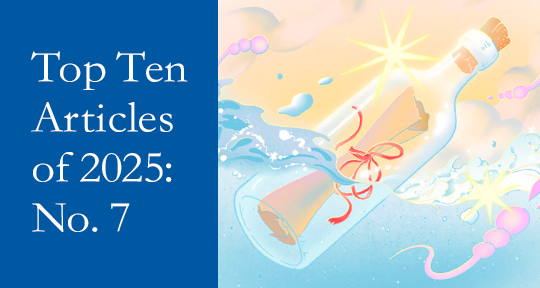
The concepts of ‘poem’ and ‘gift’ are flipped inside out as Youn flows from one point to the next, enlightening us further with each progression. Key observations point to the ‘postal essence’ of gifts, and poems as ‘words in motion.” Youn likens the latter to the message in a bottle—the poem is adrift, a precious gift for the reader who meditates on the meaning, and impassioned by the art, pays it forward through translation.
A poem-gift is only unlocked by the deeply attentive. The reader becomes a poet through translation, and in turn, the sender-poet becomes the recipient. In the process of engagement, ‘mistranslation’ is poetic embellishment, born out of a love for the message.
Youn deeply appreciates the artistry of exchanging one term for another, the symphony of finding words that capture the ‘right’ meaning. After all, “What should we call this person, who says in poems what the poet does not say, if not “a poet”? And so, mistranslations increasingly disappear. Even mistranslations are a different language turning into a poem.”
Love as Mistranslation bears witness to Lee-Lenfield’s bold assertion of Youn as among “the finest essayists and critics working anywhere in the world.” A love letter to translation that embodies the spirit of Asymptote, this is a piece sure to resonate with readers.
Excerpt:
More than need, sheer innocent longing keeps me translating. Far more often, in fact. For how wonderful it would be if you, too, love the poem I love? Like sharing pastries at a nameless bakery. So how about we read the poem together? The problem is, you don’t know the same languages that I (at least somewhat) know; you only read poetry in your native tongue; yet I want to tell you about Ocean Vuong’s first book of poems, but—look here how Vuong rewrites Rilke; and you played me Blake, but will never, ever know how my heart races for Hölderlin and Novalis; and likewise, you know a language I don’t, and how you must pity me for not knowing the beautiful poetry written in it. So please, go and read me Sappho. And then read me Sei Shōnagon, and let us remember the weather of times gone by, and talk about it. Oh, and then read us all more Anne Carson. I’d enjoy hearing that. This is the impulse driving translation. Wanting to share poems with lovely people.

Illustration by GLOO / Yejin Lee
If Asymptote has been a gift to you in 2025 too, consider helping us stick around so that it may be a gift to others down the road. Remember: the best way to support us is to join us as a sustaining or masthead member. Signing up only takes three minutes, but the good it does reverberates through time.
READ OUR SEVENTH MOST WIDELY READ ARTICLE OF THE YEAR
*****
Discover more on the Asymptote blog:
- Our Top Ten Articles of 2025, as Chosen by You: #8 The House of Termites by Ubah Cristina Ali Farah
- Our Top Ten Articles of 2025, as Chosen by You: #9 When I looked into the face of my torturer . . . I recognized my old school-friend by Bassam Yousuf
- Our Top Ten Articles of 2025, as Chosen by You: #10 Attention as Predation: Fields of Influence and Omnivorous Forces of Alignment by Johanna Drucker