
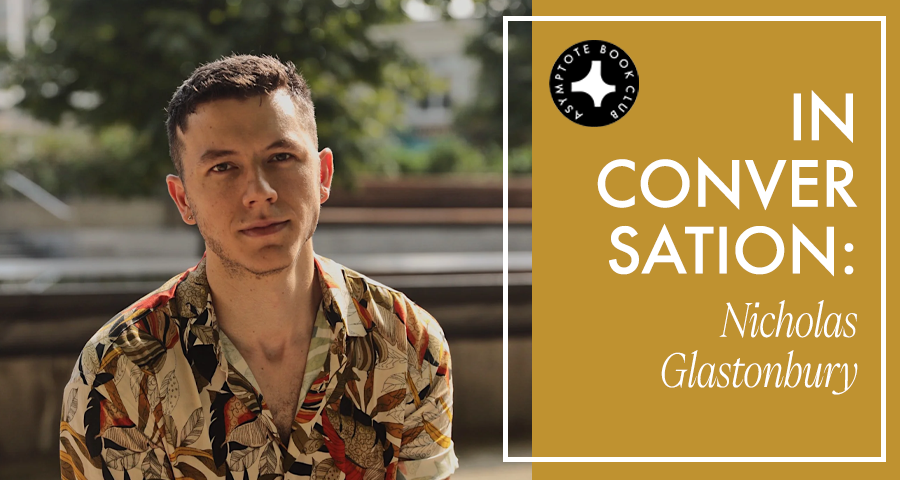
The Competition of Unfinished Stories is one of those texts that would be classified as “untranslatable” by the more cynical amongst us. Aside from addressing the intricate language politics of Turkey—namely the oppression and marginalization of Kurdish—Sener Ozmen’s text is full of jokes, narrative tangles, loose ends, shapeshifting characters, and suspicious translators. As such, the English edition of the novel is a triumph, not only in Nicholas Glastonbury’s fluid and adventurous prose, but also in his own interjections that celebrate the original’s chaos and multiplicity. In this interview, he speaks on the challenges of translating the book, authorial authority, and language’s resistance to containment.
The Asymptote Book Club aspires to bring the best in translated fiction every month to readers around the world. You can sign up to receive next month’s selection on our website for as little as USD20 per book; once you’re a member, join our Facebook group for exclusive book club discussions and receive invitations to our members-only Zoom interviews with the author or the translator of each title.
Hilary Ilkay (HI): This is a challenging and strange book! How did you find out about it? Did you pitch it to a publisher, or was it pitched to you?
Nicholas Glastonbury (NG): I met Sener maybe six years ago. I was in Diyarbakır doing research for my PhD, and there was an organization trying to build an online platform for Kurdish literature, given all of the obstacles that it has in accessing foreign language audiences, and I did some work for them. I was aware of Sener’s work a little bit, but when I met him, I became really interested in it. He’s also a visual artist, so I became really interested in how he saw the world. He’s also written quite a few books; The Competition of Unfinished Stories is his second novel, and the title is what drew me in. After I read it, I thought, what is going on here? This is a crazy book. Then I began pitching it around, and it landed with Sandorf Passage, which I’m very happy about.
HI: I was delighted to discover Sener’s prolific artistic practice when I was reviewing the book. I wonder if you could say a little bit about how you see his practice as a visual artist influencing his writing. Do you see an interplay between his art and the way that he constructs stories and narratives?
NG: I think he’s really interested in the absurd. For example, there’s one photograph of his that comes to mind; it’s a group of men hoisting a flag up a flagpole, and they’re all wearing neck braces, and they’re unable to look up at the flag. There’s a tension between violence and nation, and the obligation to nation is very much an aspect of this novel.
He has another piece, a sequence of photographs of himself dressed as Superman. He takes off his cape and uses it as a prayer rug, and the title of the work is “Supermuslim.” He’s got a real sense of humor about things that are so heavy and serious.
There was another piece he did called “Road to Tate Modern,” which is him and another artist trying to make their way to London, to the museum. They do a kind of Don Quixote and Sancho Panza act, riding a horse and a donkey, asking shepherds around the Kurdish countryside where the Tate Modern is. And the shepherds say things like, oh, it’s just over the hill. . . So there’s a sense of the distance that Kurdish cultural production has to surmount in order to reach international audiences—of course conditioned by the violences of the nation-state—that comes through in both his writing and his visual work. I think the way that his approach to writing is shaped by his visual work is how he captures images. For example, in The Competition of Unfinished Stories, the image of Neil Armstrong on the prayer mat dying stands out to me, or all the scenes of Sertac masturbating. There’s a real sense of creating these absurd tableaus, and I think that’s probably influenced by how he sees and visualizes the world through his art.
HI: You have such an impressive and interesting portfolio of translations under your belt and I’m curious, given the scope of your work, what made Ozmen’s writing unique, or what stood out about the way that he wrote? And related to that, what was the biggest challenge in trying to render this unwieldy text into English?
NG: To answer the first part, what really compelled me about this book is how funny it is. This is the first book that I’ve worked on that has been funny in this way. The first novel I translated, Sema Kaygusuz’s Every Fire You Tend, deals with a lot of the same subject matter, but it does so with such gravitas and pathos, and it’s almost unrelentingly sad. There’s power to that, but I think something that feels really compelling about The Competition in particular is how you have that register of pathos, but it’s shot through, or broken up by, these shards of levity—which makes it all the more moving. The humor was also one aspect that I really struggled with getting into English. There’s lots of vulgarity, and in the end notes of the book, his wife is just so mean, and she comes up with all of these unheard-of ways of mocking other women, just really nasty insults. That was a fun challenge, finding ways of making those work in English.
Probably the more fundamental challenge was the way the Kurdish original is marked by the Turkish. In the original Kurdish, there’s code switching, so characters will say things in Turkish. Almost all readers of this Kurdish dialect will know Turkish as well, so those moments of code switching happen in a way that I came to describe as reverse code-switching, where Sener will foreignize it. He would footnote the moments of Turkish and translate these basic sentences into Kurdish. There’s a moment early on, in the first part of the book, where Merasîm goes to a friend’s house, and this friend’s dad says to them in Turkish, “. . . don’t you have a test in the morning? Go to bed already!” Anyone who speaks Kurdish would have understood that sentence, but in the original, Sener translates it into Kurdish, as a footnote. Likewise, there are moments where the Turkish word abi, meaning brother, is footnoted and translated into Kurdish to say something like, “this means brother.” This foreignizing gesture is, I think, an attempt to mark the Turkish where it might otherwise appear unmarked.
That was totally impossible to really render well in English. After talking with Sener and my editor, Buzz, I decided to take an interventionist approach with my footnotes, to make footnotes that were menacing the text—to be a kind of unreliable translator, basically, in the same way that Sertac is an unreliable narrator.
HI: It’s rare that you will get that kind of direct intervention from a translator in the text. You mentioned briefly that you were in conversation with Sener. How closely did you two work together, and how often did you consult him on your translation?
NG: I would consult him relatively frequently, but it was sort of a “this is your baby” situation. I was grateful for the creative license that he gave me. This is a reader’s book: there are references to people like García Márquez, Foucault, and Jeremy Bentham. Likewise, there are all kinds of moments in the text where he’s injecting something that is from Kurdish folklore or something I wasn’t familiar with, so I definitely had to rely on him for those sections. But when I suggested the idea of doing these interventionist footnotes, he was really into the idea. He thought it made the book even more schizophrenic than it already is. I should say, too, that I had just read Jennifer Croft’s novel The Extinction of Irena Rey, which has a similar function, and it was like a key opening a lock; it helped me get into the text even more and make it even more unstable.
HI: I think what is so fascinating about those footnotes is that people are always threatening to take over the story. There’s this sense of a threat when you’re reading, and a lack of authority. I asked you about the challenges, but was there anything that surprised you when you were translating, or that you found joyful, or delightful, or surprising? What did you discover along the way?
NG: As I try to think about what I discovered, I’ll just speak to the first point that you were making—this question of who has authority in this text. I was thinking a lot about the relationship between author and authority, the relationship between the divine and the author. In the context of translation, so often the market in world literature is about delivering the authoritative translation of, say, Tolstoy or Proust. And, of course, these authoritative translations are going to be out of date in twenty years, when publishers decide they want to have them retranslated to make more money with a new audience or something. What was interesting about this book was thinking less about the authority of the translator, or the authority of a translation, and more about the contingency. I don’t think any other translator could have produced the version that I did, simply because my own personal experiences are in some of the footnotes. We might see the novel’s refusal of authorial authority as connected to how the form is typically bound up with nation; that is, if we can unmake or destabilize the novel, we might similarly destabilize the nation, which warrants or conscripts the novel.
One thing that did feel joyful or exciting about doing this project was getting an opportunity to think of myself more as a writer. All translation is, of course, writing, but it was daunting to know that those were my words in the footnotes. But I feel more like a writer now than I did before doing it, and that’s interesting especially given the context of the book, which is so much about this guy who is unable to write. I’ve taken from the book something that the character is unable to do.
HI: I could talk forever about these footnotes, but I’m also interested in whether you have a favorite out of the very many stories and iterations of Sertac that appear in the book?
NG: The one that lingers with me the most—and maybe it’s because it was the one that first drew me into the book—is the chapter where he goes to his psychotherapist. That long monologue is so arresting, and you get into the rhythm of his schizophrenic flights of fancy. It really names so many of the antinomies that mark Kurdish life: this idea that one can never be Turkish, no matter how hard you try, no matter how much they try to domesticate you, even if you are a willing participant in this project of assimilation, you will still always be marked. But there’s a moment where it pivots, and it’s like he’s no longer talking to the therapist, but to a sociologist who has come to Diyarbakır, through a translator. This translator says to Sertac: “Don’t you trust my translation?” And then I footnoted that: “Don’t you trust my translation?” That also distills so much of the spirit of the book, mediating what is already being mediated. And then, of course, there’s the realization by the end of the chapter that this is a total fantasy of his, right? The whole book feels condensed in this one chapter.
HI: I find that Merasîm functions as a sort of container in the book. How do you read her character? What was she like to translate? And why does she create this sense of framing and containment in the narrative?
NG: She was so hard to pin down, because you never know if you’re dealing with Sertac’s projection of her, or if, as you say, she is the ultimate device of the story. The story is also one of emasculation, and she’s a useful figure for that. One thing that struck me about Merasîm is that her name in Kurdish means ritual or ceremony, and a ceremony is a container of social practice, a regimentation and disciplining. The rituals we have make the rest of life meaningful in a way. I struggled with her, too, because Sertac is a chauvinist, and you never know at which level the chauvinism is operating. Is it the narrative level? Is it Sertac’s own diluted vision of the world level? Is it the author’s level? I think that she is an ordering figure for the book, a sort of a framing device. But a framing device in the way that patriarchal society conscripts women to be disciplinary figures. I think there’s something fugitive about her, too: her desire for a different life, a different husband. Just as Sertac is conscripting her as a kind of framing device, she’s also trying to use him as a mechanism for escaping this life that she doesn’t want.
HI: I saw that an outlet featuring the book had mistakenly said that it was translated from Turkish, and I wonder what might be instructive in that slippage. Can you speak a little bit more about the unique challenges that Kurdish literature faces when trying to get translated? Turkish is already not the most popular language. I read an interview you did with Anton Hur for Words Without Borders, where you said that a project in Turkish was turned down because it was deemed “too small.” With Kurdish, then, you have a deeper layer of marginalization, and even an attempted erasure.
NG: If you read the book, you understand why Sertac would be a total basket case. It’s because this kind of slippage is constantly happening. I do translate from Turkish, and The Competition of Unfinished Stories is so much about Turkish that it’s almost an understandable kind of mistake to have made.
As far as the broader structural obstacles to getting Kurdish literature into English. . . A lot of countries have national subvention programs for commissioning translations. There is a relationship between a national literature and a state body. Turkey has one, and it’s paid for a lot of books that otherwise wouldn’t have made it into English—but there’s not a chance in hell that they will, in the foreseeable future, ever fund a translation from Kurdish. You also don’t have people who are learning Kurdish in order to become translators, so that’s another difficulty. The struggle for Kurdish self-determination is also a struggle for Kurdish language instruction, the option to study Kurdish in schools. I had to live in Turkey to study Kurdish, and I studied it at the Kurdish Institute in Istanbul.
HI: You talked a little bit about authority, but I wonder, what do you think the book is saying about storytelling, given its proliferation of unstable narratives? And what is this competition of unfinished stories that the title is evoking? I mean, it appears in the end notes, but what do you think that’s referring to?
NG: The first thing that comes to mind—and this is maybe a bit of a digression—is the film Translating Ulysses, which is about the Kurdish translator of Ulysses, Kawa Emir (who is, by the way, very close friends with Sener). His translation of Ulysses took something like fifteen years, and one thing he says in the film, which I found so compelling, is that the Kurdish language is uniquely suited to translate a project like Ulysses, precisely because it doesn’t have the container of a state to manage it. The language is something that endlessly proliferates, like crabgrass or something. The different versions of Kurdish that you get from village to village, from town to town, from region to region, make it an endlessly varying, hybridized language. It’s mutating itself in the same way that James Joyce is messing with English in the context of the colonial space of Ireland in the early twentieth century. That, to me, feels of a piece with the book. Kurdish storytelling always has these involutions, it’s always folding in on itself. It’s incorporating things from the nation-states that occupy it, from the global, mediatized world that we live in. We think of language as organic, but it’s so often disciplined through schools and states and these ideological apparatuses, and what you have with Kurdish is something that is truly organic. It’s just this glut of lexicality that escapes containment at all times. And I think that fugitivity, we might say, of language, is what the book is also saying about storytelling: that stories are always going to be escaping the containers that we put them in. The Competition of Unfinished Stories thinks about the best stories that we can tell that breach containment.
Nicholas Glastonbury is a writer, translator, and editor from the Florida backwaters. His translations of Turkish and Kurdish fiction and poetry have appeared with or are forthcoming from Tilted Axis Press, Comma Press, Soho Press, Sandorf Passage, Nightboat Books, and elsewhere. He holds a Ph.D. in cultural anthropology and lives in New York
Hilary Ilkay works in sales for the Canadian indie press Biblioasis, and she is an Associate Fellow in the Early Modern Studies Program at the University of King’s College in Nova Scotia. She is a Managing Editor for Simone de Beauvoir Studies Journal and an Assistant Managing Editor for Asymptote.
*****
Read more on the Asymptote blog: