
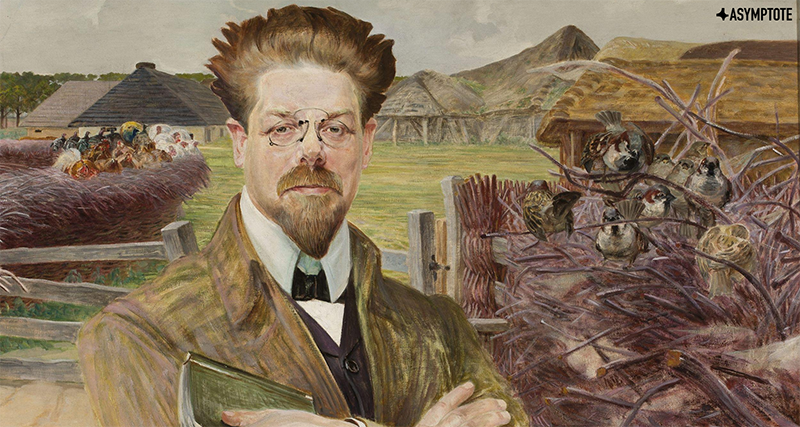
These days, the reading world eagerly anticipates the Swedish Academy’s annual awarding of the Nobel Prize for Literature, placing bets and preparing stacks of shiny gold stickers, ready to be stamped on newly reprinted books. Yet the Prize, now over one hundred years old, has had many of its laureates fall into obscurity, either due to a seeming lack of contemporary resonance, or the changing priorities of the Academy itself. In this essay, we look towards the works of one such writer, whose pivotal titles perhaps deserve a revisit for their stylistic commitment, persistent human themes, and documentation of the times.
Władysław Reymont, Poland’s second Nobel Laureate, was born to the family Rejment in 1867; in 1892, when he was first published, he insisted on changing his name’s spelling (if not its pronunciation), in part, as Polish academic Kazimierz Wyka speculated, because of its closeness to the verb rejmentować: “to cuss” in certain Polish dialects. For some authors, this would be a humorous footnote in their biographies, but for Reymont, it proves an apt metaphor for his oeuvre. His major works—including, most famously, Ziema obiecana (The Promised Land) and Chłopi (The Peasants)—are beautiful and distinct depictions of nasty, earthy lives. Like curses disguised with respelling, they reconfigure their surprising, sometimes shocking base material, deriving elegant representations from the inelegant. Despite being drawn, like so many Polish intellectuals of his era, towards a vision of Polish nationhood that literature had to help create, Reymont opted to render Poland as a grimy, smoky, bloody place—but where he becomes intriguing, and what perhaps most compelled the Nobel Committee to award him the 1924 Prize in Literature, is when that focus on the bodily and the brutish becomes celebratory and even liberatory, for both its subjects and their nation.
Reymont was born into a Poland that was, by then, absent for decades. By 1867, the nation had been partitioned between Austria, Prussia, and Russia for nearly seventy years. Seemingly mirroring this fragmentary state, Reymont was a shoemaker, then an actor, then a linesman on the Warsaw-Vienna Railway, then a prospective candidate at a monastery, before he made his way to writing. Nonetheless (or perhaps because of his aimless decades), Reymont had established himself as a major figure in the Młoda Polska (Young Poland) movement by the end of the nineteenth century, primarily through his short fiction and travel narratives. The Young Poles—working across literature, music, and art—were neo-romantics, skeptics of the old world order that seemed to edge closer to collapse with each toppled European monarchy or imperial clash, and Reymont’s best-known works are no different. In Ziema obiecana, modernity is simply decried; in Chłopi, Reymont seeks a solution by turning inwards to Poland’s rural culture, timelessly isolated from modern concerns. In both works, we meet plenty of violence, gory detail, and literary profanity, but Reymont’s choice of subject for the latter novel reframes the grit in terms that the Nobel Committee registered as transcendental and universalist.
Upon first glance, Ziema obiecana and Chłopi are distinctly different novels. The former takes place in a Łódź—then a center of the Polish textile industry—“buried in ooze,” and chronicles the dehumanizing rush of its industrialization, with trees “stripped of bark and half killed by the deadly sewerage that [runs] down from the works in deep gullies.” Its three protagonists, joined by ambition and friendship, strive to build a factory of their own—only to see it burning by the novel’s end. In this, it is far less focused on a Polish national project than Chłopi; if anything, its multicultural characters (with the high classes of Łódź being composed of Germans, Austrians, Brits, the French) and obvious opposition to industrialized capitalism (“a beast who rots on a bed of money”) feels more European in its orientation, a project laying out the same concerns as Dickens or even Zola. Chłopi, meanwhile, can more or less only be a Polish novel, with its long descriptions of religious festivals, old peasant customs, and anthropological (perhaps anthropolitical) orientation. If the grounded pan-European landscape of Ziema obiecana is frenetic and oscillating, dealing with production quotas, export controls, the Germans, English, and French—then in Chłopi, Reymont’s primary concerns are overwhelmingly Polish, overwhelmingly slow-paced, and overwhelmingly occupied with the daily lives of the titular peasants. While occasionally swerving into such unsubtlety that they approach parody (the first line of the novel, in Anna Saranko’s excellent translation, is “Praised be Jesus Christ!”), this nationalist fixation creates something that sets it apart from the more modern stylings of Ziema obiecana.
In a way, Reymont was both observing and creating the Polish peasant in Chłopi, drawing on his own biographical familiarity with rurality, but also pursuing his interest—shared by many Polish thinkers and radicals at the time—in determining whether the peasantry was a useful tool for articulating a proper notion of a Polish nation. This engagement with a class untouched by the sins of modernity documented in Ziema obiecana, constituting the honest folk of hard work and substantiating the last bastions of near-erased tradition, is no new object of interest for European writers seeking a nationalist subject, but in Poland, a country which had spent much of its modern history with its nationhood determined by outside powers, the idea of the peasantry as a torchbearer took on a particularly urgent tone. This is perhaps what contributes to the eager raptness with which Reymont describes everything about the peasantry in Chłopi, and the near-cartoonish Polishness of their daily existences.
Yet beneath all of this is a roughness around the edges, a griminess inherent in Reymont’s choice of subject. In both Chłopi and Ziema obiecana, the world is inherently violent, and thus the violence is more or less treated as normal. Yet there are two distinct ways one can read each novel’s respective treatment of that violence, depending on their independent function and intent. Towards the beginning of Chłopi, a sick cow is put down—an act depicted so thoroughly as to leave little room for imagining: “. . . the cow rasped and struggled, her blood ceasing to flow from under her belly and instead clotting into dry black cinders. . .” This pathos continues as the farmers attempt to save her, as Reymont writes:
She stretched out more and more, lifting her head occasionally and lowing long and painfully, as though for help, until the pink whites of her beautiful eyes grew dim and her heavy horned head drooped with the effort. . .
When she is finally killed, she “gave a dull bellow . . . and fell back, her throat cut and only her legs jerking . . .” as a nearby dog “lapped at the blood as it clotted in the fresh air.” With the pace of her death so slow and restrained, Reymont takes space to focus on the cultural function of animals in Lipce. The villagers gather in “quite a crowd” around the dying creature, and as Witek, the slaughterer, arrives, they make way for him. When he’s finished, two women of the village “burst into tears.” The violence, through its witnessing, becomes normal and almost communal, a critical aspect of Polish peasant culture.
In Ziema obiecana, when violence occurs, Reymont emphasizes the comparative indifference of its witnesses. When he describes a man’s death by cotton-spinner, he does so with even more commitment to detail than the cow’s slaughter:
One of the driving-wheels had caught hold of the blouse of a workman who had incautiously come too near, whirled him aloft, flung him upon the machine, spun him round and round, crumpled him up, broken him on the machine, crushed him, smashed him, and thrown the shattered mass aside, never stopping in its course for one moment. His blood spurted up to the ceiling, flooded the machine, some of the goods it was shearing, and the working-women who stood by. An immense outcry followed; the machine was stopped, but all was over now. A bleeding bulk hung on the axle of the driving-wheel; other pieces had fallen heavily on the floor from various parts of the machine; they still were quivering with the tremors of the life that had been there. The man was literally torn to pieces; it was absurd to think of doing anything. He lay like a great lump of flesh—a bloody stain on the white ground of raw percale stuff.
In both novels, these vivid deaths are dismissed swiftly by the narratives, which plod along. But in Ziema obiecana, the dismissal of something almost comedically horrific, with the machine dishing out an absurd number of violent verbs upon its victim—whirled, flung, spun, smashed, crumpled, broken, thrown—is the point. Karol (Charles in translation), one of the protagonists, is so dehumanized by the factory labor that he doesn’t even stick around to catch the end of the slaughter: “The elevator had taken him down, quick as lightning, into the dying department.” In Chłopi, the death of the cow is slow and meditatively written compared to the madness of the factory floor; for the peasants, this violence is a part of their connection to the land, to nature, to something purer than oozy Łódź. In this, Reymont describes one death to show how far we’ve fallen; he tells us about another to show us where we might return to.
Though today Nobel laureates are awarded for entire literary oeuvres, the committee was explicit in 1924 about its intent to award Reymont the prize for Chłopi. Nobel Committee Chairman Per Hallström, in a critical essay issued with the award, even highlighted the difference between “the rest of his very different production” and the authentically naturalistic and “Hesiodic peasant-world” of Chłopi. To Hallström and his peers, Reymont’s work had become so particularly Polish, so committed to a vivid portrayal of its unique subjects, that it once again became universal. The coarseness of the novel—perhaps always present in Reymont’s work—had at last found a “chosen subject” which “moved of itself towards this happy form.” For the Committee, the distinct griminess of Reymont’s writing sparkled when turned towards the peasant subject; the violence that reads so hopelessly and absurdly in Ziema obiecana becomes, by virtue of the people it describes, something new and exciting for Reymont’s educated European readership. Foulness always formed the heart of Reymont’s work, but in turning his sights onto peasant life, moving away from that of modernity, he came to transcend it. Hallström may not have known the meaning of Reymont’s name, that it had in fact been glamorized in its respelling, but in awarding him the Nobel, he seemed to gesture towards it; in his words, Chłopi was a work of “great aesthetic value, which, however, has been obtained at the expense of being defective in other ways.” There may not be a better description for Reymont—he of the defective, uncouth name—himself.
Sam Bowden is an Assistant Managing Editor at Asymptote. A graduate of Kenyon College, he was recently named a 2026 Marshall Scholar.
*****
Read more on the Asymptote blog: