
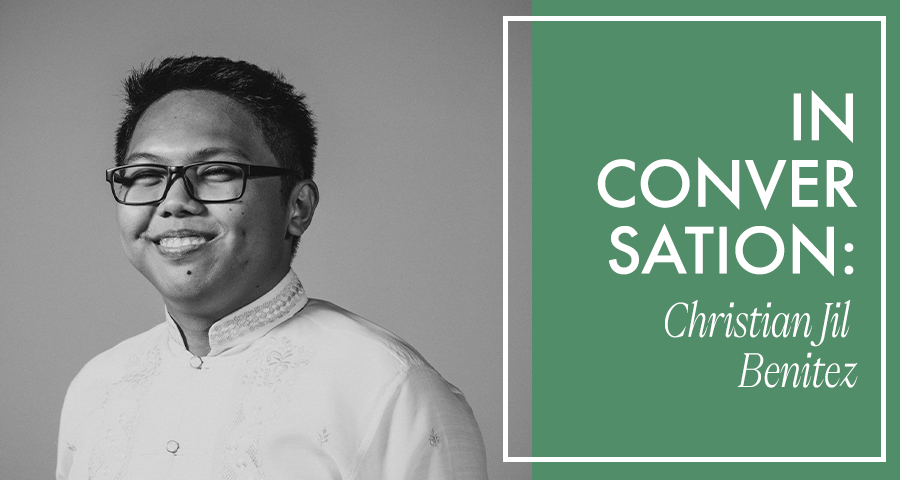
Named Poet of the Year in 2018 by the Komisyon sa Wikang Filipino (Commission on the Filipino Language), Christian Jil Benitez is a queer Filipino poet, scholar, and translator. His debut book, Isang Dalumat ng Panahon (A Theory of Time, 2022), was awarded the Best Book of Literary Criticism and Cultural Studies at the National Book Awards in the Philippines, substantiating his important work in codifying the cultural formation of ‘Filipino time’ via the material, the poetic, and the tropical, in addition to finding an equilibrium between Western critical theory and indigenous epistemologies.
Beyond his scholarship, from positioning the bugtong (or the Tagalog riddle) as ecopoetry to recasting vernacular oral traditions as matrices of queer world-making, Benitez’s translations maintain that their critical role is not merely linguistic, but also results in a creative rebirth, of ‘translation that acknowledges, and relishes even, the transfiguration of the material as it is carried over from one containing language to another’.
In this conversation, I spoke with Dr. Benitez, traversing Bangkok and Manila, about the pressures and prospects of translation in neocolonial, multilingual Philippines, as well as the ethics of barkadahan, especially when familiarity and friendship become central to the labour and logics of literary translation.
Alton Melvar M Dapanas (AMMD): Your debut, Isang Dalumat ng Panahon (A Theory of Time), excavates the construct of time through Philippine-language dictionaries, poetry, historico-colonial texts, metaphors, and indigenous orality, revealing it as ecological, discursive, and material. How does ‘Filipino time’, as you’ve theorised it, diverge from Western, capitalist temporality?
Christian Jil Benitez (CJB): We commonly use ‘Filipino time’ to refer to the tendency of Filipinos to be late: to start an event in ‘Filipino time’ means to actually start one hour after the initially agreed time. The term was supposedly coined by the Americans during their occupation in the country to shame Filipinos for this behavior, but this habit has also been observed in many Southeast Asian (as well as other non-Eurowestern) contexts, and can be understood as the persistence of polychronic sensibility in these cultures despite the imposition of Eurowestern, capitalist, and patriarchal monochronicity.
Isang Dalumat ng Panahon is an attempt to recast ‘Filipino time’ in a different light, precisely by approaching time through the modifier ‘Filipino’, understood here to be pertaining to both language and worldview. What I thought of—back in my undergraduate years—as a rather simple question turned out to be far more complicated, turning into a lifelong concern. In many ways, I’m realising now, it is also a question of translation, which entails not only offering Filipino equivalents to certain terms and concepts, but completely rethinking them in generative ways.
So it was crucial for me to begin my inquiry about time from a Filipino word: panahon, which signifies abstract temporality, climates and weathers, as well as seasons or periods for particular things, as designed by the nonhuman environment or human will. I pursued the word through old dictionaries, contemporary poems, as well as current events, juxtaposing them all together—at times rather unexpectedly (or at least I hope!)—to eventually recover and assert its often-forgotten sense: panahon as the inclination to chance, and thus to the opportune. In other words, panahon as an intuition of time that is not homogenous and empty, but always filled with possibilities, even, or perhaps especially, in the unlikeliest of forms. Panahon is therefore attuned to the multiplicity of time, what we can call as truly contemporary, with several ‘pasts’, ‘presents’, and ‘futures’ being always already entwined.
AMMD: Speaking of cultural translation, you’ve translated Jaya Jacobo’s Arasahas: Mga Tula into English as Arasahas: Poems from the Tropics, a finalist for the 2025 Lambda Literary Awards for Transgender Poetry. From the Bikolano word for sultry heat to arasáas, the Ilokano for whisper, the poetry collection is contingent upon sensuousness and its soundscape. How did you negotiate the prosody of the Filipino original for Anglophone readers? Were there moments where aural texture demanded creative adjustments?
CJB: Filipino is an inherently musical language, and so writing poetry in Filipino, at times, can easily lead to sentimentality. Jaya Jacobo’s poetry, at least in Arasahas, navigates this tendency through fragmentation, resulting in verses that are precise in terms of imagery and sharp in terms of sound. These two qualities became my priority when I translated her work to English—qualities that, I think, after all, are fundamental to poetry in any language.
Because English has its own sound, translating Arasahas was about composing a music analogous to that of the original Filipino. Without the predominant onomatopoeiacity of words in the latter language, the English translation then had to derive a parallel music in other ways, such as through slant and internal rhymes and cadence. In the process, compromises had to be made; I reordered certain items in catalogs or even sequences of entire lines, for instance, just to keep the syntax singing while still approximating the ideas of the original.
I didn’t feel the need to provide annotations for certain words in the collection, such as irago and suman, because I understand image and sound to be entangled in poetry. I wagered that the music of the poems themselves would somehow suffice to convey what these words might mean—and that if not, readers, especially those beyond the Philippines, would be generous enough to meet the text halfway, by simply looking these words up, for example. Maybe this is also a kind of risk that working with poetry specifically affords me (or at least, I hope): it’s a genre, after all, where each word, be it the Filipino arasahas or the English rogue, demands closer attention.
AMMD: Your approach of composing an ‘analogous music’ in English underscores translation as a chameleonic act, and this idea of assuming a voice seems crucial when moving between the distinct fictional worlds of writers like Alvin Yapan (for which you received a grant from English PEN and the International Booker Prize Foundation) and Allan Derain. Could you walk us through how your creative process differs when ‘inhabiting’ these voices?
CJB: Translation is a form, too, of drag. I think of the practice as the assumption of a voice speaking in a given text and rehearsing this voice in another language. Less parroting, with its primary occupation of mimicking; but more of being a chameleon, with the imagination of how the adopted voice would suit a given environment, even if the original author hasn’t done so. So whenever I try to render a text into another language, it is important for me to first learn the sound I am going to embody; only then would I be able to hear the translation unfold.
Working on Alvin Yapan’s Ang Sandali ng mga Mata (Time of the Eye), for example, required me to inhabit the character of an old storyteller, whose lengthy sentences shouldn’t get tangled in the process of translation. Meanwhile, for Allan Derain’s fiction, such as ‘The Boy with the Pet Dog’ and those in the micro-chapbook Fabrications, I often channel a wittier voice, always predisposed to sarcasm and even self-deprecation. Approaching, or at least giving sensible analogs for, these registers is what I consider the core of translating fiction, for they found the very world of a text. These voices determine for me, for example, whether to localize some terms or simply retain them, based on their capacity to accommodate such terms while still sounding faithful to the music.
AMMD: You’ve also engaged with ecofeminism in your scholarship. Writing for The Routledge Companion of Ecofeminism and Literature, you historicised ecofeminist discourse in the Philippines vis-à-vis locally-published ecocritical anthologies, from After the Storm to Lunop Haiyan, from Sustaining the Archipelago to Látag. To what extent have these contemporary anthologies helped transform the perception of ecopoetry from a relatively niche genre to a critical tool for understanding and addressing our climate crisis?
CJB: These anthologies remind us that memory and imagination are crucial to our understanding of and dealing with the present climate emergency. What we are experiencing after all is not just an ecological crisis, but an epistemological one too—the unravelling of what Amitav Ghosh calls our ‘great derangement’ as a species, having been deluded to think that we have gained mastery over the nonhuman environment. In this light, such anthologies matter especially for a context such as the Philippines, as they demonstrate the potential of literature and literary studies in these times, despite being commonly dismissed.
At the same time, it also bears emphasising that the Philippines remains to be a country that hardly reads such texts. There are many contributing factors to this, including the deterioration of the educational system, worsening of labour conditions, and further widening of our socio-economic gap. So, while such anthologies can possibly help us to collectively think about and eventually confront the present climate emergency, they also signify—and in many cases, proliferate even—divisions in the Philippine society. Recognising this reality must then oblige the elucidating mode of literature to merit its attempt in the first place. It is our responsibility as writers to create something new and worthwhile.
AMMD: Continuing this thread on indigenous forms in ecopoetry, you argue, in Poetry and the Global Climate Crisis, that the bugtong, or the Tagalog riddle (and its iterations throughout Philippine languages such as the Hiligaynon paktakon, the Waray patitgo-on, and the Bagobo atukon), operates as a form of ecopoetry beyond Western paradigms. In what ways does the bugtong subvert conventional Western ideas of ecopoetry, and what might this reveal about indigenous Filipino knowledge systems on the environment?
CJB: The bugtong inspires a sense of wonder, urging one to see the world beyond mere pragmatism, and hopefully as a field of possibilities. In my favorite Tagalog bugtong, for example, what appears to be bamboo during daytime turns into the sea at night: ‘Bumbong kung liwanag/ Kung gabi ay dagat.’ More than knowing the answer to this riddle (a sleeping mat!), it is the lingering in the moment between hearing the poem and finally knowing its supposed solution—the very experience of figuring it out—that I consider the most instructive in the bugtong, as it compels one to think about the nonhuman world with a certain openness.
Riddles, of course, are not unique to the Philippines—they can be found in many other cultures, including Eurowestern ones. So I thought it is quite strange that such poems, among other Indigenous and folk literary forms, are often forgotten in ecocritical discourses, even in the Philippines; when one looks up ‘ecopoetry’, what usually comes up are texts written by contemporary writers. It becomes crucial then to at least consider similar Indigenous and folk poetic forms when it comes to thinking about ecopoetry, to trouble the ideation and historisation of the latter and to offer provocative reimaginations.
AMMD: In the context of colonial legacies, given the Philippines’ history as an American neocolony and the enduring dominance of English in literary spheres, how can Filipino translators balance the need for global accessibility with the preservation of cultural and linguistic nuances that may be obscured (or erased or simplified or homogenised) by English as a dominant target language and its literary markets?
CJB: It is important to always assert these nuances in translation—by way of annotations, for example, or working around them through English. In the case of Jaya Jacobo’s Arasahas, we were fortunate enough to be working with the Filipino-American collective PAWA, Inc., and Paloma Press, who understood the importance of having that particular Bikolnon word as the title of the collection, and even encouraged it. At the same time, I also knew it was important to append the subtitle Poems from the Tropics, in order to mediate Arasahas beyond the Philippines—a kind of balance necessary to remain grounded on a specific cultural context while opening up to the rest of the world.
And yet, working within a text can only do so much. Just as how there are extra-literary factors that shape literary production, there are also extra-linguistic forces that affect and even determine the lives of languages. I, for one, try to involve myself in keeping these cultural and linguistic nuances alive through my practice as a scholar and as an educator of Filipino literature, by writing and sharing them, in the hopes that people would somehow keep them in mind—especially at a time where such nuances are easily flattened out by the homogenisation and automation of languages.
AMMD: This brings me to the social ecology of our local literary scene. Months ago, we talked about how most Filipino author-translator duos are friends, which makes our scene a kind of barkadahan. But how can barkadahan be shaped to create inclusive communities and to ensure that these spaces foster collective care rather than replicating hierarchical cliques?
CJB: Benedict Anderson once described the persistent feudal political system in the country as ‘cacique democracy’. The term cacique originated from the Taíno kasike, which pertains to their chief; eventually, especially in the Latin American context, it came to refer a local political boss. Meanwhile, in his analysis of the concept of power in the context of Javanese culture, Anderson describes the wahju and tédja as kinds of radiance that emanate from a person with power, which then attracts their followers.
I am reminded of these concepts because, with the geopolitical reality of the Philippines as an archipelago, I think it is inevitable that such central figures emerge, leading to formation of various collectives. After all, with all the languages and cultures of the country, one can only speak of the ‘Philippine’ in partials, and so, if one aspires to at least convey this diversity of our context, collaborations are necessary. This is especially true for those who have yet to be read and heard of in centres of literary production.
This social structure becomes dangerous, I think, when preformed connections take precedence over the quality of actual work—for instance, including a friend’s translation in an anthology despite their glaring inaptitude; or, conversely, excluding another’s work, despite its possible merits, on personal grounds alone. Against such cliquish tendencies, it is crucial to always keep the circle somehow open—letting someone in, or out, however temporarily—to allow new possibilities emerge.
AMMD: For an international journal like Asymptote, this openness is key, but I face a specific issue as the editor-at-large for the Philippines that most of my colleagues don’t: global demand for Philippine literature in translation is strong, but many locally-published titles remain invisible due to systemic distribution barriers. Local indie presses often lack the resources to ship their books overseas, and catalogues of university presses are absent from global distributors. International journals, in turn, shy away from reviewing books their readers can’t access. What concrete actions should relevant Philippine government agencies—like the National Book Development Board (NBDB) and the Department of Trade & Industry (DTI)—take to overcome these barriers?
CJB: I think prior to the question of distributing Philippine literature in translation, there’s the crucial question of its production: in the Philippines, translation is still hardly recognised as an art of its own, as attested by the scarcity of support currently offered to its practitioners.
For example, in the present translation subsidy program of the NBDB, publishers are the eligible applicants, without any definite protocol regarding the support given to the translators themselves. As a Filipino-to-English translator, this means that the institution effectively expects me to first strike a deal with a publisher (from the Anglophone world, no less) before possibly availing their support; however, the process of coming to such a deal—which includes much labour—remains overlooked in the program.
It is important to return to this reality of production because it is how Philippine literature in translation may eventually be better circulated. If more Filipino translators are given better support, it could allow such texts to gain more visibility across the world, making more platforms—including international publishers—develop further interest in what we offer.
AMMD: I’ve long believed, however, that our local literary translation scene would thrive by turning to its own roots first: more Bikolano osipon (short story) translated into Tausug, more Cebuano Binisaya garay (verse) recast into Ilokano, etc., using Filipino or English as bridges. With our archipelago’s nearly two hundred living languages, do you regard ‘intra-Philippine’ translation as vital groundwork? Or should our priority be vaulting Philippine literature straight to international readership?
CJB: I agree with Resil Mojares, among other scholars, in regarding intra-Philippine translations as vital toward a national consciousness. After all, with the linguistic and cultural diversity of the Philippines, it is possible to exist and identify as a Filipino and still have a minimal knowledge about languages and cultures in regions outside of one’s own. Through intra-Philippine translations, one could have a sense, however preliminary, of the others with whom they are somehow entwined, being supposedly in the same imagined community that is the Philippines.
At the same time, knowing that any translation project requires resources, I also understand why the predominant tendency remains translating to Filipino and English, as these two languages have larger potential readerships than other Philippine languages. Translation, at the end of the day, is also an industry, and thus seeks ways to sustain itself, if not thrive. This reality, however, does not and should not undermine the importance of intra-Philippine translations, especially between the more peripheral languages. Government institutions like the Komisyon sa Wikang Filipino (KWF) and National Commission for the Culture and the Arts (NCCA) can and should play a more active role to realize these possibilities.
AMMD: The heart of our discussion, perhaps, lies in the very semantics of the practice. The Tagalog salin (translate) encompasses a range of meanings, from pouring liquid from one container to another, to the endorsement of documents and the delegation of authority, or even ‘to transplant’ in Kapampangan. There are also intriguing possible false cognates, like salin as ‘excess’ in both Bikolano and Cebuano Binisaya. Considering all these layered connotations across our languages, what does pagsasalin (translation) say about the distinctively Filipino worldview on the practice and cultural significance of literary translation?
CJB: Salin is instructive on how we can reconsider translation, particularly through the image of liquid being poured it evokes: unlike the Cebuano Binisaya hubad, which also suggests the baring of a presumed core or the disentangling of supposed separate threads, the Filipino salin appears to emphasise that the core is being held—or mediated—by some vessel. And because liquid takes the shape of its container, this image can lead us to an intuition of translation that acknowledges, and relishes even, the transfiguration of the material as it is carried over from one containing language to another: from a globular-shaped water to a tube-shaped water, for example, or even a leaking or overspilling water—because excess can be recognised, too, as a kind of form.
Here, I think again of translation as a form of drag, as a gesture that is hinged on transformation; at the same time, I also think of oral literature, whose materiality is its very transmission, and thus is always already shifting. Imagining translation this way, it becomes apparent how it is never just about faithfulness to the original, but a departure from it, and a question, too, of how such a deviation can be performed and to what end. Translation then as Überleben or ‘afterlife’, as Walter Benjamin famously asserts it. But in salin, even the life must already be an aftermath: after all, the water being poured must have also come from somewhere else.
AMMD: As a writer and translator, how have scholars and authors from the Global Majority, particularly those from Asia and the Philippines, fundamentally shaped your intellectual and creative ethos?
CJB: Alvin Yapan, Allan Derain, and Jaya Jacobo were some of my professors in my master’s program who inspired me to pursue my interest in Philippine folk literature. Rosario Cruz-Lucero’s essay on the concept of time and space for the Indigenous Dulangan Manobos prompted me to rediscover my interest on physics—this time with the eye of a literary scholar—which led me to write my thesis, and eventual first book, on Filipino time. Gary Devilles’s work on sensing has inspired me to place myself in my own writings, despite my tendency for self-effacement. And then, there’s Martin Villanueva, whose seminar on nonfiction back when I was an undergrad changed the way I approach writing since: ‘Everything’s essay!’
Particularly in translation, my time in Bangkok during my doctoral studies was crucial for me to cultivate a new relationship with English. Being in another country whose vernacular I can barely speak, I had to learn how to dwell in English, to be comfortable with it, at least at the time. It was through this language that I got to learn about Thai culture, by reading their translated texts such as those by Duanwad Pimwana, Prabda Yoon, Saneh Sangsuk (all translated by Mui Poopoksakul), and Veeraporn Nitiprapha (translated by Kong Rithdee). It was also during this time that I got to hear the Korean translator Anton Hur talk about the craft, in which he made an important point I’ve carried with me since: that one of the tasks of a contemporary translator is to offer the world something it doesn’t know—or probably wouldn’t ever know—it actually wants to read. All these encounters have made me realise that there is, or at least should be, a place for Philippine literature, my literature, in the so-called ‘world literature’.
AMMD: If you were to teach a course on Filipino Literature in Translation, for instance, which books and works (both critical and creative) would you wish to include as key texts? Can you name some theorists and practitioners of translation that you would be inclined to incorporating to this imaginary syllabus?
CJB: There would be contemporary texts, such as the edited volumes Ulirát: Best Contemporary Stories in Translation from the Philippines (published by Gaudy Boy in New York) and Pa-Liwanag: Translating Feminisms (published by Tilted Axis Press in London); the recent special feature of Shenandoah Literary on Bikol poetry in translation; and individual pieces like John Bengan’s recent extract from R. Joseph Dazo’s The Man with a Thousand Names, and your translation of Stefani J. Alvarez-Brüggmann’s essay ‘Dansoli’, with its instructive introduction regarding the sanaysay, or the Filipino essay, for Exchanges: Journal of Literary Translation (University of Iowa).
There would also be the staple works, such as Vicente Rafael’s Contracting Colonialism: Translation and Christian Conversion in Tagalog Society under Early Spanish Rule, Rosario Cruz-Lucero’s introduction to Dulaang Hiligaynon (Hiligaynon Drama), Resil Mojares’s ‘The Circuits of Translation: The Philippines and the World’, and Michael Coroza’s ‘Pampanitikang Gawain ang Pagsasalin’ (Translation is a Literary Practice).
But there would also be translations to Filipino of works such as T. S. Eliot’s ‘The Waste Land’, iterated by Bienvenido Lumbera as ‘Ang Pagas na Lupain’; William Shakespeare’s Romeo and Juliet by G. D. Roke and Rolando Tinio as Sintang Dalisay; and even Sappho’s lyrics by Faye Cura in Punan: Sinalin at Tinagni-Tagning Tula. The recent special issue of the local literary magazine Santelmo on translation to Filipino is also an invaluable resource.
Then finally, there are Filipino texts that are somehow translations too, in and of themselves, such as Francisco Balagtas’s metrical romance Florante at Laura, José Rizal’s political novel Noli me tángere, and Deogracias Rosario’s short story ‘Greta Garbo’. It would be interesting to read particularly how these texts adapt Eurowestern texts in order to discuss Philippine colonial conditions.
And maybe, just to further complicate what translation may mean in the Philippine context, I’d also throw in my favorite bugtong somewhere: ‘Bumbong kung liwanag/ Kung gabi ay dagat.’ Historisations of Philippine literature often begin with this folk poem anyway, so wouldn’t it be intriguing to also begin the history of Philippine literature in translation with the same couplet of a text?
Christian Jil Benitez, PhD (he/him) earned his AB and MA in Literature from the Department of Filipino at the School of Humanities of Ateneo de Manila University (ADMU), where he currently teaches literature, criticism, and rhetoric. His critical and creative works in both English and Filipino have been published in several journals and anthologies, including eTropic, Kritika Kultura, and Here Was Once the Sea: An Anthology of Southeast Asian Ecowriting (University of Hawai’i Press, 2024). His first book, Isang Dalumat ng Panahon (2022), was published by the Ateneo de Manila University Press. A recipient of the inaugural grant of the English PEN and the International Booker Prize Foundation, he has just finished his PhD in Comparative Literature degree from Chulangkorn University in Bangkok, Thailand.
Alton Melvar M Dapanas (they/them), essayist, poet, and translator from the southern Philippines, is Asymptote’s editor-at-large for the Philippines and author of three books of prose poetry and lyric essays including M of the Southern Downpours (Australia: Downingfield Press, 2024). Their original writings and translations (published from South Africa to Japan, France to Singapore, and translated into Chinese, Damiá, German, and Swedish) appeared in World Literature Today, BBC Radio 4, Michigan Quarterly Review, Sant Jordi Festival of Books, Wasafiri, and the anthologies Infinite Constellations (University of Alabama Press) and He, She, They, Us: Queer Poems (Macmillan UK). Formerly with Creative Nonfiction magazine, they’ve been nominated twice to the Pushcart Prize for their lyric essays. Find more at https://linktr.ee/samdapanas.
*****
Read more on the Asymptote blog: