
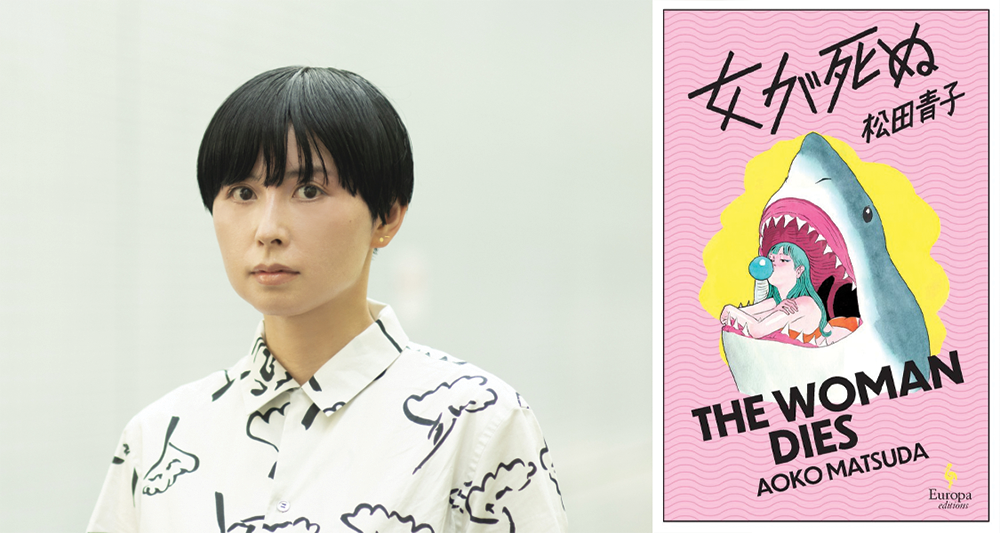
The Woman Dies by Aoko Matsuda, translated from the Japanese by Polly Barton, Europa Editions, 2025
Within the new wave of openly feminist Japanese literature, Aoko Matsuda is well-known for her fierce, sharply funny critique of sexism in contemporary Japan. Her work has previously appeared in English with publications like “The Girl Who Is Getting Married” (translated by Angus Turvill) and Where the Wild Ladies Are (translated by Polly Barton), and now, with the appearance of The Woman Dies—also translated by Barton—Matsuda continues her incisive vision with fifty-two short stories that jump from the mockery of gender roles to subtler reflections on girlhood, often interspliced with delightfully whimsical commentary on the everyday.
As sexism and anti-LGBTQ stances persist in Japan, the increasing number of talented Japanese writers translated into English nonetheless reveal literary discourses that dissect and challenge the limits of how gender and sexuality are established in mainstream society. Feminist discourses in Japan are also growingly transnational, with readers eagerly devouring feminist fiction translated from English, Korean, and other languages. Matsuda herself is not only an accomplished fiction writer and essayist, but also a translator of English, bringing out Japanese iterations of works by Karen Russell and Amelia Gray, among others. The Woman Dies is a unique addition to Japanese literature in English translation—which does not include much flash fiction—and certainly introduces fresh, lively feminist perspectives. At the same time, despite how the collection is advertised, it is too limiting to suggest that all of its stories can fall under “feminism,” as many of Matsuda’s pieces—sometimes only one or two pages in length—are charming snippets of everyday life, resisting any kind of categorization.
The titular story, however, is a strongly feminist piece. First published in 2018 in Granta and shortlisted for a Shirley Jackson Award, “The Woman Dies” is powerful and darkly funny in how it approaches the problem of gendered narratives in films. Matsuda begins:
The woman dies. She dies to provide a plot twist. She dies to develop the narrative. She dies for cathartic effect. She dies because no one could think of what else to do with her. Dies because there weren’t any better ideas around. Dies because her death was the very best story idea that anyone could come up with.
She goes on to outline the cliched use of marriage, pregnancy, miscarriages, and rape in the same manner. The story then turns to several moviegoers who watch precisely such a mediocre film, only to find themselves in a surprising situation; on the street, they are confronted with an actual woman dying, who leaves them with some passionate, unexpected last words. Even when collapsing the distance between depiction and the real-life violence faced by women, the story’s tone remains humorous, and Polly Barton aptly captures the rhythm of Matsuda’s short, repetitive sentences, as well as her dry critique of male-dominated creative industries and their limited imagination. But it’s not all cynicism; “The Woman Dies” ends with a thoughtful commentary on how even a brief feminist intervention might spark some kind of change for people in their everyday lives.
Many other stories contain clear critiques of feminine gender norms. “I Hate the Girls that You Like” is a cathartic listing of all the characteristics pushed onto girls, with a kind of unchanging severity specific to contemporary Japan:
I hate the girls that you like. The girls that you like are slender, dainty, and ethereal. . . . I hate the girls that you like. The girls that you like are selfish, fancy-free, and capricious as kittens. And yet, they make an exception for you. . . . I hate the girls that you like. The girls that you like catch on very quickly, have great potential, and respond well to teaching. The one doing the teaching is, of course, you.
Other pieces engage the topic with a softer touch, such as “The Year of No Wild Flowers,” a lyrical description of wildflowers, sometimes anthropomorphized (singing in the bath, getting a prescription, or eating McDonald’s hamburgers). Despite never mentioning gender, the story nonetheless seems to be a poignant reflection on the possibilities of girlish existence without the predetermination of gender norms. Meanwhile, “The Purest Woman in the Kingdom” literally pulls no punches, depicting a chauvinistic prince who uses a magical set of glasses to search for a woman who has never been sexually touched, only to end up with a wife who leaves him crying in pain. Concerning the prince’s harsh judgment of all the women he deems ineligible, Matsuda writes: “It didn’t occur to him that sexual touch potentially encompassed a whole range of different things: being groped, raped, sexually abused, and so on.” Certain stories reflect the specific failures of gender equality in Japan; “CV” is a straightforward first-person narrative of a woman’s life from age twenty-two to thirty-two, with her basic experiences being: encountering sexual harassment as a secretary, working as a receptionist, always being treated as “a woman” or “a girl.”
In addition to such frank portraits of inequality, Matsuda’s collection also continually surprises the reader with playfulness, randomness, and pleasure, with frequent references to works of art, television characters, actors, and other aspects of popular culture. In this, the hidden theme of the collection might simply be: imagination—not only to question gender normativity, but also the curiosity and wonder in the everyday experiences of childhood and girlhood. “God Must Be Stupid” (part of the “Cats are Brilliant” series) denounces God’s failure to make cats immortal. “Starry Night” is told from the perspective of a child living inside Van Gogh’s painting. In “This Precious Opportunity,” the narrator confides in the reader their secret love for licking yogurt lids. The makeup brands NARS, MAC, and Addiction are referenced in the instructions of “How to Transform from a Punk into a Girl-Next-Door,” and the following story providing instructions for the opposite transformation. “Bette Davis” stars a group of fans who hire a psychic from New York to summon the titular star for them.
More serious reflections—such as on Japanese nationalism and war—also appear throughout the collection, but these stories, as well as the many openly feminist pieces, are folded into the fabric of many other dreamy, odd narratives that might simply make the reader laugh or smile, with no particular agenda. Barton’s translation does an excellent job of adhering to these different, sometimes dramatic shifts in tone—particularly with how it produces Matsuda’s sense of humor in English. The Woman Dies is often undeniably funny, whether one reads it in English or Japanese, and its skillful repetitions of subjects and sentence structures coalesce in unifying poetic rhythms and striking visual effects, in addition to strategically inserting a critical vein into the limited space of very short pieces.
Some aspects of Matsuda’s writing might have posed particular problems for Barton. Though the stories include many first-person narrators whose genders are not overtly described, the ambiguity is alleviated in the Japanese language by their associated first-person pronouns; the use of either “watashi” (neutral, often female) or “boku” (younger, male) serves as a hint despite the increasingly flexible, gender-bending use of pronouns in Japan. However, in English, only the pronoun “I” is possible.
As for the more subtle intercultural engagements within the prose, “The Masculine Touch” contains the most references to Japan-specific literary, cultural, and political contexts of sexism that remain hidden beneath the surface in Barton’s translation. The story presents a gender-reversal scenario in which male perspectives are suddenly “discovered” to be important and subsequently lauded in shallow ways; the Japanese text specifically describes male authors as “danryū sakka,” mirroring a belittling term historically used for female writers (“joryū sakka”), and also includes references to the early twentieth-century feminist group Seitō; former Prime Minister Abe’s exhortation for women to “shine”; Monique Wittig’s “One Is Not Born a Woman”; and the term “office lady,” or “OL,” used for working women (humorously written in the Japanese as “office gentleman”).
For different reasons, “Victoria’s Secret” also stands out as a story whose meaning might be lost in translation for English-speaking readers. Part of a trilogy of stories, we soon discover that the narrative (referencing the lingerie brand) is a Japanese high school girl’s imagined tale of two girls in the US countryside. The story begins, “For as long as she could remember, Victoria had wanted to be a boy.” However, during Victoria’s discussion with her friend Teresa about coming out with this “secret,” Teresa remarks upon how becoming a man seems unpleasant, and both girls also seem unable to distinguish between gender identity and sexual orientation. One reading might be that the Japanese student ostensibly writing this story (depicted later in “Dear Doctor Spencer Reid”) is herself confused about these identities, but queer readers might feel uncomfortable about the flippant tone of the story (originally written in 2016), particularly given the extreme violence of ongoing attacks on transgender communities in the US and elsewhere. Perhaps one consolation is that the Japanese national anthem (“The National Anthem Gets It Bad,” etc.) might be gay in Matsuda’s portrayal, which is undoubtedly brilliant.
The collection includes a section at the back titled “Aoko Matsuda’s One-Line Commentaries” that outlines the origins or inspiration for each story, but the glib style of these commentaries avoids over-explaining or decoding. It was rewritten slightly for an English-language audience by Matsuda herself, sometimes according to suggestions provided by Barton, and this careful collaboration speaks to the author and translator’s shared desire to impart specific details in an overall outstanding translation. However, in both Japanese and English versions of The Woman Dies, much is left to the reader’s own discretion; the collection ends appropriately on a penultimate story called “The Death of Context,” which says, “Texts live on even after their context is dead.” As readers, we are encouraged to bring individual contexts to these smart, imaginative, and hilarious stories, infusing Matsuda’s idiosyncratic sense of wonder into our own daily lives.
Grace En-Yi Ting (she/they) is a Taiwanese American queer/feminist studies scholar specializing in Japan, women writers, girls’ culture, cuteness, and crip/disability studies. Recently, her work deals with transnational feminisms and queer politics between greater China, Japan, and Asian America, particularly the critique of discrimination and violence within activist communities. She is also a literary translator from the Japanese and Chinese and writes essays, poetry, and book reviews sometimes.
*****
Read more on the Asymptote blog: