
—Heather Green, Visual Editor
Because you’re a translator, and a frequent past contributor to Asymptote in that capacity, I want to begin with translation. You translated Reina Maria Rodriguez’s collection, The Winter Garden Photograph, which received the PEN Award for Poetry in Translation. Did this collection’s meditation on photography—photographs as a way to access writing about one’s own locality—influence your thinking for your own book? Also, I’m curious about, more broadly, how your sustained engagement with literary translation influenced your writing process, and even how you approached shaping the collection itself?
Reina’s determination to cut through language, to create something other, might not so much be an “influence” as an index of writing likely to hold my attention. So it’s probably more about affinity, the way affinities weave through each other across time.
I didn’t have any conscious plan to read Barthes’s Camera Lucida before I realized it was necessary to translating The Winter Garden Photograph, or Sontag’s On Photography either. I read them to find new language, which changed how I translated Reina’s book. That weave or expansion in language took years, with the final revisions to Reina’s book overlapping the composition of Dissonance.
Over time, those writings on photography have had more influence than I foresaw. When I picked up George Baker’s Lateness and Longing, a more contemporary reflection on photography, sections of it really struck me. It isn’t a direct source text. Somehow, though, passages by Baker feel relevant in juxtaposition with Dissonance.
Juan Carlos Flores is another Havana-area poet whose approach to place and time led me to think more actively about my own, and about how to give a shape to Vermont-based poems. I translated his book The Counterpunch (and Other Horizontal Poems). Those poems range around his public housing community of Alamar, on the outskirts of Havana.1 They’re aesthetically layered despite a tight, minimalist appearance. Although Juan Carlos took his own life in 2016, Dissonance is a kind of response to his place-based book and to the other poets, including Reina, who generated their own unique poetic topographies. My response had to be based here, in a place they would see as the (far) north. I wrote an essay on “the south” in a poem by Reina, from The Winter Garden Photograph, that made me think about “the north.”2
To get into your question about shaping Dissonance, I was trying to build a poetic psychology of attention. The form had to match that purpose. Eventually I drew from the geography here in a valley in Vermont, in the foothills, where we come and go using a dirt road that changes a little bit every day. Form also came out of my everyday movements, including regular walks down that road, occasionally with a camera—I was thinking about multisensory qualities, physical repetitions, and effects of movement on the mind.
Attention mattered because I started drafting a lot of those poems during the first Trump administration, characterized by constant misdirection, antisocial speech, extreme bullshitting, and the manipulation of digital dependency. It followed that one had to reclaim the ability to concentrate. Eventually I decided that interruption itself signified, so it became integral to the form. I chose to let my mind drift regularly, so that it would reorient toward realities that mattered to me, rather than the scripts that the administration was trying to force on the public.
Your book opens with an epigraph by René Char, translated by Nancy Kline, and includes numerous quotes by Char, as well as material from Paul Celan (trans. Pierre Joris) and Marcelo Morales, whom you’ve translated, and also contains material from government sources related to security and immigration enforcement. Could you talk about your research process for this book; what models, if any, you had for this research or documentary-based poetry; and how you handled the aesthetic layers and documentary demands of the project during the writing and editing process?
I didn’t have a particular model in mind, but the people you’ve named have been touchstones. I loved how Char could cut through and across his own scenes, his own times, could be at once fully in and out of them.
Contemporary literature in a kind of expanded field of the document does interest me. To give just a few examples, I was taken by Mary-Kim Arnold’s Litany for the Long Moment, incorporating documentation related to her family search reaching to Korea, as well as meditations and quotes over and around photographs. Paul Hlava Ceballos’s Banana [ ] also explores documents through frames of migration and interconnectedness, especially in “Banana [ ]: A History of the Americas,” which uses almost 300 notes.
The way M. NourbeSe Philip and Don Mee Choi have assumed official documents and redirected them into artistic expression is impressive. If they take the language of the archive and extract from it loss, then I’d add a contrast to Daniel Borzutzky and Raúl Zurita, who use very different strategies. They’re conscious of the unbearable non-archive: people and information so repeatedly, systematically disappeared that expression just breaks and cycles over itself. And to anyone who hasn’t yet read Landlock X, by Sarah Audsley, get it to see a combination of poetry that is clearly “of Vermont” yet mingles with transnational documentation, including visual material.
With Dissonance, I was exploring how all other demands circled through a physical demand—the way you have to get up and start walking after a major medical event, forcing you to exist differently in the world. At the same time, in terms of layers, I wrote across boundaries between selves—writer, translator, scholar, etc.—and let things that I read for one purpose return through a different one. The poems came to hold different mental planes, sometimes enfolding language from research.
We live in a time when literary translators have been firmly asserting that we can be both researchers and creative writers, so essentially, I asked myself what it could look like to let more of that out on these pages.
In that sense of ranging across roles, Roberto Tejada, with whom I co-edited the journal Mandorla: Nueva escritura de las Américas / New Writing from the Americas, has been a model for, I think, many many contemporary writers. He’s able to grasp something visionary about poetics in everything. He has written books with and about photography, including meditations on archives. Just one of those books is Still Nowhere in an Empty Vastness, with a photo spread in the center. That spread appears just before “The Zone is Immanence,” an essay about contemporary Cuban poets that registers oddly for me. It feels almost like a personal “archive” of affinities and admirations, because Roberto discusses people whose work I’ve translated. I’d highlight Urayoán Noel as another thinker and artist on the move, whose work I got to know better thanks to Mandorla. He has this characteristic, brilliant energy that somehow self-renews, through constant overflows from poetry into scholarship and back again. He’s impressive.
I’m interested in the relationship between photographs and text in this book. In your book you quote Jaime Permuth: “Photography is an emotional response to light.” And in a sense poetry could be an emotional response to language, or etymology (as of “foothills,” in your book). How did you come to work with photography and, in particular, with photographs edited to include text, within this book of poetry? Did the poems or the photographs come first, and how did they influence one another?
As a teenager, I took mountains of images and spent hours in a darkroom messing with ways to develop them.
Years later, as a translator, I was using images for more or less straightforward documentation, a useful tool when you’re introducing writers and content new to English-language readers. In “Intermedium,” the extended series on translation that I wrote for the digital poetics magazine, Jacket2, I incorporated many photos. They lean toward documentation, thought I was starting to think more about how to make things other than documentation documentation—or expanding outward from it—happen with images.3
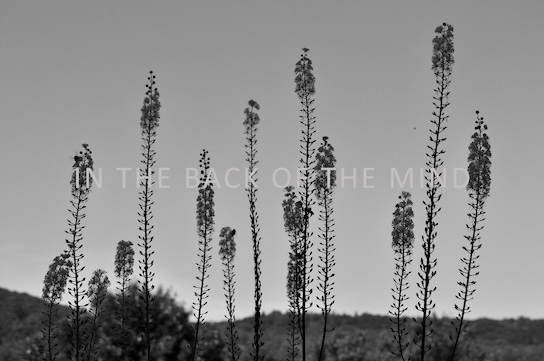
While writing Dissonance, I took ridgeline photos on and off for years. My recollection is that the compositional process involved moving back and forth between text and image. I asked myself why I gravitated toward certain photos. One image that made it into the book, with text, shows plants with a ridgeline behind them (see page 38). After taking it, I read a study referring to ridgelines and views as landscape features that are often cited in legal battles over land use in Vermont. I began to think more often about how ridgelines made psychological shapes for our everyday lives. Trees and plants rise vertically over the erratic horizontals of ridgelines in a lot of my photos. I was translating Marcelo’s new manuscript then in process, writing English phrases like “The areca palm at the base of my skull,” so with his Cuban references in mind, I started thinking about my different baselines here within the Vermont landscape.4
Words suggest, and they also fail. I asked my husband Brian, a visual artist, to look at the image/texts in progress with me. We agreed that the words should not be dominant but start to sink into the landscape. It’s the opposite of what people might expect after looking at work by, say, Barbara Kruger; with a professional history of placing captions on images, she makes text stand out assertively.
I didn’t find Forrest Gander’s Knot, with photos by Jack Shear, until I had drafted most of Dissonance. It’s a newer touchstone for thinking about what can be done with poetry and image.
In your recent essay in Poetry Daily, you mentioned that time itself became a crucial element in your book. Could you say a bit about how your poetry moves in time, documents it, and is experienced in time (possibly in comparison with photography)? I’m interested in the way each medium can dilate a moment, but also how your book’s focus—a dirt road near foothills in Vermont—is something that feels timeless but also always in flux, dynamic.
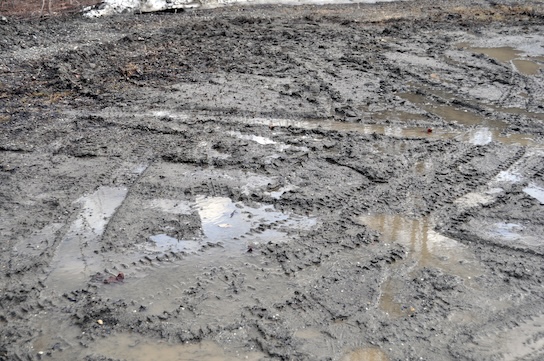
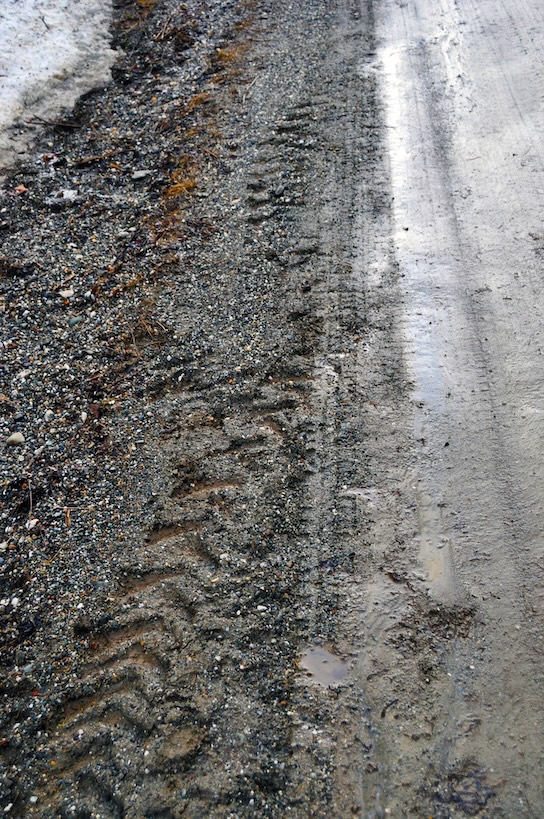
Yes, the dirt road looks static, but dirt roads are always changing. Reality equals mud.
Time flexes all throughout the book, in many different modes. For example, one mode is geological. Acknowledging the life of mud, or how the contortion of rock layers under our feet can make present and future access to water uncertain. A single rock sitting in the mud owns a story far longer than what humans will ever experience in our own timespan.
Baker’s Lateness and Longing, which is the most recent meditation on photography to draw my attention, returns again and again to matters of time.
I’m also curious about your title, Dissonance. First, I often think about ICE activity at the US border in relation to the southern border, shared with Mexico, but your book focuses on an area that’s near the Canadian border and explicitly engages with US immigration issues there. Immediately, I sense a dissonance between the rural beauty and the horrific militarization of the border forces (“Now hiring. To grasp at some people.”); between the US constitution, and, as one of your photos shows, the way it’s not “fully” enforced within a hundred miles of the border (“Do you live inside a hundred-mile zone = maybe so most of us do.”); and the dissonance between advertisements for Vermont as a travel destination and the realities of northern, rural living. What other dimensions and resonances does this title have for you?
It keeps making sense to me that William Carlos Williams wrote, “Dissonance / (if you are interested) / leads to discovery.” And it makes equal sense that Rosmarie Waldrop incorporated his lines into an entire book she titled Dissonance (If You Are Interested). His lines reappear in “The Space of a Gap, A Fragment,” an entry where she comments on interruption. Waldrop prioritized sparks given off at the edges of fragments, which she collected from disparate sources.5 Both poets thought across languages; it’s easy to imagine how juxtaposing English to Spanish or German could generate layers, sparks, and friction.
My father is a musician, and I grew up surrounded by sound. His wall-to-wall record collection included plenty of experiments in dissonance. You realize that musicians use dissonance to create textures, imagine pluralities of sound, work over the emotions you can feel while navigating fragments. Harmony would bore us, would be unconvincing, without dissonance.
None of that undoes the political material you mentioned. I’m interested in the way we get implicated in border politics even while imagining that we’re somehow outside their workings. People all around the (mainland) US literally live in zones defined by the nationshape, a hundred-mile strip all the way around. Here in the north, the entire state of Maine, like a chunk of Vermont, is covered by the hundred-mile zone.
The killings of Renee Good and Alex Pretti, under the pretext of immigration enforcement in Minnesota, drew a new attention to northern border states in January 2026. While writing Dissonance, I was concerned about the violation of the rights of migrants, and also exploring its psychological dimensions, like how those violations drive a wedge into larger visions of justice. That wedge has been abused again and again: It’s a method for getting us to accept gradual diminishments to the rights of all.
I read that some US audiences are starting to respond this year by seeking to force violence back from northern border states toward our southern border. But this plays into long-stereotyped thinking about people, about the south and north, and about where federal violence supposedly “belongs.” There’s no fix in recycling old stereotypes and violations.
To what does this national community actually aspire? Continuing to devalue justice, peace, and our own future is a dead end. As a community, we’ll have to put in the work to retake ideals, name what we value, change the vicious direction of the era.
Douglas Kearney writes of your book: “In Dissonance—over four sections of tightly calibrated and still, nigh ghostlike stanzas that drift, seemingly estranged, apart from each other—place is slowly disarticulated from presence, even as the ligatures between the concrete and the abstract grow more taut.” And indeed, people are implicated, insinuated, and alive at the edges of the pages, and children appear periodically (breaking rules, “refusing food,” “holding a colander with tomatoes”), but the poems elide the narrator’s presence, and investigate place in a restrained and multiperspectival way. This question may be related to my earlier question about time, but would you say a bit about this “disarticulat[ion] from presence,” so striking in its accumulation of effects?
Many things grow more present when you don’t look directly at them.
I was thrilled to see how Douglas captured the drift and accumulations of Dissonance. His Optic Subwoof might seem to be about other topics but includes remarks like this one about how highly disarticulated expression can still conjure a presence: “We recognize what’s happening and nod our heads to the fact that despite all the cuts, it has a pulse.”6
I tend to be interested in works that tense just in a moment when they’re pulling you outside yourself, or into some threshold space, half in, half out. That drift and estrangement cycles back to how music and translation work on the mind and body. The document, the research, can be part of the drift. When humans generate documents, we estrange our habits and desires from ourselves. Documents insinuate these nonetheless and add social textures, other presences, made possible by their exterior functions.
Contemporary ecological thought suggests other twists on presence. It draws attention to non-human presences, seriously considering them as part of our community existence. This semi-rural but residential zone in the hills, just past the bounds of a spreading city that appears likely to consume it before too long, has a lot of energy beyond the self or even the human. For me, there are affinities with works like Gander’s translation of fungus skull eye wing, by Alfonso D’Aquino, who also largely elides a narrator’s presence. People are still very present in Brenda Hillman’s Cascadia, but there I was especially interested in what she did with geology. Scientific language and creatures of all kinds permeate Eleni Sikelianos’s The California Poem: “Edentata belonging to the (inhabited) Earth, edacious at the tooth of Time / nibbling some sweet thing, fiery / Hymenoptera edulcorated by their history with men.” One of the photos that she incorporates features whale bones. Her exuberance reminds me of the Uruguayan poet Amanda Berenguer.
I have to ask about what I’ve come to think of as the “library interludes” in the book, in which a library is described, followed by bracketed litanies, containing language and images somewhat tonally rather different from the rest of the volume. It’s almost like a visitor to this landscape stops into the library and peeks into multiple distant worlds. How did these pages come to be?
Litany, yes, as a succession or catalogue, maybe even ceremony. Though without the sometime connotation of litany as expressing a negative view.
You look around in a library, and you’ll see books that shaped the outlooks and successes of generations. Our family has spent a lot of time in the two Vermont small-town libraries mentioned in Dissonance. One library is in Hinesburg, to the west of the dirt road running through the book, and the other is in Huntington, near the eastern terminus of that road. I started to write down what I actually saw in those places. Each library features books by Vermonters, so I started checking some of those books out, to see what people thought the community “looked like” at different times.
Some of the books illustrate how people imagine disappearing from their everyday life into Vermont, heading for the hills in search of other lifeways. The last title I discarded for this book was “Who Disappeared into the Hills.” There are also a lot of books offering visions of alternative lives or futures. Want to build yourself a garden shed with Danish flair and raise chickens while foraging native plants from the forest edge? Check the shelves for advice.
Huntington’s library is beautiful and usually sort of dark on the inside, stark from the outside. Silent and borderline magical, just as you’d expect of a former meeting house finished in 1870. You look around these rooms and see how important public libraries are to democratic well-being. In the pandemic, we started noticing more and more “Little Free Libraries,” which seemed to capture an intense need for some social aspect of reading. They’re those handmade boxes attached to posts, where passersby can take and leave books.
Your book looks at various shapes and systems that co-inhabit or criss-cross the landscape in a specific place, and I was taken with your description of the beavers, their status in relation to the ponds and roads (and cars) and human governance. I remember reading that there were hundreds of millions of beavers in North America prior to the fur trade, and that they shaped the landscape in ways they now cannot. Could you talk about your observations of animals as you prepared to write this book, how they made their way in, and how the writing of Dissonance affected your relationship to your environment in Vermont, and to the land, flora, and fauna there?
My first memories are from a home on a dirt road in Ohio, where most neighbors were bilingual Amish farmers to whom we were “the English.” If you look around rural roads, they’re not empty. The zone is full of inhabitants following patterns and needs through the landscape.
Here there’s a beaver pond at the bottom of our hill, alongside the main dirt road that crosses this little valley, west to east. You have to constantly be aware of animal life. Baby Canada geese wander out of the pond, into the road, every spring. People stop their trucks to pick up turtles. Deer jump out at dusk. A woodpecker just flew hard into our window and is recovering safely inside a box on our woodpile as I’m answering you. Ask Bernie Sanders about the history of hunting for food in Vermont.
I’m happy to live at a time when people are publishing more research about animal intelligence, and the rise of ecology has linked knowledge from isolated disciplines into bigger, more holistic pictures. The crow sitting in a tree is actually watching and remembering you. People have started to talk more about the valuable actions of animals, like the ecological restoration value of beaver activity, but it’s still a conversation that needs to expand to change human habits. One of the books I found in a local library was by Bernd Heinrich, a biologist at the University of Vermont whose writing could almost have been based on our road. I also got a guide developed for the local naturalist training program, thanks to my husband. He went through that program, though as a visual artist, accompanied almost entirely by scientifically trained people. The arts of estrangement matter in these contexts. Scientific worldviews are themselves strange to other people, especially when new knowledge undercuts custom.

