
On 9 September 1996, the plane that’s brought us from Moscow lands at Ezeiza Airport, Buenos Aires. After getting our passports stamped in Immigration, we make our way towards the exit, lugging four enormous suitcases. The intense humidity makes my hair go frizzy. Mama’s nervous, Papa’s anxious, my brother’s tired. The four of us watch the automatic doors opening and closing, we can see the street, the people hugging each other outside.
A besuited man carrying cases steps out of a taxi, approaches, stops abruptly and fires an unexpected question at us: “Why have you come to Argentina? This country’s hell.” Our minds go blank and we say nothing. The man rushes off.
Another, very short man is waiting for us outside the airport, holding up a sign with our surname on it. How could he possibly deal with my confusion, my incipient homesickness, Mama’s nerves, Papa’s repressed anxiety, my brother’s teenage loneliness? Despite all these emotions, we’re excited: the newness of it all gives us butterflies in the stomach.
The man greets us flatly, with a brief smile. I take careful note of the crow’s feet spreading from the corners of his eyes, the sharp contours of his chin, his moustache, which looks false. I commit his face to memory, just in case.
He guides us towards his car, we put our cases in the boot and squeeze all the things that won’t fit onto our laps. The engine roars and we set off down the motorway: although we’re no longer on the plane, it feels to me as if we’re still airborne. I’ve never seen a motorway like this before or experienced this constant surge of honking cars, deafening me.
So much is startling: the shrubs with their oversized flowers, the strange street names, the aroma of grilled meat, the long-haired men. Everything’s new to me, and my eyes are doing two things at once, observing and interpreting. My eyes are nets which I cast out over my surroundings. Arriving in Buenos Aires at the age of ten, I feel like a baby seeing the world for the first time.
The man drops us off at the entrance of a family hotel in Calle Congreso. He assures us it’s a good place because there’s a Russian family living there, he knows them very well, and they’re happy to be our guides: they’ll show us the local supermarkets, the schools in the area, the parks, the Russian Orthodox church, and teach us the right phrases to use when greeting, thanking and saying goodbye to people.
The hotel manageress is a woman of around fifty, slight and stringy with overly tanned skin. She always puts her curly hair up in a bun before getting down to the job of scrubbing the three floors and the many corridors of this building where everyone knows everyone else’s personal affairs.
Although the manageress clearly isn’t very eager to engage in conversation, she addresses me out of a sense of obligation. Each time we pass each other, she comments, “What white skin . . . ” She says this so as not to say, “What pale skin, what an odd seedling transplanted into the wrong soil.”
Our room isn’t large, and the window looks out over a busy street. The flow of cars is endless, like a river roaring in full spate twenty-four hours a day. But it’s the only thing I can get my mind around in these new surroundings.
It’s only a few hours since we landed and we’re already settled in this cramped cubicle. It’s my birthday tomorrow and I have trouble getting off to sleep. Under the sheet, I play at being a mummy swathed in bandages that both constrict my breathing and give me protection.
“What white skin,” I think. “White like a mummy.”
The other family
The Russian family comprises the father, Oleg; the mother, Sveta; and their daughter, Oksana. She’s thirteen, with lank albino hair that exudes a scent of faded flowers exposed to the sun for a long time. I ask her why it smells that way, and she replies that it’s because of something all the girls at her school do: after shampooing their hair, they apply conditioner but don’t rinse it off.
Her hair has a solid appearance, as if the partings were held in place by invisible clay. Mine is different: it’s short, and it’s been impossible to trace any kind of pathway through it since my braids were cut off a few days before the journey to Buenos Aires.
Oleg, Sveta and Oksana are very quick. They’re quick to cross the street, quick to reply, quick to laugh, to point things out, show us where the post office is, ask how much money we’ve brought with us. Their eyes glitter when Mama tells them. We, on the other hand, live in slow motion, like European elk crossing a lake in winter, careful not to crack the ice.
I don’t like Oleg, Sveta or Oksana. But my parents lean on them. They fill a gap. They speak our language, share our codes, and although they’re slightly younger than Papa and Mama, they all treat each other as equals. But I don’t understand why they’re still living in this hotel if they arrived in Buenos Aires several years ago.
After two months of friendship, they suggest that my parents invest the money we brought from Gomel to buy a plot of land together. They’ll put up half the cash. They say it’s the best thing we can do with the sum we obtained from the sale of our flat, furniture and car—ten thousand dollars. They know a trustworthy estate agency which can take care of all the administrative paperwork, and a salesman. They say the plot is large and accessible, and the winters aren’t harsh in Buenos Aires, so it will be easy enough to build houses for both families. Mama and Papa like the idea and are keen to view the plot.
The room we rent in the hotel is on the second floor. A policeman lives on the third floor with his wife and three-year-old daughter. Each time he spots me in the courtyard, the policeman comes out and asks me to say a word in Russian. Within a few months he’s learned a lot of words and phrases, and his pronunciation is impeccable.
There are no plants in the courtyard, so it’s the perfect place to dance when there’s no one around. I practise leaping and run through choreographies I learned at ballet school. I used to hate this kind of dancing: my head would hurt from having my hair pulled back into a bun, my leotard stuck to me and the other girls showed no interest in making friends. Now dance is a way to forget that my life has changed and to do without any language.
The policeman’s name is Ricardo, he’s grey-haired and kindly, always in a good mood, and everyone in the hotel greets him with a smile. He’s fond of drinking maté in the afternoon and likes to sit on the stairs eating sandwiches with the crusts cut off.
Sometimes Ricardo emerges from his room with his thermos while I’m dancing. So as not to interrupt me, he creeps back inside and waits patiently for me to finish. The day I realised he was doing this to avoid bothering me, I said “Spasiba,” and he offered me a cup of maté, replying, “Nezashto.” That was my first cup of maté, both bitter and sweet.
Helped by Sveta, Mama enrols my brother and me at a state school, Colegio Félix de Azara. I can say a few basic words like Hola, Chau, Sí, No, Gracias, No entiendo. But when I utter any of them, my face turns into a grimace.
It’s September and not very long until the end of the school year. The kids in fourth grade treat me like an alien creature: they observe me, encircle me, and whisper among themselves. Once my classmates are used to my being there, they start to steal my pencils, tear my exercise books and say insulting things, or at least that’s how it seems to me. They know nothing about where I come from, they don’t call me a “firefly” or ask if I glow in the dark. They just make fun of me because I’m an easy target.
In October, my brother and I decide to stop attending this school. Mama and Papa don’t ask why, but accept our decision. It’s the first time our parents haven’t raised any objections to something so important, which worries me. We don’t tell them that my brother has to fight off boys who won’t stop bullying him, or that the girls try to pull my blouse off when I’m in the toilet so they can cut it into shreds. I don’t understand what they want from me. To see my body? Isn’t it like theirs? Or do they want to pinch me like I used to pinch my grandmother’s goats, so they’d run about like crazy and get lost?
The things I don’t understand about the new school
The fact that there’s a flagpole in the courtyard.
The fact that they hoist the flag each morning and make us sing the Flag Anthem, starting with the words “High in the sky a warlike eagle”.
The fact that we have to wear a white overall like doctors instead of a uniform.
Having clothes on under my overall and feeling that when people in the streets see me, they think I’ve got nothing on underneath.
The fact that the teacher calls me gordita, “Chubby”, instead of calling me by my name and surname.
The fact that there are so many ceremonies.
The fact that the headmistress wants my parents to attend all these ceremonies. That my parents don’t want to come because they wouldn’t understand anything.
The fact that kids can speak in class without raising a hand. That they can talk among themselves.
The fact that they can run about in the classroom. That they can throw things at each other.
The fact that they put stickers on the sheets of paper they do their homework on. That the teacher draws a smiley face on their homework when she marks it.
The fact that girls and boys who can’t stand each other exchange goodbye kisses at going-home time.
The things I like at my school: the fact that there’s a jacaranda tree in the courtyard.
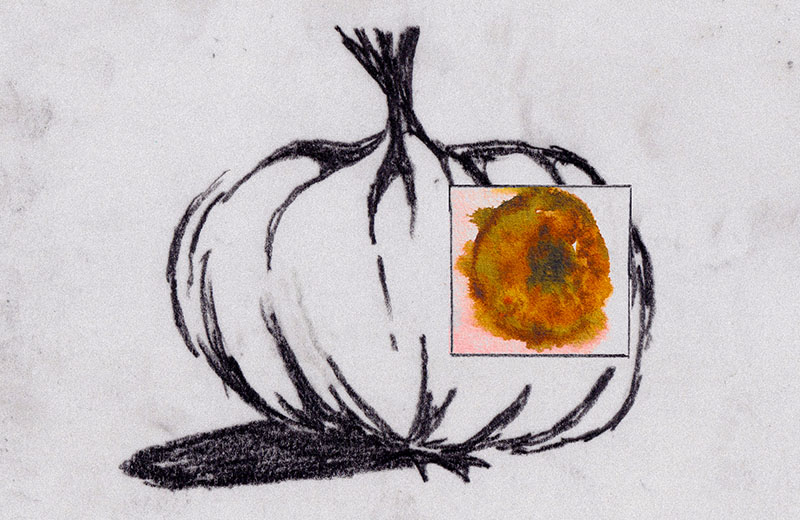
Ojo for ajo, an eye for garlic
I don’t wear a weatherproof jacket or scarf during my first winter in Buenos Aires because I’m used to much lower temperatures. I miss the snow, the iced-over lakes and the clouds of steamy breath.
People in the streets stare at me in amazement, as if my lack of an overcoat makes them feel cold. They also look askance at Mama, perhaps thinking she isn’t looking after me properly. She doesn’t notice their stares, having other things on her mind that demand her attention. She gets worked up about the things that make no sense to her in a country so different from her own, and is wondering whether to stop replying to the letters that arrive from Gomel, from her women friends and sisters, who keep asking why we moved so far away.
When we’re at the greengrocer’s, Mama asks for ojo, eye, instead of ajo, garlic. She tries to tell them they’ve given her the wrong change, looks for products we used in Belarus, which they don’t have here, and realises there’s no way for her to integrate into this new world without people correcting her sentences or her accent.
It’s not hard to understand a woman who enters a butcher’s shop holding her children by the hand and articulating each word slowly for fear of making a mistake. You need only notice the precision with which she pronounces each syllable in her efforts to get to the steaks and mincemeat.
The butcher guffaws, clasping his vast paunch, and calls his countrified assistant over to gawp at Mama as if she were a caged monkey. The young man blushes, putting on an amiable mask while we wait for the performance to end. He shakes my hand and I realise he’s missing two fingers. I tug at Mama’s coat. While she stoops, without letting the butcher out of her sight, I whisper, “Mama, he’s lost some fingers, like Grandma Yelena.”
I want to take hold of this hand and squeeze it tightly, I want him to take me for a walk around the neighbourhood, the two of us united by this amputation. I want to show him the hotel where we’re living, tell him the gossip about the people we live with and talk about how hard it is to attend a school where no one understands me. But the hand stops shaking mine and grips the knife.
Goldmine
I find it hard to fall asleep at night. I’m troubled by the honking horns and the heated discussions between men drinking beer at the corner kiosk until late. Never before have I felt the lack of silence and solitude so acutely. In Gomel, the noise level started to fall after six in the evening, and we would have our evening meal between seven and eight. Papa would choose the background music according to his mood, which could vary from Bulat Okudzhava to Aquarium or Mashina Vremeni.
I miss our parrot Mashka, Grandma Yelena ticking me off for trampling on her strawberries in pursuit of a cat, and the gossip of Mama’s women friends, which I’d listen to from behind the kitchen door. The enclosed balcony where we could play in winter, and my collection of colouring books. And the River Sozh after a snowfall. I used to explore its surface in the hope of finding a fish trapped in the ice.
What are our relatives and friends doing now? Do my old classmates think of me, do they feel my absence when the class photo is taken at the end of the year?
Have they marked Argentina on the map? Do they make up stories about my departure?
I’m aware of my sadness every day. Sometimes it feels as if I can’t live without it: little by little, I’m becoming an addict.
Sadness is no goldmine, I tell myself. It would be better to take the compass I never learned to use properly at school, mark out an opening in my stomach, stick my head inside and push my way in. I disappear into myself for a while. To think, and to find peace where there’s no light and I’m lulled by the beat of my blood. There’s no gold to be found in sadness.
Merry-go-round
My teacher’s name is Rita, she’s as slender as an ear of wheat and has a mane of black hair. She always wears the same skirt and a short overall. Each time she sees me she smiles and her brow furrows. She speaks slowly to me, in a loud voice, and I nod. She checks if I’ve noted down my homework correctly and asks me several times whether I understand what I’m to do.
She strokes my head, and every day she asks, “What did you have for breakfast this morning?” My reply is always the same: “Tea.” That’s the shortest possible answer and it ensures she’ll leave me be. Although the months pass and I quickly learn new words and more complex sentences, my teacher persists in asking me the same question. And I continue riding this merry-go-round that the two of us have built, repeating the same thing again and again: “Tea.” But what I’d really love to do is say to her: I’m gobbling you up, chewing you, incorporating you into myself, so that we can exist one within the other, in silence, if there’s nothing else we can talk about.
Contract of sale
Relations between Mama and Papa are going from bad to worse. This state of affairs isn’t new, but now we’re here their differences appear more pronounced. They’re becoming less noble, less affectionate towards each other; we’re like animals who can’t find shelter, and there’s a storm on the way. Given our precarious situation, Mama and Papa agree to the land purchase. The Russian family is delighted. We toast each other with cider in their room. The next day, Papa, Mama, Sveta and Oleg go to the estate agency and sign the contract of sale. Mama and Papa talk about the new house, the building work, the climate and the soil. Their eyes sparkle.
The day after the signing of the contract, the Russian family disappears. My parents don’t suspect anything to begin with, thinking they may have gone out shopping and then to visit some Argentinian friends. But night falls and they don’t return. The next morning, Mama asks the hotel manageress where they are. “They left early yesterday morning and took all their stuff with them,” she replies, chewing, with an extinguished cigarette between her lips.
Papa throws himself face down on the bed we share between the four of us. Mama paces the room as if about to race off, propel herself into the air, quit her own body. My brother and I watch Mama’s beautiful face age in seconds.
When I write, I attempt to reconcile the important and the non-important, the specific and the universal, tragedy and happiness, past and present, pain and tenderness. I think of Oksana and her albino hair: I thought she’d passed through my life without leaving a trace, yet the oppressive scent of her hair presaged the disaster that would strike our family. What is important, and what isn’t? And what if what is important drowns in the tumultuous sea of memory? Writing is like deep sea diving. The weight of my story drags me down. Plumb the depths without forgetting the experience, and afterwards you will fly.

