
There was a time when my mother was just a woman and my father was just a man. And also, when I was their only daughter.
My father had gone to the University of Lisbon in Portugal to study Portuguese for two years. He had spent his first year abroad alone, but the following year, for reasons I still do not know, my mother also flew to Lisbon. My father would often send us photos he had taken with the small community of Koreans in Lisbon—fewer than fifty in total—who had gathered out of homesickness in a foreign country. In those pictures, a young female college student was always seen standing next to him with a coquettish smile. I wonder if that had a hand in my family’s reunion.
I still don’t know whether Father brought Mother over or whether something had unsettled Mother, urging her to move. In any case, she made up her mind to leave her in-laws, her eldest daughter, and her son in Seoul, and to take only me, her youngest, to join my father.
*
The day we arrived at Lisbon Airport, we went straight to our apartment and unpacked our luggage. Then I fell asleep from the journey’s fatigue. When I woke up from my nap, the sun was already setting beyond the window. I lay in a strange room I had never seen before. Since I had always shared a small room with my sister, this European-style room of my own felt anything but familiar. The ceiling rose too high, the bed was king-size, and drab portraits hung on the wall. Tears welled up in my eyes before I realized it. I carefully opened my door, walked down the long corridor, and turned the knob to the main bedroom. I peeked inside, and under the covers, my parents were affectionately whispering to each other. Their bare shoulders had slipped out of the blanket. Suddenly, I recalled how they had written love letters to each other in high school under the names “Marie” and “Sean.” My mother would sometimes take out those letters and proudly show them to me when I was little.
“Sun, you’re up,” my mother said when she spotted me. “Why are you crying? Our maknae is ten but still a baby, aren’t you?”
Instead of scolding me, she wore a caring smile. She casually slipped on a shirt, gently nudged my father out, and beckoned me, still standing in the doorway, into that already-warm bed. Her calm, untroubled face relieved me, and I snuggled into my mother’s embrace like a baby and fell asleep again. I didn’t realize this at the time, but that was a moment when I could have had a younger sibling. Come to think of it, my mother was forty, just like I am now . . .
*
It was in Lisbon that I first became aware that my father was a man, and an exceptionally handsome one at that. His doe-like eyes were imbued with the shyness of a sweetishly “pretty” boy. Just a year earlier, when he had worked at the Government Complex Seoul in Gwanghwamun, my mother and I had visited him to deliver a document. He had stepped out of his office into the corridor in a navy suit and a white dress shirt underneath, and, without greeting us, checked the envelope with a stern face. After a cursory glance at his youngest daughter, he had given a curt nod and disappeared back into his office.
But in Lisbon, dressed for the warm Portuguese weather, he wore a crinkled cotton shirt and trousers, and draped a red wool sweater over his shoulders; at times, he puffed on a cigarette to look cool. At home, he listened to Richard Clayderman’s piano album or ABBA’s Gold: Greatest Hits, and drew colored-pencil sketches of the wildflower photos he took as a hobby. My father seemed to be too young to shoulder the responsibility of three children.
Knowing my older sister and brother had stayed behind in Seoul while attending middle school, I feel bad for thinking this, but I believe my father would have found some room to breathe if I had been the eldest child. Could this be why I enjoyed several privileges as the only daughter at the time?
*
For an older, grown-up student abroad, the hours after school passed in peace. On days when my father finished his college classes early and came to pick me up, he played basketball games in the setting sun with Mr. John, my fourth-grade homeroom teacher. Somehow, my father looked incredibly cool to me then. Of course, he fell far behind Mr. John in both skill and stamina. Being an American, Mr. John didn’t go easy on him simply because he was a parent, either. Yet my father, clumsy as he was, laughed, dashed, had fun, and worked up a sweat.
On my way back home to the apartment in Carnaxide, walking hand in hand with my father, I met a shepherd herding dozens of sheep. We cut through the flock and arrived at home, and my mother, in a languid tone uncharacteristic of her, often coaxed my father to dine out. Then the three of us slipped on our shoes again and went to the small seafood restaurant nearby. We ate freshly grilled sardines, escargots, or mildly seasoned grilled cod paired with steamed potatoes, and my father drank all the port wine he wanted.
*
In summer, I took my mother’s hand and went to the beach every day. We needed nothing but a beach towel. My ten-year-old body seemed to grow like a weed with each passing day. I grew a handspan overnight; my chest swelled, and my nipples itched. My hips stayed small and flat, though, so from behind I looked like a boy. I kept my short hair, too, and my mother went out of her way to mark me as a girl by putting me in a flower-patterned swimsuit. The fine sand felt sleek as silk, and the sun enveloped me in gentle warmth. The ocean water always rippled somewhat lukewarm to the touch. How could everything be so perfectly suited to me? I preferred staying in the water to building sand castles on shore. Yet I was a poor swimmer, and the waves swept me back to the beach again and again. Whenever that happened, seaweed clung to my fingers.
Even when my face was baked red under the sun and my lips blistered from the salty water, my mother simply sat beneath the parasol and rested with her brimmed hat on until I came out of the water on my own. Only after the sun set did she approach the ocean to look for her daughter. At night, a sudden chill set in my body, quite different from the heat of a moment before. My mother rolled and dried me in a huge beach towel, then covered my hair with a smaller towel and squeezed out every last drop of water. During that time, I fixed my eyes on the waves as they grew rougher. Please let me come here again tomorrow, I prayed.
*
When the University of Lisbon began its summer break, the three of us set out on a road trip through Southern Europe. We loaded the trunk of a tan, pre-owned Peugeot with doenjang, gochujang, a portable stove, and camping pots, then took to the road. People speak of the charm of road trips, but our European road trip turned out to be less charming and more laborious. A road trip, naturally, means that you spend most of your time in the car, on the road. Whenever we encountered a sign promising that we would soon reach a town, it served as a signal of relief: that we could finally stop driving.
At times, without warning, the car would suddenly pull over to the side of the road. Then, my parents would step out of the car without a word and search for a patch of shade, usually under a small olive tree. The menu was always consistent: white rice, doenjang stew with potatoes and onions, and gochujang. Some days, my mother ventured into the fields and found a colony of bracken. Then the three of us forgot all about our trip and focused on gathering ferns. The next meal would turn into steamed bracken rice. Whenever we grew tired of rice, we tucked Emmental and ham into baguettes, so between legs of our journey, we had to shake the crumbs off the floor mats.
Even though the trip lasted for three weeks, all I remember eating is those three dishes and a simple spaghetti Bolognese we had at the Swiss border. We had gone too long without a meal in a proper restaurant, so the delicious spaghetti brought tears to my eyes. Only after I cleared my plate did I realize that I had forgotten to sprinkle Parmesan, and tears rose again out of vexation. Funny how a meal could stir up such joy and fury.
By day, we parked in a town and walked around, but once night fell, my father drove down the dark highway at 120 kilometers an hour to save time. One after another, the boring night drives soon wore me down, and I often drifted off amid the vehicle’s steady vibration. In that drowse, I heard my parents’ voices like a hallucination; my mother mostly kept up a stream of conversation so that my father wouldn’t nod off. Neither of them were talkative to begin with. After a long race down the highway, they would pull up by the roadside, tilt their seats back, and sleep for a couple of hours. Then I’d lie wide awake alone, and in the stillness where the only sound I could rely on was my parents’ faint breathing, I had nothing else to do but gaze up at the night sky studded with white stars like diamonds.
Whenever we reached a small town late at night before sleep overtook my father, he would slow down and park in front of a one- or two-star hostel. I would grumble about how I hated the creaking stairs, the bed with broken springs, and the witch-like manager on duty, about how I was scared and couldn’t fall asleep. But most of my complaints went ignored, and the three of us lay side by side on a narrow, rattling bed, trying to get some sleep. Even with their hardy stomachs though, there were places my parents shook their heads at.
Once, at the sight of a rusty iron bed frame, linens that looked hospital-issued, old wallpaper darkened by mold, and a cramped bathroom where medieval ghosts might spring from the toilet, we avoided the eyes of the manager showing us the room and rushed out of the hostel saying “pardon.” The manager, seemingly used to such reactions, merely shrugged. Tasked with finding another hostel, my father started the car again with a weary gesture.
*
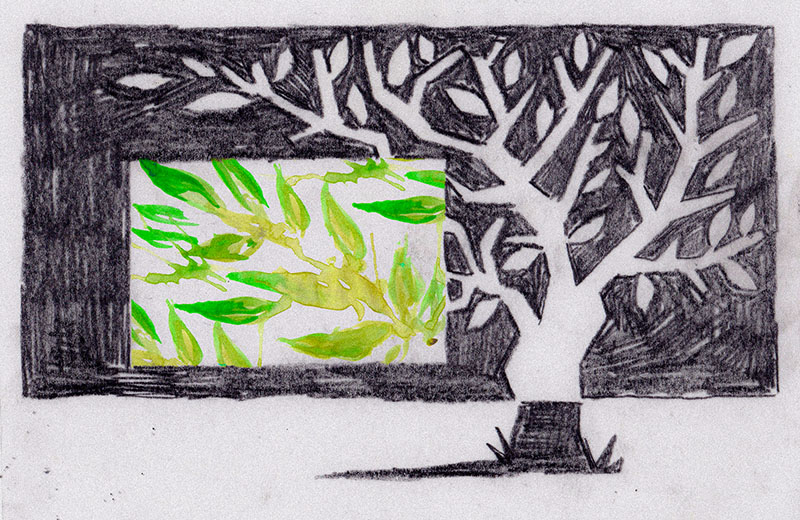
Most of the photographs from that road trip show my mother and me in the same pose with the same exhausted expressions, only against different backgrounds. Since we kept waking in the night, we moved through our days half-asleep as we roamed cathedrals, museums, and art galleries. I was only ten at the time, so I couldn’t possibly grasp the meaning of all those products of history and art unfurling before my eyes. No matter how great the artists were, I was bound to tire of looking at too many of their works. Often, I was the only Asian with slanted eyes in that particular space and would draw the mockery of local kindergarteners out on a field trip—“Chinês! Chinês!” A Chinese. At the time, it rather relieved my boredom. Even so, a sense of being touched by something utterly beautiful during that long trip still lives in me to this day. It wasn’t the Michelangelos, Picassos, and Leonardo da Vincis that “shaped” my soul. Rather, it was the ineffable, nostalgic green of olive leaves, the bitter taste of doenjang stew cooked with the ingredients from our car trunk, the slightly different humidity or smell in the air in each unfamiliar city, and the rumbling of the waves that slapped my soft, unripe young body before they rolled away.

