
When does a war end so I can look back on you purely and freely—as your own human being and not as a carrier of the death and destruction of an entire country, Sidsel Ana Welden Gajardo asks in this essay: A letter to her late father.
Dear father. I’ll write you a letter. A letter you will never read because you are dead. I also want to write a letter to all the parents who have children in the countries they have fled to, even though they are not born there themselves. A letter that I hope other children of refugees will read. There is something between us—the child and the parents—that we cannot broach. That we can't talk about.
In 2017, Vietnamese author Ocean Vuong wrote a letter in The New Yorker to his mother, with whom he fled to the United States as a two-year-old. A letter I, the daughter of a refugee, also had to write. And for different reasons neither of our parents are able to read these letters. We all live on with parts of our parents’ history. As a child of a refugee, it is no different. Therefore, this question keeps coming back to me, and I never asked you before you passed away. One question that I do not know how to answer: But when does a war end?
*
You died in Denmark. Far away from home. Far away from your beloved Andes mountains, your warm Atacama desert—and far away from your friends and family.
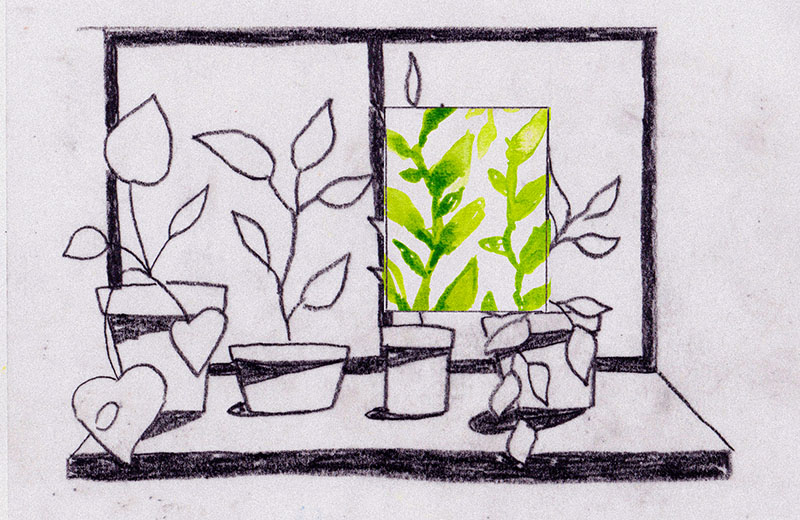
While you were alive, you always wondered how Denmark could be so flat. Whenever you missed the mountains, you walked into Søndermarken to walk on top on the pathetic small hills. The park was just behind your apartment—it was the farthest from your home you could go by yourself. You also didn't understand how a country could be so cold and the trees so barren several months of the year. Instead, you filled your windowsills with large green plants to feel closer to the nature of your home.
*
The war you lived and fled from is long gone. For years of my childhood, the war was an exciting and fictionalized story that I had not been able to link to reality. For you, the war lived on in your mind, in your loneliness, and it broke down your new life in Denmark as the years went by. A new life where you were without your family. You were friendless, unemployed and had lost your own identity. All that you lost; you gave to me, by putting me in the world, by fleeing to a country that you had never even heard of. Denmark. Thousands of Chileans were executed, imprisoned and tortured. Even more disappeared and fled. The military dictatorship lasted for 17 years, but another 30 years after that, the war still raged within you wherever you tried to flee too. USA, Spain, Denmark. War is a mental illness no psychiatrist can control.
*
I remember once, you and I went for a walk. A woman was standing on a corner begging for money. My memory of her is her looking creepy and untidy. She walked very close to your face, spoke to you in Spanish, she placed a hand on your heart. Then you gave her $20. I was running and playing as we walked along the curb, and I didn’t realize that you were no longer behind me. I turned around and saw your body collapsed. You sat bent over on the ground. This time your own hand pressed against your heart. You hyperventilated and said we had to go home. I didn’t understand anything, I didn’t understand that what I saw was the face of war shouting through your body.
Later you explained that meeting another Chilean who had fled the war, who lived on the street, and the sound of your native language in the middle of Valby Langgade, had provoked images and memories you struggled to cover in everyday life. You stopped speaking Spanish to me and I quickly forgot all I had learned.
*
Once I played with my friend in your garden. You were sitting inside in the living room, and we came in with toy guns that my friend brought from home. As a reflex you raised your voice, saying guns were not toys. Guns were something people used to kill or torture each other with. You fell silent, you groped your hands as if trying to catch the words you had come to release. Instead, you handed us a bag of sweets and a bucket of chalk. We could play with that instead. For every piece of candy I swallowed I remembered what you said. Guns are never toys.
*
To flee for life. To escape from the life you know. A tragedy that refugees carry. Which can develop into illness, anxiety and PTSD. To name a few. It's not about being strong or growing stronger from the traumas that doesn’t kill you. Time doesn’t heal everything. It’s about the limit of traumatic experiences that people can go through and live on without being mentally scarred by it. You were constantly struggling to keep memories and images down. But the smallest things could make your wall crack. A certain smell. One particular date that emphasized that it was now 15 years since you left the South American continent. Being with too many people in one place. Your own daughter’s childish play.
*
The first time I visited you in the hospital, I must have been around ten years old. At that age, our contact had already begun to thin out. When I stayed at your place you slept longer during the day. We rarely went out the door, and I missed my mom every time I was staying the weekend with you. I remember how you quietly nodded and handed me the phone every time I asked once again if I could call my mother. When I was at my mom’s house, I missed you a lot, but I didn't have a language to express it. Instead, I just commanded my mom to make her spaghetti bolognese more like yours.
There was something uplifting about visiting you in the hospital. We were only allowed to see you in the amount of time you were at your best. We ate candy and cake, you told us stories of your youth in Chile, you laughed with your big infectious laughter, so your teeth appeared in the middle of your full black beard.
*
When I entered university, you said that you knew I would experience all the success that you did not have access to in my country. That’s what you called it: your country. Never ours. I read your medical records when you died, and followed your path through the system: a deroute that went from a college education in your home country to several unskilled jobs, to unemployment benefits, to cash benefits, to abuse and numerous psychiatric diagnoses, to a huge debt, because you were not awarded early retirement, even though you fought it for ten years. That was when I realized that I can fly through my glass ceiling while yours was rock solid. It was when you told the cashier in the supermarket on the corner, the one that always imitated your accent that I, your daughter, had gotten an A for my high school degree, that I saw how at every moment you had to fight for just a little respect from your Danish fellow citizens.
*
The second time I visited you in the hospital, I was 13 years old. We ate white buns with butter in the canteen. The buns started to become something I could look forward to. They still had those buns at your last hospitalization when I was 19 years old.
*
When does a war end? Does it live on in me, in all the other children who have never even seen or experienced the horrors of war themselves? How can I think of you, without also looking at everything you are connected with. Because when I remember your small apartment that always smelled of smoke and had worn and hollowed furniture, it's also where the war comes to light.
When you drank a bottle of vodka a day and we had to visit you in the psychiatric ward, that too was when the war came to be known. The war was expressed in your plants, your rolled-up curtains, your incorrect pronunciation of Danish words, that you consistently said “third” instead of “thirty.” The war sat, in the way you eventually walked with your bent neck, the way you chain smoked, sitting on your couch, rocking like an animal in a cage too small that could never find peace.
When does a war stop so that I can look back on you purely and freely, as your own human being and not a carrier of the death and destruction of an entire country?
*
I have often thought of your life in Denmark as an afterlife. As if your life ended when you fled your homeland. I asked you several times if you shouldn't just go home. Your answer was: “Home? Where is home? I don't have one anymore.”
The pain of seeing Chile, as it looked after Pinochet’s dictatorship, would be greater for you than staying in Denmark. You would rather imagine that the place you loved as a child and a young adult still existed. Exactly as it was.
There was also another reason why you didn’t want to go home. My sister and I. We were the biggest reason you had any kind of value in Denmark. Your life consisted of watching TV from your couch for many years. Without family, without a job, without friends. Filled with anxiety that turned into seizures, hallucinations that you could soothe—not much, but infinitely little with alcohol and prescription drugs. It was the only thing you could reach for.
*
Many parents with PTSD will avoid talking about the trauma. Because it can make them relive unbearable memories. But also because they try to protect their children as they feel ashamed of the things they have experienced. When I was 17, I remember that—once again—I was going to help you appeal a refusal of early retirement, and I therefore read your medical records. I put the paper away and said, “Why did you never tell me that you were tortured?” Your answer was: “You should not have seen that. Forget that you ever read it.”
Of course, I never forgot that. But over the years, I developed anxiety symptoms myself, anxiety attacks, got notions that everyone I loved would die.
Research suggests that children who grow up with parents with PTSD can inherit the symptoms. Although we have not experienced the traumatizing events our parents have, we can carry on those anxious personality traits. It is a way for children to seek identification and closeness with their parents. The war goes on for generations, long after peace is restored to a country.
*
When I was 21, you died. I had sent you some emails that you did not reply to. Very unlike you. You always sat by the computer, that was the silver lining in your day. A call or email from me or my sister. I was on my way to my psychologist when it struck me that you had not answered. I got dizzy. What now, I thought. I was preparing myself for a call from a doctor who would say you were hospitalized again. How bad would it be this time?
*
This is perhaps the case for many children living with a very mentally ill parent. Whether it is abuse, PTSD, anxiety, depression or anything else. We know very well that the time we have with them is brief. We have imagined it many times. Their death. Sometimes I even hoped for your death, other times I feared it more than anything. So, when the day comes, you won't be so shocked. What is shocking is the pain that comes afterwards. For me, it was the way I could suddenly see you, how a pervasive sense of forgiveness came and has been in me ever since.
*
When does a war end? I want it to end so I can see you in a different light. I wanted it to end when the military dictatorship was declared over. I want the war to end so that I, and so many other children, will not lose their parents to the traumas that can never be forgotten when one has been through war, torture and persecution.

