
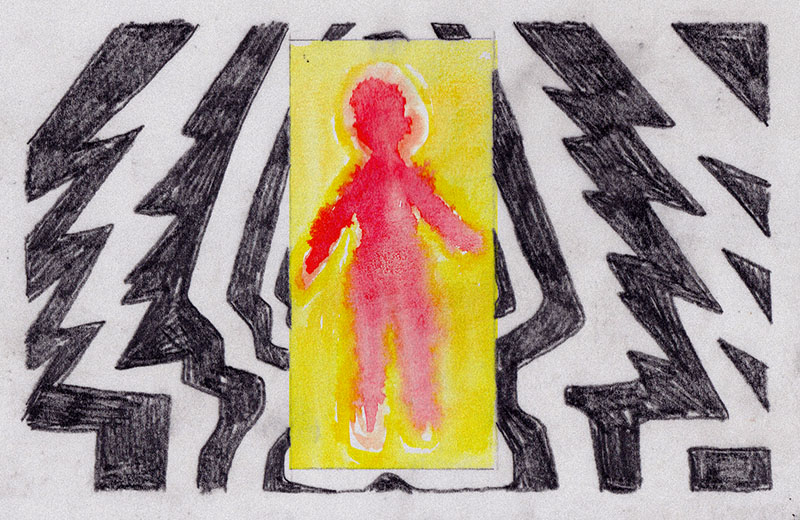
Subal’s heart leapt into his mouth the moment he saw the man from afar. A tingle ran across his body; his heart began to thump. As always, the index and middle fingers of his right hand stole to his left wrist and felt his pulse throb. There, right there . . . the man in the blue half-sleeved shirt standing by the side of the road, looking around as though he was waiting for someone, it was definitely Haripada-babu. Ignoring the fluttering in his chest, Subal stared fixedly at him. A hunter’s concentration kept Subal from blinking for even a nanosecond. Only a few feet separated him from his prey. The matinee show had just ended at the adjacent movie theatre in this part of the city where the British used to live once, and an avalanche of shoppers and hawkers streaming to and from New Market were adding to the numbers on the pavement.
It was Sunday, which meant that the area was more crowded than usual, as Subal knew it would be. He had been standing here on the assumption that there would be an enormous crowd, with all kinds of people passing by. He was convinced that it was in such crowded places that he would have to look for Haripada, who, he felt, wasn’t exactly the type to run away from civilization. Although his quarry was close by, the chaos meant that Subal could not look at him without interruption. People kept coming between them, intermittently blocking the man from his view. Subal kept his eyes on him, however, running through various strategies in his mind to corner Haripada-babu. But he didn’t want to make a mistake. He had once been dangerously close to being beaten up by passers-by on a pavement in Sealdah after mistaking a stranger for Haripada and wrapping his arms around him from behind. Another time he stalked a cinemagoer who had just come out of Nandan. Subal had heard that if you suddenly called out the name of even the most hardened of criminals from behind, their body language was bound to give them away. So when he was close, so close that he was practically breathing down the man’s neck, he had modulated his voice and called out “Sir” and “Haripada-babu”. Although passers-by were startled and looked at him, the man in front of him didn’t turn a hair. That was earlier. Today, however, Subal was all but certain that this person couldn’t be anyone but Haripada-babu. He may have made a mistake the other day, but he was sure this time, and he wanted to be fully prepared before proceeding.
The man waiting on the pavement took off his glasses and wiped them with a handkerchief. Subal remembered that Haripada had never used such trendy glasses. But so much time had passed that it was natural for him to have got himself new ones. He noticed that the man was holding the glasses with his right hand and wiping them with his left, something that left-handers normally did. Was Haripada-babu a lefty? Subal was thrown into confusion. He definitely signed and wrote with his right hand—diving into his old memories, Subal tried his utmost to recall the various ways Haripada used his hands for everyday tasks. A collage of scenes from his long years with Haripada at the office flashed before his eyes. He turned the scenes over in his head with the finesse of a doctor performing an autopsy.
This was not the first time Subal had spotted Haripada, however. He had come across Haripada several times in the past. That is to say, after a long wait somewhere, his eyes would invariably fall on someone who made him think that his long search was at last over, that he would soon find out from Haripada himself the reason for his sudden disappearance. There were many rumours in the office at the time, typical of such situations. Most of them were bizarre—ridiculous, juicy efforts at character assassination. But who knew Haripada better than Subal? People began to say that he—someone who had never accepted even a piece of thread from anyone in his life—must have baited businessmen with false promises of lucrative contracts, only to vanish after gobbling up millions. A few others said he wasn’t getting along with his colleagues, so he had renounced both his home and workplace. But Subal blamed himself. He was convinced that Haripada had disappeared because of him, that he was the only one responsible for it, and this idea had been gnawing away at him ever since, which was why he had been looking for him everywhere all this time. He couldn’t rest until Haripada himself revealed why he had disappeared.
Eventually, however, everyone had to admit that towards the end Haripada wasn’t quite himself. The things he would say had at times become impossible to understand. Subal was more aware of this than most. In fact, it was to him that Haripada used to say most of these unintelligible things. He had even let Malati know of this change in Haripada’s behavior. Recalling madam suddenly brought every cell in Subal’s body to life. Something had coiled up in his chest and stomach, something alien intent on obliterating everything inside his body. His only possible deliverance now lay in retching out everything that he had borne within.
Alone and isolated amidst the deafening tumult of people in the fading autumn sunshine, the friendless Subal recollected that nearly ten years had passed since Haripada’s vanishing act. There was a bit of a to-do at first; the authorities had ordered an enquiry too—but it revealed nothing. All that came to be known was that Haripada had disappeared late one night or early the next morning. He took no money, clothes, or any other possessions, which also became clear during the investigation. What followed was usual in such cases. People lost interest quickly, their memories of him fading slowly, taking up a grey corner of the brain. Soon Haripada was nothing but a collage of three or four photographs for most, but not for Subal. In fact, it was just the opposite for him. As time went on, Haripada began to claim an even bigger space in his head. Haripada’s probing eyes, his calculated and confident expression, the way he spoke and the manner in which he waved his hands in rhythm with his words . . . these things remained distinctly alive in Subal’s mind. With every passing day the memories grew even more vivid. He stopped going to Haripada’s house. Madam must have been astonished; perhaps had been upset, too, by his behaviour. Subal was aware that it would be difficult for his withdrawal to be considered anything but unethical and cruel. So in his heart he was convinced that when Malati was alone, perhaps looking at herself in the bathroom mirror, a string of simmering reproaches—born of deep hurt and anger—would flow from her lips. And Subal would deserve every one of them. But he had ignored everything over the past ten years, applying himself instead to meeting his only objective: find Haripada. On every single holiday he made it a point to wait at one of the spots where he was convinced he would run into Haripada one day. At the football game between the top clubs, on the platform before the long-distance express train was scheduled to leave, in alleys and avenues, among the throng of devotees at temples and at mosques, he searched for Haripada. The moment his eyes landed on anyone who looked like Haripada, he would switch on the focus of a predatory beast and get moving. Among crowds he wandered, a deranged man, seeking the person lost from his life. Now, as he desperately tried to spot resemblances between Haripada and the man in the blue shirt, his trance was shattered by a sudden burst of music. Subal couldn’t identify its source at first, but it got his attention. To his utter surprise, the music was emanating from somewhere near his body. Only after he had composed himself did he realise that it was coming from his own breast pocket. It was the ringtone of his mobile phone. Since home was no longer where his heart was—how could it be, when he was in a different part of the city, every weekend?—Atashi had made him get a mobile. Although phone prices had gone down, it was still an expensive proposition. It was only after being assured repeatedly that he wouldn’t have to pay to receive calls that he had agreed to keep the device on his person. But who would call him anyway? That’s why the phone had been silent all this time. Fumbling ineptly to accept the call, Subal pressed the phone to his ear. A familiar voice floated across the chasm of many years. “Subalda, madam has asked for you to visit her at home. She has some urgent business with you.” Subal was overwhelmed to hear from Malati through Abdul—Haripada’s long-time chauffeur. His mind went back at once into the quiet house surrounded by trees, built with great tenderness on the outskirts of Calcutta.
2
The iron gate could be opened by inserting your hand through the bars and sliding its bolt. He had come to know of this recently. Entering the compound, Subal inhaled deeply twice. The air was thick with the smell of ripe tamarind. Haripada-babu had planted the tree himself in a corner of the garden as he did all of its numerous trees, Haripada had told him so. His face used to brighten visibly whenever he talked about them, as though these trees were closer than kin to him. With a wife and a son, his household brimmed over, but it was the inhabitants of his garden who were his real family. Junior employees at the office made jokes about this behind his back, with Subal joining in sometimes. The fragrance of the ripening fruit numbed his senses briefly. Madam had sent for him on account of some urgent business, this was all he had been told on the phone. She revealed nothing else, but this sufficed for Subal, who knew not to expect anything more. Though the front door of the house was no more than thirty paces from the gate, this distance seemed to stretch beyond his reach on these occasions when he was summoned by phone. In his head the thirty paces had turned into hundreds of miles. He knew that every time he walked this path, he left strewn behind him the corpses of many relationships. He was abandoning social acceptance itself.
On this particular day, too, their meeting followed a familiar pattern. Malati choreographed the days of their trysts to a pre-determined rhythm, constructing a seeming normalcy with impossible skill. As though there was nothing more routine than Subal coming to see her at this hour on this desolate afternoon. Her behaviour betrayed no hurry, no great excitement either. As with any other guest, she chatted to Subal about everyday matters, asking after things at home and at work. Just when Subal began to wonder why she had sent for him, the discussion would take a different turn, to the subject of her husband Haripada. Malati would now ask whether Haripada was in fact a changed man nowadays. What was he preoccupied with? What did he tell himself over and over when no one was listening?
Subal had informed Malati of his apprehension some time ago, telling her that Haripada’s demeanour was making him uneasy. He said Haripada often stopped the car on a deserted road and gazed at the barren fields rolling away on either side. There was an infinite emptiness in his eyes at these times, as he mumbled to himself words to the effect that he was waiting for something, a great shift. He said he knew his life was at a juncture at which everything would change. The magical transformation was at hand, all he had to do was keep his eyes open. The first time Subal had told Malati about this change in Haripada was on a similar afternoon earlier, in the much more private setting of Malati and Haripada’s bed, during snatches of conversation in the midst of foreplay. Subal remembered the early days of his meetings with Malati. It was true that he had overcome his inhibitions to make the first move, somewhat recklessly, driven by an unfamiliar and forbidden urge. He had felt that everyone, even he, had the right to throw caution to the wind at least once in their lives. Malati had accepted his advances—indulged them even. But that initial sense of surrender evaporated when she took over the reins of their developing relationship just as Subal began to sink slowly into profound doubt.
There were two kinds of attraction at work here. He was drawn, drawn like a magnet, to intimacy with Malati. Every moment he spent with her in the bedroom brought the excitement of discovering a new geography. At the end of every tryst Subal began counting down to the next call summoning him to traverse the distance of thirty paces that felt like hundreds of miles, at the end of which, after some small talk, they would be united again in that primal, restricted space. The wait would begin for that moment, when the moans of pleasure, the passion, the sweat oozing from every pore in the body, the accelerating pace of their heartbeats, would transport them once more to the last frontier of the world. Coming face to face with Haripada after this, he would be stricken by guilt with a force that submerged him into an unbroken expanse of black water. Of late, Haripada had casually brought up—in phrases and fragmented sentences—the idea of a bottomless lake to Subal. A magical lake that gave shelter to certain people on its banks, indulging them as they turned into trees. Haripada’s company seemed to afford Subal flashes of the same lake, and he lived somewhere between these two attractions. Sentences gathered slowly at the tip of his tongue, things he wished to tell Malati at the appropriate time. He had a collection of such sentences for Haripada too. But he never got round to actually saying these to either of them. Unable to find release after building up for some time, they slid down Subal’s throat into the depths of his body where, digested by various abdominal juices, they broke into pieces and disintegrated entirely. Meaningless scraps of vowels and consonants remained wedged between the ribs and around the lungs. Subal found it increasingly difficult to breathe. The small and large intestines, the liver and spleen, all of them were covered by the decomposing corpses of various syllables. Subal realised that his body was gradually turning into a wasteland for the unidentified carrion of miscarried sentences.
Subal knew that Haripada was not in Calcutta that day. Malati had told him that their only son was not in the city either, the school had organized an excursion. Samantak hadn’t been very keen, but Malati had insisted. Subal sank into even greater doubt. Does madam actually have some urgent business with me? Why has she chosen a day such as this? Is it only to spend some time with me?
All the questions that Malati had for Subal about the office—or Haripada—had been answered. Eventually the moment arrived: there was nothing more to say. Malati rose from her chair and, as she walked towards the bedroom, told Subal that the pretty lamp on the bedside table wasn’t working, could he have a look? For some reason unknown to him, Subal felt a stab of fear—he almost jumped out of his chair. “Of course, I’ll fix it.”
3
It was Abdul who had first realised that Haripada was turning into a different person, and Subal was the only person he told. Then, of course, Subal had recognized it himself, and informed madam accordingly. He was a little worried now to get Abdul’s call. He could sometimes see his own role in Haripada’s disappearance. Perhaps Haripada had found out about Malati’s relationship with him. Was this what had compelled Haripada to go away? At the outset of the conversation Abdul had given Subal a new number for madam: her mobile number. Abdul said Malati spent most of the day alone in the large house, and found it difficult to climb the stairs these days, so she used this mobile phone now. She wanted Subal to contact her on it as soon as possible. As he spoke to Abdul, Subal noticed someone going up to the man in the blue shirt and talking to him—probably the person his quarry had been waiting for. After a brief conversation they went off together towards Chowringhee. The man in the blue shirt no longer looked like Haripada.
As he was tucking in their bed’s mosquito net, Subal disclosed to Atashi casually what she was waiting for him to tell. “Abdul said Malati madam wants me to meet her, some urgent business. I’ll go over one of these days. She’s Haripada-babu’s wife, after all. We do owe it to her.” Ever since Haripada vanished, an anxiety often gripped him, sometimes in the form of a bad dream at night, or sometimes, without warning, during his working hours in the day, one that stemmed from the possibility of an alliance between Atashi and Malati. He frequently had a nightmare in which both the women in his life were asking him in unison about the reason for Haripada’s disappearance. This dream would recur in different forms. Sometimes he saw himself back in Malati and Haripada’s cherished bed, with Atashi appearing beside it as they were about to climax. Atashi, holding the bedpost, and Malati, in his arms in bed, asking him in a chorus where Haripada had disappeared to. Sometimes he saw Malati in his own house, kissing Atashi deeply. He would try to sneak past them, only to have both women ask him the same question in harmonising voices. Haripada . . . Haripada . . . Haripada . . . Subal had had this dream countless times in the past few years. In varying configurations. Malati, Atashi, and he. On the streets in public. In the house in private. Two of them would be engaged in some form of intercourse when the third appeared. And each time, unfailingly, both women would interrupt sex to interrogate him about Haripada’s disappearance. This, even though he could not remember whether Atashi had ever actually met Malati.
4
Subal finally typed in the number Abdul had given him. He gazed at the phone number on his screen, trying to gauge whether it would change his life again. At last, he pressed the green button and held the phone to his ear. After three rings Malati’s voice wafted over the ether, along with a tsunami of memories across an ocean of time. Subal was startled to hear Malati addressing him directly. He had expected her to ask who it was, which would have given him the opportunity to present himself properly. He realised Abdul must have given his number to Malati. She could have been the one to call him, but just like in the old days, she must have wanted to dictate how things happened. Her voice on the phone was remarkably calm and matter-of-fact. Malati got to the point at once. An important occasion was coming up; her only son was going to be married, and she needed Subal’s help. It would be great if he could come over this weekend. Without giving him time to think it over, Malati ended with “Then it’s settled, come around 12 on Saturday”. Subal made one last attempt to find out what it was she wanted him to do. “There are so many things to organize for the ceremony, Subal. I don’t have anyone to take care of things. There was someone here once, but he left without a thought for us. I’ll tell you the details of what I need from you when you’re here on Saturday. Oh, one more thing. Do you know of a reliable place for timber? I want to do up Somu’s room before the wedding.” After a pause, Malati sealed the request with a sentence: “I’m looking for the same quality your Haripada-babu would have wanted if he’d been here.”
The Subal who lived to please Malati got to work looking for dependable timber merchants on the southern outskirts of the city. It didn’t prove too difficult. Enquiries led him to Rakhal Sardar’s timber store. The shop was old, and had obviously been set up in Rakhal’s father’s or even grandfather’s time. Quite large for a timber shop, it stood in the middle of a sprawling plot as a flagbearer of another era. He entered with the intention of introducing himself to Rakhal—he wanted to be friendly with him, so that when he told Malati about the place or even brought her here, she could give him an approving glance and say to herself, Subal is so efficient, there’s nothing he can’t do. The first time Subal set eyes on Rakhal Sardar, he was struck by how familiar he seemed, even though his shop was in a part of town he never frequented, so there was no possibility of them having ever met. Still, the man approaching Subal felt like someone he had known a long time.
“There’s a big ceremony coming up at home, so we’d like to purchase some fine wood to make furniture. I’ve heard a great deal about your shop, so I wanted to see it for myself.” Rakhal didn’t answer, offering only a nod and a smile. There was something about Rakhal that made Subal want to get to know him better. And besides, the mystery hadn’t been solved—even as he was sure he had never seen Rakhal before, why did he feel so intimately familiar? Subal groped for something suitable to say so that he could stay longer.
Rakhal’s expression softened at last. His eyes bored deeply into Subal’s as he ruffled his thinning hair slowly with this left hand. Both his hands moved to a particular rhythm when he finally spoke—this was why he had seemed familiar to Subal from the beginning—gesturing to the colossal tree trunks in the corner. “My grandfather set up this timber shop. If you’re a property developer or a real-estate agent, you won’t get anywhere with me. I have no intention of closing down this shop.” After a pause he continued, “Everyone in my family thinks I should sell it though. My wife, my sons . . . everyone. So if it’s this land you’re looking to buy, it’s best to keep in touch with them, your wish will be fulfilled sooner or later.” Moved, Subal walked up to the stranger and took his hands in his own. Without meaning to, he had clearly hit a nerve with Rakhal. Rakhal gently freed his hands.
“Those trunks you see lying there?” he continued, training his eyes on the timber, “they were all trees once. Large trees, with inextinguishable life in them. Living trees, alive like you and me, like humans. And these trunks are their corpses. In that sense this place is also like an inn for the dead. Where they can rest a little before being sawed and cut into pieces. That’s not a small thing.” Now it was Subal’s turn to have a nerve struck. Without showing it, Subal broke down. For the first time in a long while, he pictured the lake that Haripada had spoken of so inarticulately. Rows of giant trees standing beside water that stretched across the horizon, living, alive. The same trees who had come here after their death for a few moments of rest. Wordlessly, he took his leave from Rakhal.
5
On subsequent days, Subal had occasion to talk to Malati several times. The first time, he informed her of Rakhal. Because he wanted to earn her approval, he constructed a story that was a mixture of truth and lies. “I’ve known him a long time, he lives not too far from your house, close by, in fact. They’ve been running the timber shop for a long time, from his grandfather’s era. Trustworthy, and someone I know, a friend of sorts. Won’t cheat you, madam.” Reassured, Malati said she would get the measurements from the carpenter soon, after which Subal could take her to Rakhal’s shop. Subal called several times over the next few days to find out whether Malati had gotten the measurements. Then he rang to ask when he should visit her at home again. On each of these occasions he said much more than the business at hand warranted, meaningless things. When their conversation tapered off into silence, he experienced both despair and excitement at the same time.
Now, however, it was just the latter as he stood before the front door of the two-storeyed building set in the middle of a garden. Subal realised his heart was thumping again, just like it did in the old days.
The grille on the gate was new, Subal realised, taller and thicker. The perimeter walls had also been repaired. And, with a new coat of paint, the house had shed its melancholic air and was almost unrecognisable. Instead, it dazzled with fresh colours and the promise of new life. Subal entered through the gate and saw that there were people to take care of the garden now. The fragrance of ripe tamarind blowing in on a gentle breeze entered his nostrils. He was struck to learn that the tree had survived all these years. Does nothing actually change then?
Malati was ready to leave for the timber shop as soon as he walked in. “I’ve informed Abdul. He’s here already. Let’s get it done with quickly, Subal. There’s a mountain of work ahead, only a month to go.” This was not how Subal had imagined their encounter would go after such a long time. In the screenplay he had composed in his head, Malati and he were supposed to sit down in private and go over the past ten years. Haripada-babu was now firmly in her past, whereas Subal alone had remained in the same place.
Rakhal didn’t disappoint Subal when they arrived at the timber shop, giving him a wide smile reserved for friends. After the introductions, he listened to Malati with close attention, effortlessly grasping the nature of the furniture she wanted. Then, as though he’d just remembered, he mentioned the trunk of a particular tree that had just been delivered to him. He felt its wood was the best for the furniture Malati was thinking of. “It’s only just arrived, ma jononi. A massive mango-pine tree. The wood makes for excellent furniture.” He signalled to one of the workers to come closer, and asked him to put the trunk on the sawing machinery. Then he gave instructions for the wood to be sawed in various sizes as required by the measurements Malati had given him. Subal noticed a sudden change in Malati as soon as Rakhal mentioned the mango-pine tree. Her abrasive manner fell away, and a tender melancholy enveloped her. Her gaze softened, her pose lost its stiffness. Suddenly, like a bolt of lightning, the image of a lake flashed into Subal’s mind. Among the trees standing on its edge, one seemed familiar. Is that the mango-pine? As the teeth of the saw began to sink into the trunk, a fine sawdust blew towards them, gradually covering Malati’s figure.

